
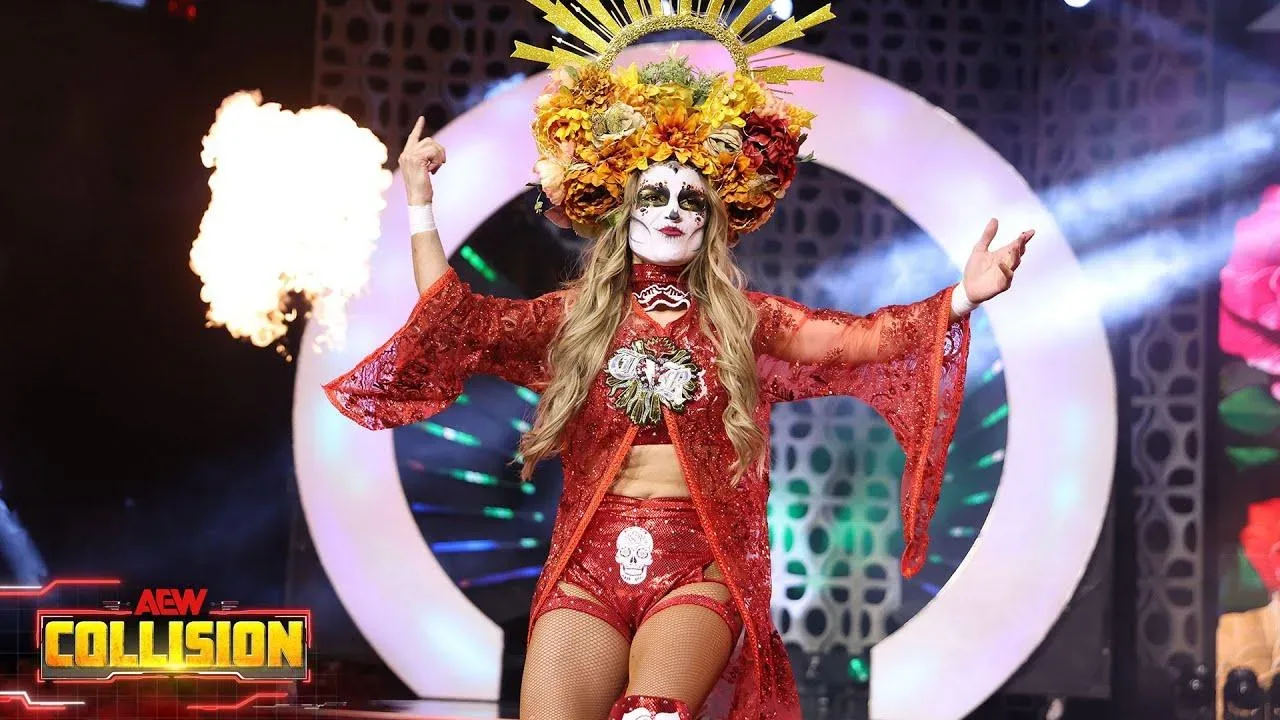
Thunder Rosa’s face paint is one of the most recognizable pieces of her in-ring presentation, but the work behind that look can be considerably different from one appearance to the next.
Speaking on the Battleground Podcast, Rosa explained that there is no single fixed timetable for creating her face paint. Depending on the available time, the complexity of the design and whether she has assistance, the process can take anywhere from roughly 30 minutes to several hours.
“It also depends on the artist. Also depends [on] how much time do I have. Like today, I have a makeup artist doing my hair and makeup. Sometimes I do my face paint myself, and I do very simple stuff. I don’t use jewels cuz I don’t carry them. So, I’ve gotten really fast at actually doing my face paint. When I’m in a rush, I can do my face in 30 minutes. You just have to sketch, you get used to it, and that’s how you do it.”
A Flexible Process for a Signature Look
Rosa’s comments underline the practical side of a visual element that can appear effortless once she walks through the curtain. Face paint may be part of a wrestler’s character and ring gear, but it is also preparation that has to fit into the realities of a show day. Travel, call times, media commitments, hair and makeup availability, wardrobe preparation, match planning and the pace of a live event can all affect how much time a performer has before bell time.
For more background on this topic, read Andrade El Idolo Says PAC Needs to Leave Death Riders to Become AEW World Champion.
For Rosa, the difference begins with who is applying the paint. On the day she discussed during the interview, she had a makeup artist handling both her hair and makeup. At other times, however, Rosa does the work herself. That naturally changes the approach, particularly when she is moving quickly and needs a design that can be completed efficiently.
Her answer also makes clear that her fastest process is not simply a matter of rushing through the same elaborate design. Rosa said that when she handles the face paint herself, she tends to keep it simple. She specifically noted that she does not use jewels because she does not carry them. The result is a presentation shaped not only by artistic preference, but by the supplies at hand and the amount of time available.
That is an important distinction in wrestling, where an entrance look needs to function in a demanding environment. A performer’s appearance has to read from a distance, remain recognizable under arena lighting and cameras, and still be manageable before a physically intense match. The visual identity has to work alongside every other part of the performance rather than becoming an obstacle to it.
Experience Has Made the Routine Faster
Rosa said she has become much quicker at applying her own paint through repetition. When time is limited, she can complete the process in 30 minutes by sketching the design and relying on familiarity with the routine.
“You get used to it,” Rosa said, offering a straightforward explanation for how a more detailed-looking piece of presentation can become a streamlined part of her preparation.
That kind of repetition is central to the way wrestlers build their routines. The public sees the finished entrance and the match, while much of the work happens before the cameras focus on the ring. For performers with distinctive makeup, masks, hairstyles or gear, preparation can be as much a part of maintaining a consistent identity as a catchphrase or a finishing move.
In Rosa’s case, the process has enough flexibility to account for changing circumstances. A day with a dedicated artist and more time can allow for a different level of detail. A rushed day calls for a simpler version that Rosa can execute herself. Either way, the goal is to arrive ready to compete while preserving the visual element audiences associate with her.
The range Rosa gave—30 minutes at the fast end and potentially several hours at the other—also illustrates why the paint should not be viewed as a minor accessory. The time commitment can vary dramatically. Even when a wrestler is capable of doing the work quickly, the preparation remains another responsibility to balance on a day already built around an in-ring performance.
Presentation Is Part of the Performance
Professional wrestling relies on instantly recognizable visuals. Color schemes, entrance gear, makeup and other details can help establish a performer’s presence before a match begins. Those choices are especially significant in an environment where athletes may have only a brief entrance to create an impression with viewers in the building and watching at home.
Rosa’s face paint serves that purpose while also leaving room for adaptation. Her comments show that it is not a static, one-size-fits-all ritual. The application can be adjusted based on whether she has professional help, how much time the schedule provides and how complicated the design is meant to be. Rather than treating every application as identical, she has developed a process that can meet the moment.
There is also a clear practical benefit to being able to do the work herself. Rosa does not have to depend entirely on another person to complete the look. If she is in a rush, she knows the necessary steps: sketch the paint, work through the familiar design and use the experience she has built over time to get ready within a half-hour window.
Her mention of jewels provides a small but revealing example of how preparation choices are made. Decorative additions can alter a look, but they also require supplies and time. Rosa’s preference not to carry jewels means that her self-applied designs are structured around what is readily available to her. That is not a limitation she presented as a problem; it is part of how she has learned to keep the process dependable.
Why the Details Matter on a Wrestling Show Day
Rosa’s explanation offers a look at a part of wrestling that often receives less attention than match results or promos. The time before a show is not merely waiting for an entrance. It is a working period in which performers prepare physically and mentally, coordinate their appearance and make choices that affect how they are presented once they reach the ring.
A face-painted performer has an additional visual task to complete before competing. The paint must be applied with enough care to fit the intended design, but it must also fit the clock. Rosa’s ability to handle the job in approximately 30 minutes when necessary reflects the value of having a reliable abbreviated process. At the same time, her estimate that the work can take hours in other situations shows how much more may go into a presentation when circumstances allow.
The difference is not necessarily about one version being more legitimate than another. Rosa described a system that responds to the day’s needs. A simple self-applied design can be the right choice when time is tight. A makeup artist can contribute when more extensive hair and makeup work is possible. Both approaches support the same broader objective: entering the arena ready to perform.
For fans, the face paint is part of the complete Thunder Rosa image. For Rosa, it is also a skill and a process—one that can involve collaboration, personal technique, basic sketching and a great deal of repetition. Her comments bring the preparation behind that familiar visual into focus without taking away from its impact once the show begins.
Rosa’s Routine Comes Down to Time and Preparation
Ultimately, Rosa framed the process in practical terms. The artist matters. The time available matters. The level of detail matters. On some days, she has help with her hair and makeup. On others, she takes care of the face paint herself and chooses a simpler approach. When she needs to move quickly, she has trained herself to finish in 30 minutes.
That adaptability is the key takeaway from her comments. A signature look can be highly personal and visually memorable while still requiring the discipline to make it work under changing conditions. Rosa has turned the application of her face paint into a repeatable piece of her professional routine, whether she has several hours to work with or only enough time for a fast sketch before it is time to compete.

Darryl Polo
Darryl Polo is a passionate wrestling fan covering WWE, AEW, TNA and beyond. He loves great rivalries, breakout stars and the moments that keep fans talking long after the bell. How we work.