
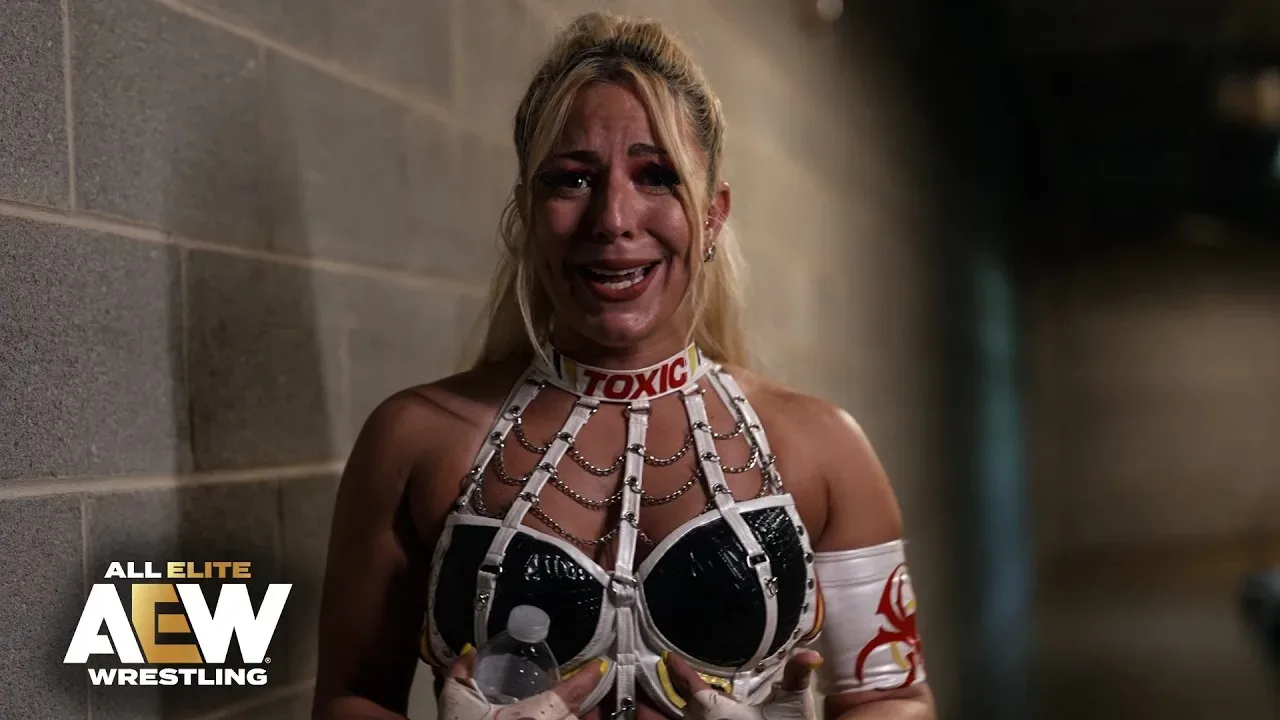
Thekla believes Triangle Of Madness has helped create more space for women in AEW to be aggressive, unpredictable and willing to push beyond conventional expectations inside the ring.
Since Thekla aligned with Julia Hart and Skye Blue in July 2025, the trio has developed into one of the more distinctive presences in AEW’s women’s division. Thekla has effectively stood at the front of the unit, while her own rise has included winning the AEW Women’s World Championship earlier this year. Speaking in a new interview, Thekla was asked whether the group has given female wrestlers permission to show a greater edge or embrace more violence in their presentation.
Her answer made clear that she sees Triangle Of Madness as more than a collection of allies. In her view, the group’s identity is rooted in pushing emotional intensity, psychological manipulation and physical punishment to uncomfortable places.
“I do think that,” Thekla said. “Women have, for a very long time, tried to make up for a lack of technique and stamina in the ring. We just have to get a little bit more insane. Just come up with crazy shit that we can do to humiliate each other, use psychological warfare and weapons, whether it’s a crazy happy Skye Blue covered in blood or if it’s Julia Hart misting left and right, or if it’s me getting out my belt and starting to punish the referee.”
For more background on this topic, read Jon Moxley Challenges The Cut To Anarchy in the Arena at AEW Full Gear.
Triangle Of Madness built around disruption
Thekla’s description of the group emphasizes the ways each member can contribute a different type of chaos. Rather than framing the trio solely through victories or championship pursuits, she pointed to images and actions that are intended to disturb opponents and change the atmosphere around a match.
Skye Blue being “covered in blood,” Julia Hart using mist, and Thekla wielding her belt are all examples Thekla chose to illustrate that mindset. They are not presented as interchangeable acts of violence. Each image carries a different visual and emotional effect, whether it is menace, humiliation, intimidation or a sudden loss of control.
That distinction is important to Thekla’s broader point. An edge is not simply about being physical. It is also about making an opponent unsure of what may happen next. Psychological warfare, as she called it, can be just as valuable to a group’s identity as a strike, a weapon or a decisive finishing sequence. Triangle Of Madness has positioned itself around that uncertainty.
Thekla’s comments also suggest that she sees intensity as a creative tool. The objective is not merely to be violent for the sake of violence, but to find memorable, extreme and character-specific ways to make a conflict feel personal. Humiliation, fear and unpredictability can all become part of the story being told when the group enters a feud or confronts an opponent.
Thekla’s championship position adds weight to the message
As AEW Women’s World Champion, Thekla’s words carry added significance. She is discussing the value of a more unrestrained approach while holding the division’s top championship, and that places Triangle Of Madness at the center of the conversation about what the women’s roster can look like.
Her success does not mean the other members are reduced to supporting roles. Thekla specifically identified Hart and Blue as essential pieces of the group’s image. Hart’s mist and Blue’s willingness to embrace a blood-soaked visual are presented as examples of the different forms of menace available within Triangle Of Madness.
At the same time, Thekla’s reference to bringing out her belt reveals how she connects championship status to the group’s attitude. A title belt is traditionally a symbol of achievement and authority. In Thekla’s hands, as described in the interview, it can also become an instrument of punishment. That twist fits the group’s larger approach: taking familiar wrestling symbols and making them feel threatening.
Thekla has emerged as the unit’s most successful member, but the appeal of Triangle Of Madness lies in its collective identity. The group gives its members a framework in which dark imagery, ruthless tactics and heightened personalities can exist together. Each woman can be recognizable within the act without making the others seem out of place.
More than a question of technique
Thekla’s remarks included a pointed observation about women feeling pressure to compensate for perceived shortcomings in technique and stamina. Her proposed answer was not to abandon in-ring ability. Instead, she argued for adding another layer: becoming more imaginative, more intense and, in her phrasing, “a little bit more insane.”
That is a character-driven philosophy as much as it is a wrestling one. Thekla is arguing that a performer can establish an edge through choices that are emotionally forceful and visually impossible to ignore. A wrestler who can unsettle an opponent before the bell, exploit fear during a match or leave behind a striking image afterward can reshape the audience’s perception of the confrontation.
For Triangle Of Madness, that approach is built into the group name and presentation. The members are not trying to appear calm, orderly or restrained. Their purpose is to make disorder feel deliberate. Whether it comes through Hart’s mist, Blue’s wild visual presentation or Thekla’s willingness to turn the championship belt into a weapon, the group operates through escalation.
Thekla’s comments do not claim that Triangle Of Madness created the idea of hard-edged women’s wrestling. Instead, she expressed her belief that the group has helped encourage performers to lean further into that side of their characters. The distinction matters. Her focus is on permission and possibility: the idea that women can be frightening, violent, vindictive and strange without those traits being treated as exceptions to the rule.
A defining identity heading into Fright Night Dynamite
The timing of Thekla’s comments is notable with AEW’s Fright Night Dynamite lineup currently in focus. A group such as Triangle Of Madness naturally fits a setting built around darker aesthetics and heightened tension, but Thekla’s remarks indicate that the trio’s outlook is not limited to one themed event.
Violence and psychological pressure are central to how Thekla describes the group at all times. Fright Night Dynamite may provide an especially fitting backdrop for that identity, yet the message remains consistent: Triangle Of Madness wants opponents to feel that they are dealing with something more volatile than a standard alliance.
For Thekla, the group’s influence is measured in part by whether other women feel able to take bigger creative risks. Her examples were vivid because that is the point. Triangle Of Madness is designed to leave an impression, whether through blood, mist, weapons or acts meant to embarrass and destabilize an adversary.
With Thekla holding the AEW Women’s World Championship and Hart and Blue continuing alongside her, Triangle Of Madness remains positioned to make that philosophy visible. Thekla’s view is straightforward: the women’s division does not need to be limited by expectation. It can be sharper, more theatrical, more psychological and, when the moment calls for it, considerably more dangerous.

Darryl Polo
Darryl Polo is a passionate wrestling fan covering WWE, AEW, TNA and beyond. He loves great rivalries, breakout stars and the moments that keep fans talking long after the bell. How we work.