
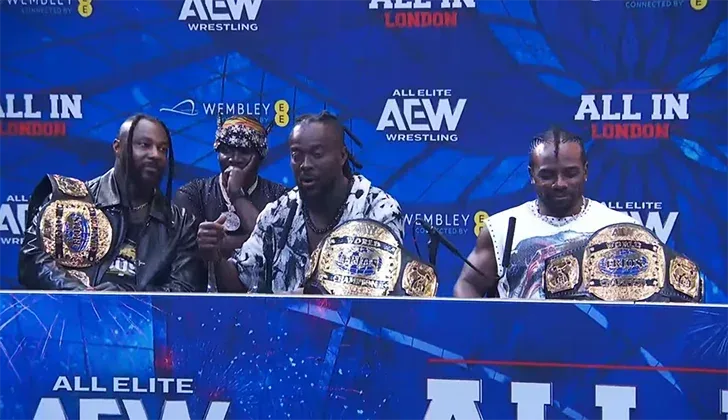
Kofi and Austin Creed have spent enough time in professional wrestling to understand that public perception can become part of a performer’s identity. For years, the pair have been viewed by fans and colleagues alike as two of the most approachable and upbeat personalities in the industry. Even when their on-screen direction called for a sharper edge late in their WWE run, that established connection with audiences remained difficult to shake.
Now competing in AEW as The New Level, Kofi and Creed were asked whether being regarded as two of wrestling’s nicest people creates pressure to maintain that reputation. Their response made clear that neither man sees kindness as an act, a branding exercise, or an obligation created by fan expectations. Instead, they described it as a natural reflection of how they approach the locker room, their profession, and the unusual life that professional wrestling has allowed them to live.
Creed explained that his outlook is rooted in the way wrestling was presented to him while he was coming up in the business. To him, the performers sharing a roster are connected by the physical and personal demands of the profession.
“I feel like that’s just that’s just how we move,” Creed said. “Like, the way that wrestling was explained to me when I was coming up is like, this is a fraternity and these are your brothers and sisters, brothers in bumps, you know, and so, yeah, you love wrestling like I love wrestling so we’re clearly friends.”
That perspective speaks to an important element of The New Level’s presentation as they enter a new phase of their careers. Wrestling is built around rivalries, competition, and personalities who often push their characters to extremes. Yet the environment away from the camera requires performers to coexist through long travel schedules, demanding training, injuries, and the day-to-day uncertainty that comes with the industry. Creed’s description of a fraternity of “brothers and sisters” reflects the bond formed by people who understand those pressures firsthand.
It also helps explain why a hostile on-screen turn can be difficult to make fully believable when it involves talents who have spent years cultivating a positive relationship with the audience. Kofi and Creed’s heel work toward the end of their WWE tenure encountered that challenge. Their history as likable figures was so deeply established that it naturally affected how fans received a different side of them. The issue was not simply whether they could say or do villainous things on television. It was that viewers had a lengthy body of evidence pointing to a very different reputation.
For Kofi, that reality does not appear to be a burden. He framed the discussion less around the need to protect an image and more around gratitude for a career that remains inherently extraordinary. He noted that professional wrestlers are human beings first, even when their work takes them across the world to play exaggerated characters in front of passionate crowds.
“We take a lot of pride in just being human beings at the end of the day,” Kofi said. “We’re all just human beings, you know? What we get to do, to be able to travel the world, to be able to have matches, to be able to go to these different countries and to threaten to ground kids in France and to tell, you know, kids in Japan that I’m going to come into the crowd and I’m going, ‘You better listen to me cuz I’m going to…’ What are we doing? You know what I mean? Like, how can you be mad? How can you be angry? How can you be in a bad mood?”
The point is a revealing one for any performer who has worked at the highest levels of wrestling. The job asks competitors to become larger-than-life characters, to insult opponents, provoke audiences, and create confrontations that can feel intensely personal in the moment. But Kofi’s comments emphasize the absurdity and privilege within that process. A wrestler can be playing the role of a threatening authority figure in one country and receiving a completely different reaction in another, all while sharing the experience with fans who are eager to be part of the show.
That appreciation for the work has been a recurring component of Kofi and Creed’s appeal. Their connection has never depended entirely on one tone or one character alignment. They have been able to embrace comedy, competitiveness, crowd interaction, and serious stakes because their chemistry comes across as genuine. The audience can recognize the friendship and shared enthusiasm behind the performance, whether The New Level are looking for laughs or trying to establish themselves as a major problem for another team.
In AEW, that dynamic arrives in a division with no shortage of established tandems and ambitious competitors. Kofi specifically pointed to the company’s roster depth, particularly among tag teams, as a reason for optimism about what comes next. Rather than treating their move as a simple change of scenery, he described it as an opportunity to test themselves against a broad collection of talent.
“You know what I’m saying, man? Like, this is such a blessing to be able to have this career, and now to be able to do it with AEW is even crazier because the amount of talent on the roster is insane, especially within the tag team division. You know it’s going to be so much fun.”
That enthusiasm is significant because the tag division gives The New Level a clear platform for their strengths. Both men bring extensive experience as a unit, and their familiarity allows them to work with the timing of a team that has spent years learning how the other thinks in and out of the ring. At the same time, AEW provides fresh opponents and new matchups that can challenge the audience’s expectations of what Kofi and Creed can do together.
Their arrival also adds another layer of personality to a division where styles can vary dramatically. Some teams center their identities around power, others around speed, aerial offense, technical precision, or aggression. The New Level can bring a blend of veteran instincts, crowd awareness, athleticism, and a willingness to lean into the entertainment side of wrestling. Kofi’s reference to engaging children in crowds in France and Japan illustrates how naturally both men can turn audience interaction into part of the experience.
Of course, being positive and personable does not mean being passive. The most effective version of The New Level in AEW will still need urgency, competitive focus, and the willingness to stand across the ring from teams determined to prove they belong ahead of them. A friendly locker-room presence does not remove the need to win matches. If anything, their comments suggest they understand the distinction: wrestlers can respect one another as peers while pursuing the same championships and spotlight.
There is also a broader message in Kofi and Creed’s remarks about how wrestlers navigate their public lives. Fans frequently build strong impressions of performers based on television characters, social media, interviews, and stories from other wrestlers. For The New Level, the “nice guys” label has become durable precisely because it appears to be based on consistency rather than calculated public relations. Creed spoke about shared community, while Kofi spoke about gratitude and the basic humanity behind the spectacle. Those are values that can exist regardless of whether a storyline calls for cheers, boos, or something in between.
As The New Level continue their AEW chapter, their reputation will follow them, but neither Kofi nor Creed appears interested in treating it as a limitation. They see professional wrestling as a rare opportunity, one built on relationships with fellow performers and fans around the world. With AEW’s tag team landscape ahead of them, Kofi and Creed are approaching that opportunity with the same energy that helped make their partnership resonate in the first place: appreciation for the moment, belief in each other, and an eagerness to have fun while competing at the highest level.
Keep reading on SmackDownOnYou

Darryl Polo
Darryl Polo is a passionate wrestling fan covering WWE, AEW, TNA and beyond. He loves great rivalries, breakout stars and the moments that keep fans talking long after the bell. How we work.