
The Miz has spent more than two decades building a WWE career around knowing how to command attention. Whether he is serving as an arrogant host on Miz TV, working as a championship contender, or leaning into the kind of character work that invites an arena to react loudly, Miz has generally understood how to keep a segment moving.
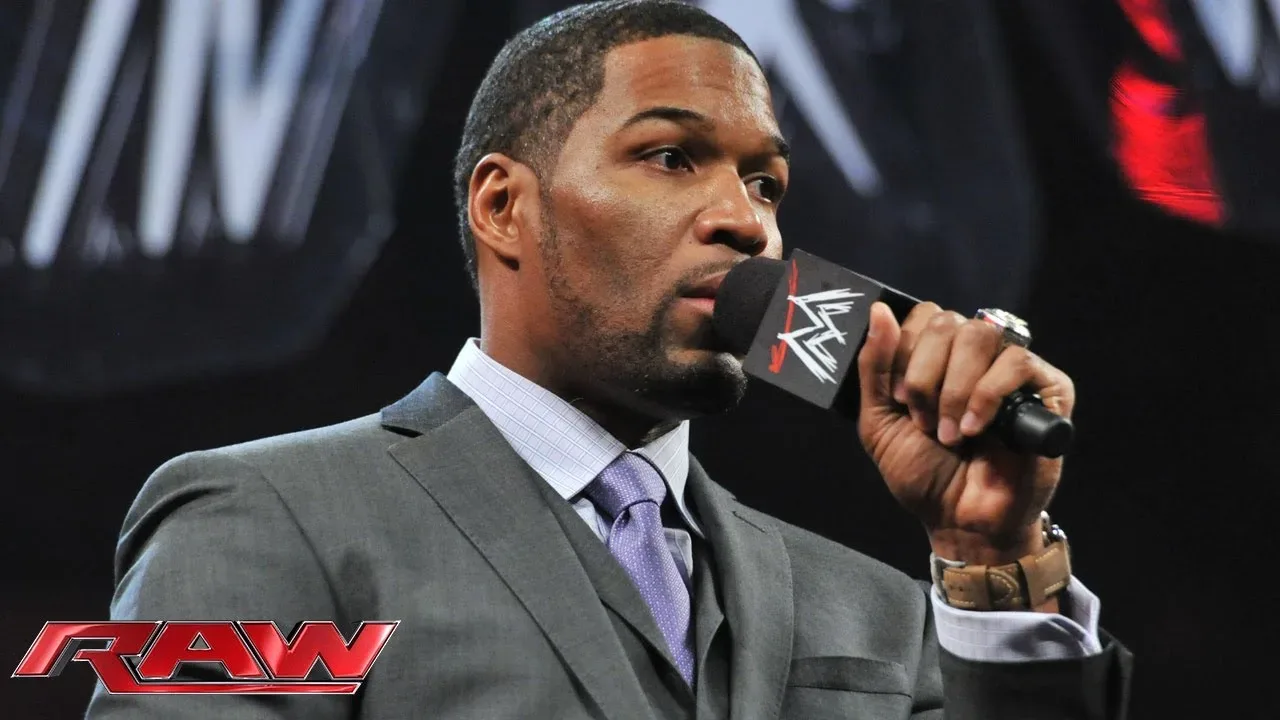
That is why his answer when asked about the dumbest WWE storyline he has been involved in was so direct. Looking back during an appearance on Hot Ones Game Night, Miz singled out a November 2013 episode of Raw in which he hosted Michael Strahan and Titus O’Neil on Miz TV. The segment ended with Strahan delivering hip tosses to both WWE stars, but Miz now considers the premise a clear miss.
“I had a hip toss competition with Michael Strahan,” Miz said.
It is a memorable answer not because Miz disputed Strahan’s appeal as a celebrity guest, but because he separated the former NFL star’s television presence from the specific wrestling angle WWE chose to present. Miz made it clear that, in his view, the problem was not having Strahan on the show. It was turning the segment into a contest built around a basic wrestling move and placing it in front of a crowd unlikely to quietly accept a weak premise.
For more background on this topic, read Nick Khan Outlines WWE’s Ticket Pricing Strategy for Premium and Upper-Bowl Seats.
A 2013 Raw Segment Miz Would Rather Forget
The appearance took place in New York in November 2013, with Miz hosting the Miz TV portion of the program alongside Strahan and O’Neil. Celebrity involvement has long been part of WWE’s formula, particularly when a guest has mainstream name recognition and is comfortable performing in front of large audiences. Strahan certainly fit that description. His career as a football player and television personality made him a recognizable figure well beyond wrestling.
In this case, though, the segment revolved around hip tosses. Miz explained the move in simple terms while discussing why the idea did not work for him.
“A hip toss is you take a guy and you kinda toss him, they kinda do a flip,” Miz said. “The higher they get, the better it looks.”
That description captures a major part of why the segment stood out in hindsight. A hip toss is a familiar foundational move, but it is not usually positioned as the centerpiece of a major in-ring challenge. Wrestling matches and physical angles often use such moves to create momentum, establish control, or punctuate a sequence. A competition centered on who could deliver it best is a much more unusual concept, especially for a featured celebrity segment on Raw.
Miz even acknowledged some uncertainty about the supposed criteria behind the contest. When considering whether the throw was meant to be judged by height, he responded, “It can be [about height]. I mean, to be honest, I don’t even know.” That uncertainty is central to his criticism. If the performers and viewers cannot easily identify what the competition is meant to establish, the segment has little chance of creating sustained investment.
New York Crowds Offer No Easy Escape
Miz also pointed to the location as a factor in why the segment was particularly difficult. WWE crowds in New York have a long reputation for being vocal, discerning, and willing to reject material that does not connect. That does not mean every New York audience reacts the same way, but it does mean performers know they are likely to receive an immediate and honest response.
For Miz, that made the hip toss concept an especially awkward fit.
“It was in New York of all places,” Miz said. “New Yorkers are very known as a crowd that like, they’ll let you know exactly how they feel. If they don’t respect you, they’ll do nothing. That’s the worst thing you could possibly have and they don’t care.”
That observation speaks to a basic reality of live wrestling television. Boos can be useful. Cheers can be useful. Even a divided response can add energy to a presentation. Silence, however, is generally much harder to work around. It can signal that an audience has not accepted the stakes, does not understand the angle, or simply has no reason to invest in what is happening.
Miz has worked in enough high-pressure settings to recognize that distinction. As a heel, he has often sought negative reactions and used them to fuel his performances. He has also occupied positions where he was expected to guide a segment through verbal tension, celebrity involvement, or an in-ring confrontation. The concern he voiced was not that the audience was too harsh. Rather, it was that the material did not give the crowd enough to care about.
Strahan Was Not the Issue
While Miz was blunt about the hip toss competition, he did not criticize Strahan personally. In fact, he went out of his way to praise the guest star’s ability as an entertainer.
“Michael Strahan’s always amazing on TV,” Miz said. “Anytime you put him in any situation, it’s great, except for a hip toss competition.”
That distinction matters. Celebrity appearances in WWE work best when the guest is placed in a role that matches their public persona, has a clear conflict, and gives the audience an obvious reason to respond. Strahan has repeatedly demonstrated comfort in television settings, so the issue was not a lack of charisma or presence. Miz’s point was that even a polished performer can be undermined by an idea that does not translate naturally to a wrestling audience.
The ending of the 2013 segment saw Strahan take out both Miz and O’Neil with hip tosses. It gave the celebrity the expected physical payoff and allowed him to leave the interaction standing tall. That structure is familiar in WWE celebrity angles. The guest appears, tension builds with WWE talent, and the guest gets a celebratory moment at the end. In this instance, however, Miz’s recollection suggests the journey to that payoff was more notable than the payoff itself.
There is also an element of self-awareness in Miz choosing this moment. WWE performers are often asked to make a wide range of creative ideas work on live television. Some become enduring memories, while others become footnotes that are best revisited with humor. Miz did not attempt to reframe the segment as misunderstood or defend it as a necessary part of the show. He simply called it a bad idea.
Miz Remains Active on Raw
The retrospective comes while Miz remains part of the current WWE landscape. On the most recent episode of Raw, he faced LA Knight in a match tied to a Team USA spot for Survivor Series. The bout placed Miz in a competitive, present-day WWE setting rather than solely in the role of a veteran reflecting on an old storyline.
That contrast underlines the range of his WWE tenure. Miz has been involved in celebrity segments, talk-show confrontations, championship programs, tag team stories, and high-profile matches across multiple eras. With that amount of television time comes a lengthy list of angles, and not every one of them is going to be remembered as a creative success.
His answer about Strahan is also a reminder that wrestlers are often the people most aware of when an idea is not landing. They are standing in the ring, reading the crowd in real time, and trying to make the material feel important regardless of whether the concept is ideal. The talent may not control every creative decision, but their reactions years later can reveal which moments felt difficult even while they were happening.
A Straightforward Assessment of an Awkward Idea
Miz’s verdict on the 2013 hip toss competition was ultimately uncomplicated: it was a segment he believes should not have aired. His explanation was not fueled by personal animosity toward Strahan or by an attempt to diminish O’Neil. Instead, it centered on the strange nature of the contest, the uncertainty around what was being judged, and the challenge of presenting it before a New York crowd.
In a business built on bold ideas, not every experiment produces the intended reaction. Some celebrity encounters become highlights. Others are remembered because the concept feels odd when viewed years later. For Miz, the Michael Strahan hip toss segment belongs firmly in the latter category.
And given the way he described it, that may be the clearest possible takeaway: a television-friendly guest, an experienced WWE host, and a familiar wrestling move did not automatically add up to compelling WWE television.

Darryl Polo
Darryl Polo is a passionate wrestling fan covering WWE, AEW, TNA and beyond. He loves great rivalries, breakout stars and the moments that keep fans talking long after the bell. How we work.