
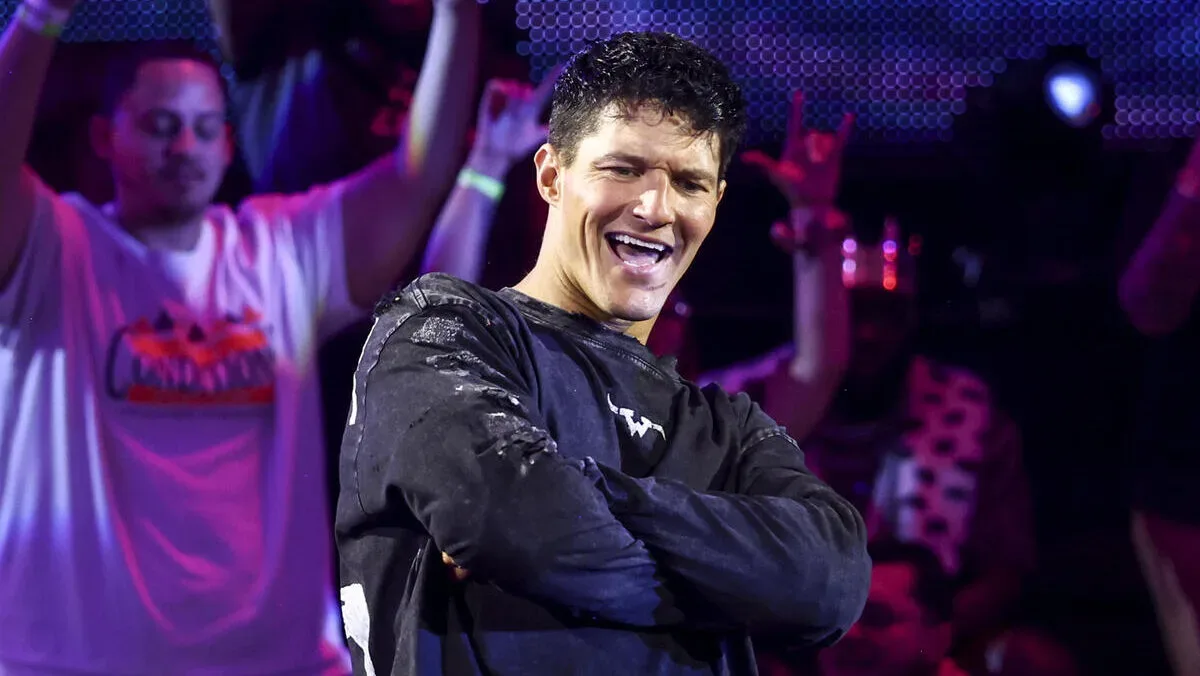
Tate Wilder is finding an important guide in the NXT locker room, and he has singled out Myles Borne as the person currently having the greatest influence on his development.
Speaking about the learning environment around WWE’s NXT brand, Wilder described a culture in which performers regularly challenge one another, offer observations after matches and form groups centered on improvement. While he stressed that there are several people he could name, Wilder said Borne stands out because of the amount of training they do together.
“Oh man, there’s a few. I don’t want to hurt any feelings by not saying names,” Wilder said. “In WWE, especially when I’m at in NXT, there’s a lot of — you get in these cliques with guys that are always trying to better themselves and if they notice something in your match — whether it’s a live event or TV — you have a connection with them. They’re going to point that out to you and allow you to see it from a different perspective and get better on that end.”
When asked to identify someone helping him at this stage, Wilder made Borne his clear choice.
For more background on this topic, read Ric Flair Files $10 Million Lawsuit Against FAM Networks Over Name, Image and Likeness Claims.
“If I was going to say anyone that’s helping me out right now, I would say Myles Borne has been a big one because we do a lot of training together. I’d probably say Myles by far right now.”
Borne’s influence extends beyond the ring on television
Wilder’s comments shine a light on a side of NXT that does not always make it onto weekly television: the constant exchange of advice among wrestlers at different points in their respective careers. In-ring performance can be judged in public during matches, but much of a wrestler’s progression comes through repetition, training sessions and candid feedback after the bell.
For Wilder, Borne has become an especially valuable voice within that process. The shared training time matters because it creates an opportunity for immediate discussion and practical adjustments. Rather than feedback existing as a general compliment or a broad criticism, the relationship Wilder described is built around people seeing details in a match and offering another perspective on how a wrestler can improve.
That distinction is significant in a developmental system. A performer can have a different view of what worked, what did not work and what a crowd responded to in a given match. Having someone trusted enough to identify a missed opportunity, a technical detail or another possible approach can help accelerate that learning process. Wilder’s remarks indicate that Borne has filled that role for him more than anyone else at present.
Wilder was also careful not to present the NXT locker room as a one-person support structure. He noted that there are multiple names he could mention, but did not want to leave people out. His answer instead emphasized the groups that naturally form when wrestlers are consistently trying to get better. Those connections may develop through training, live events, television matches or simply the shared goal of improving every part of a performer’s game.
Training together has made Borne a natural resource
The strongest point in Wilder’s answer was the straightforward explanation for why Borne has taken on such importance: they train together frequently. That regular contact has apparently made Borne more than a colleague offering occasional advice. Wilder described him as someone who has effectively taken him under his wing.
There is a practical value in that type of relationship. Training partners develop familiarity with each other’s strengths, habits and areas that need attention. They are in a position to notice progress over time, not just react to a single match. Wilder’s assessment suggests Borne has become a consistent presence in his effort to refine his work rather than simply a wrestler who provided one memorable piece of advice.
The arrangement also reflects the collaborative side of a competitive environment. Every wrestler is seeking to earn opportunities and stand out, yet Wilder’s description makes clear that individual ambition can coexist with a willingness to help others advance. The cliques he referenced are not presented as exclusionary groups. Instead, he framed them as circles of people united by an interest in bettering themselves and the performers around them.
In that setting, an established connection can make feedback easier to give and easier to receive. A wrestler who has trained alongside another performer is likely to understand the context behind a choice made in the ring. That familiarity can lead to more useful conversations than a generic observation from a distance. Wilder’s praise of Borne points to that kind of trust.
Myles Borne has established a new direction in NXT
Borne’s role as a training partner and mentor arrives during a period in which he has continued to establish himself as a prominent figure in NXT. Earlier this year, he split from No Quarter Catch Crew, creating a new direction for his career on the brand. Wilder’s comments suggest that, alongside his own competitive ambitions, Borne has also become a resource for younger talent working to find their footing.
The No Quarter Catch Crew split was an important turning point because it moved Borne away from that group identity and allowed him to further define himself on his own terms. Wilder did not address the split directly, but his account adds another dimension to Borne’s current standing. Borne is not only focused on his own path; he is also investing time in another wrestler’s growth through shared training and match analysis.
That does not mean Borne has publicly positioned himself as a formal coach, nor did Wilder portray the situation in those terms. Wilder’s language was personal and specific. He named Borne as the person helping him the most right now, based on their regular work together. The takeaway is not a sweeping claim about an official role. It is a reflection of the influence one NXT wrestler can have on another through daily effort.
For Borne, the endorsement is meaningful because it comes from the perspective of someone directly benefiting from the relationship. A wrestler’s reputation among fans is often shaped by television performances and major moments. Within a locker room, however, reputation can also be built through preparation, work ethic and the willingness to share knowledge. Wilder’s comments speak to that latter kind of value.
The NXT system is built on feedback and adaptation
Wilder’s description of the environment also underlines how important adaptability is for wrestlers developing in NXT. He specifically referenced matches on both live events and television. Those are different settings, but each provides material to study. Live events can offer opportunities to experiment and build experience in front of a crowd, while television adds the pressure and visibility of a broadcast presentation.
In either case, Wilder said, a connection with another wrestler can lead to valuable feedback. Someone might notice an aspect of the match that the performer did not see in the moment. They might offer a different way to view a sequence, a reaction or a broader decision. The central point in Wilder’s answer was not that feedback is automatically easy to hear. It was that it can help a wrestler see things differently and improve from there.
That perspective is particularly relevant for younger names seeking to build consistency. Development is rarely limited to a single major breakthrough. It is often made up of smaller corrections and repeated work: training, performing, reviewing, listening and applying lessons the next time out. Wilder’s comments show that he values that process and sees Borne as a major part of it.
There is also an understated confidence in Wilder’s willingness to discuss the help he receives. Rather than treating guidance as a weakness, he presented it as an essential part of trying to improve. In a roster where performers are competing for attention, the ability to identify trusted voices and act on constructive criticism can be just as important as confidence in one’s own abilities.
What Wilder’s comments mean going forward
Wilder did not attach a specific competitive goal or predict what this mentorship will lead to next. His comments were focused on the present: Borne is the person helping him most, they spend substantial time training together, and the relationship has helped him gain another perspective on his matches.
Still, the remarks provide a clear picture of Wilder’s current approach. He is learning from the people around him, building bonds with wrestlers committed to improvement and embracing detailed feedback from someone he trusts. Borne, meanwhile, has earned public recognition from Wilder for the time and effort he has put into that relationship.
As both men continue their work in NXT, Wilder’s praise offers a reminder that progress on the brand is not only measured by what happens under the lights. It is also shaped by the training sessions, conversations and relationships that prepare wrestlers for those moments. For Wilder, Myles Borne has become the most important figure in that process right now.

Darryl Polo
Darryl Polo is a passionate wrestling fan covering WWE, AEW, TNA and beyond. He loves great rivalries, breakout stars and the moments that keep fans talking long after the bell. How we work.