
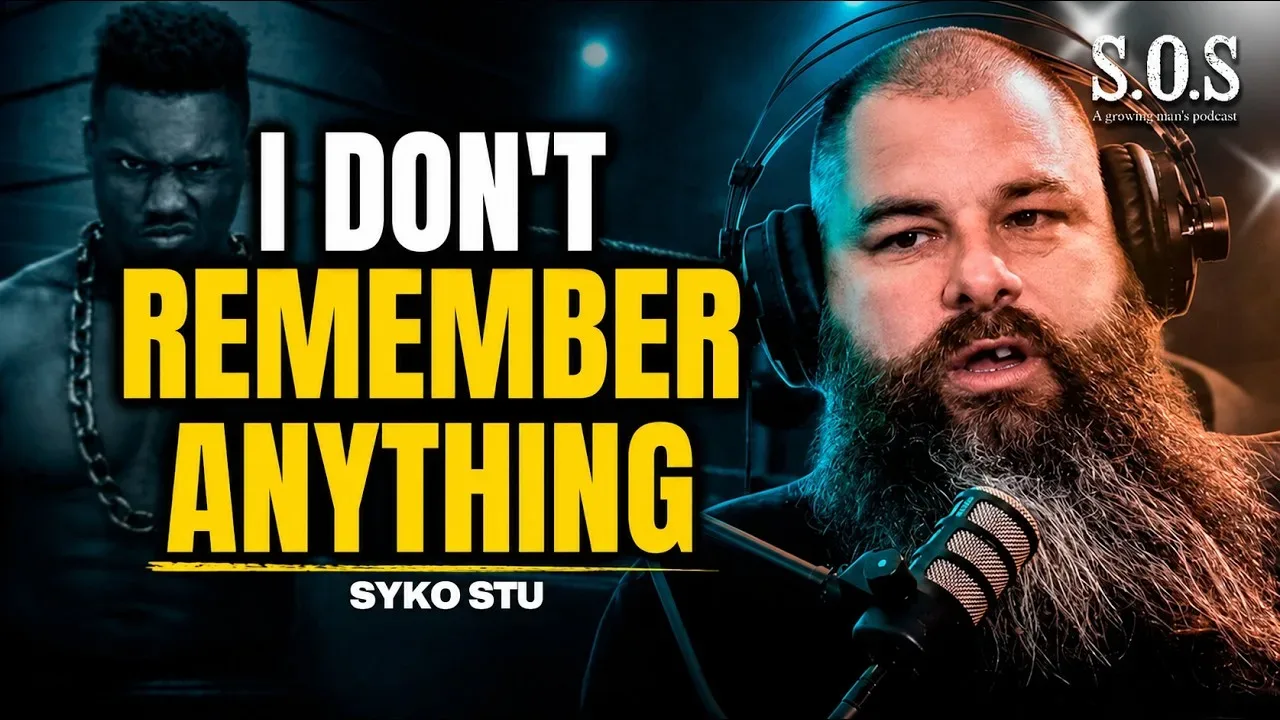
Syko Stu has offered an extensive account of the August 23, 2025 incident at KnokX Pro that left him hospitalized with serious injuries and has kept him out of professional wrestling ever since.
The independent wrestler discussed the situation during an appearance on the SOS Podcast with Matt Rosa and Neno Torres, reflecting on what he remembers from the day, the planned in-ring angle that preceded the violence, the lengthy recovery that followed, and why he draws a distinction between letting go of a grudge and forgiving Raja Jackson.
Jackson, the son of former MMA champion Quinton “Rampage” Jackson, entered the ring during the KnokX Pro event and slammed Stu, rendering him unconscious. He then delivered more than 20 legitimate unanswered blows to Stu’s head before wrestler Doug Malo intervened and pulled him away.
The confrontation had its roots in an earlier moment outside the venue. Stu had approached Raja and struck him with a beer can. Stu believed the moment was part of a wrestling angle, but Raja did not react as though it were a worked spot. Stu subsequently apologized and the two shook hands. A finish was then discussed in which Raja was to enter the ring and throw a single wrestling-style punch in response to the can incident.
For more background on this topic, read Tiger Jeet Singh Addresses Fan Injury After Saber Incident At Japanese Appearance.
A Planned Finish That Escalated
Stu said he has limited recollection of the events surrounding the incident, though he recalled Raja being backstage while filming. In his view, the proposed resolution was intended to be a controlled wrestling segment rather than anything resembling the events that ultimately transpired.
“I don’t remember a lot of it,” Stu said. “I do remember Raja coming backstage and he was filming. Usually you don’t film backstage like that. I know there was the can spot and I don’t remember too much after that. I do remember that we did call a finish and he was supposed to come in. I think he was going to give me one punch because of the can spot. It’s supposed to be a wrestling punch, but if he would’ve connected with it a little more, I could’ve sold it better. I don’t think anyone expected what was going to happen to happen.”
Stu said he did not understand why Raja appeared to take the beer-can moment so personally. He explained that, after realizing Raja was not a trained wrestling performer, he acknowledged that he had been wrong to involve him in that type of spot. From there, Stu believed they had arrived at an angle designed to address it in the ring.
The match itself, Stu said, had gone well before the conclusion. But he said his memory ends at the slam.
“I was out on the slam. I don’t remember anything,” Stu said. “The match went really good until that. I don’t remember anything until, I believe it was Tuesday. I woke up in the hospital. I was in and out of consciousness the whole time. I woke up on Tuesday and saw some of the wrestlers. Rikishi was there and we were talking. I was just trying to recover.”
Stu entered the hospital on the Saturday of the event and was discharged the following Thursday. He said that, while hospitalized, people around him deliberately avoided showing him footage of what happened or discussing it in detail. His family was upset by the attack, he said, but has remained a key part of his support system throughout his recovery.
Severe Injuries and a Continuing Recovery
The physical consequences have been substantial. Stu said he suffered a severe traumatic brain injury, lost two teeth and shattered his maxilla, the upper jaw bone. He also noted there were additional injuries that he could not fully recall during the interview.
“I really had to relearn how to walk. I couldn’t walk after that for a while,” Stu said. “I did have a severe traumatic brain injury. I lost two teeth. I shattered my maxilla. I know there’s more stuff, but I can’t remember off the top of my head. I was off work for an entire year.”
The effects have extended well beyond the immediate aftermath. Stu explained that his non-wrestling work involves significant computer use, which made a return to work more difficult while dealing with the cognitive impact of the injury and frequent medical appointments. He remains under the care of traumatic brain injury specialists and is still awaiting completion of dental treatment, including implants for the teeth he lost.
As part of his rehabilitation, Stu has been doing word exercises. However, he said memory problems remain a regular part of daily life. He described forgetting information just minutes after hearing it, repeating tasks and struggling at times to remember names and faces. Those challenges have directly affected his relationship with the profession in which he had been active before August 2025.
Stu said he is physically capable of wrestling, but is not mentally ready to return because he cannot reliably remember matches or planned spots. He has not wrestled since the incident and said he has been advised not to do so, although he still hopes to eventually get back in the ring.
Not Holding a Grudge Is Not the Same as Forgiveness
One of the most important clarifications Stu made concerned public characterizations of his response to Raja. He pushed back on the idea that he had said he forgave Raja, explaining that his actual position was that he did not want to carry a grudge.
“That was a little bit out of context,” Stu said. “What I actually said was, ‘I’m not holding a grudge.’ I never said anything about forgiveness. Everybody can learn something from this. I just didn’t want to hold a grudge because that brings the negative energy into it. When you have to let something go, it kind of helps you heal from it.”
For Stu, that distinction matters. He framed the choice not to hold onto anger as part of his own healing process, rather than a declaration that the harm done to him had been forgiven or minimized. He also referenced a statement he read in court and indicated that the way it was later characterized did not match what he believed he had said.
Raja ultimately served 90 days in prison after pleading no contest to one felony count of battery with serious bodily injury. When asked whether that sentence was sufficient and whether justice had been served, Stu declined to give a definitive assessment.
“We might have to hold off on that one for now,” Stu said.
That answer reflected the unresolved nature of the matter from Stu’s perspective. The legal case produced a sentence, but the medical and personal consequences remain active in his life. His comments made clear that recovery has not been a completed chapter marked by a discharge from the hospital or the end of court proceedings.
Stu Addresses Contact From Rampage Jackson
Stu was also asked whether Raja or Quinton “Rampage” Jackson had reached out to him after the attack. He said that he did not have access to his phone throughout his hospital stay and faced a large volume of messages once he was able to review it. He saw that Rampage had called and asked him to return the call.
However, Stu said he chose not to do so after hearing Rampage make comments about him on several podcasts. Stu objected specifically to claims that he was drunk all the time, saying people who know him would not support that portrayal.
“I saw Rampage called and he wanted me to call him back, but then I saw him go on all these podcasts and was basically trashing me,” Stu said. “I’m not going to call you back if you already made up your mind about me. I kind of let it go, but he was on different podcasts talking about me being drunk all the time. None of the statements from other people who actually know me would support that.”
Stu said he does not know what he would say to Rampage if they were to meet now. His uncertainty is consistent with the broader account he gave: he has worked to release the negative weight of the incident for his own well-being, but he has not presented himself as having found easy closure.
A Sobering Reminder for Independent Wrestling
The incident remains a stark reminder of the responsibility carried by everyone involved in a wrestling environment, particularly when non-wrestlers are brought into physical angles. Pro wrestling depends on cooperation, communication and an understanding of how to perform simulated violence as safely as possible. When those boundaries break down, the consequences can be severe.
Stu’s account underscores the gulf between a planned single punch in a storyline and what unfolded after he was knocked unconscious. It also highlights the long-term reality behind the footage that circulated following the event: months of lost work, neurological care, dental reconstruction, rehabilitation and a wrestling career placed on hold.
More than a year after the incident, Stu remains focused on continuing treatment and managing its everyday effects. He wants to wrestle again, but he is also candid that wanting a return and being medically or cognitively prepared for one are two different things. For now, the recovery remains ongoing.

Darryl Polo
Darryl Polo is a passionate wrestling fan covering WWE, AEW, TNA and beyond. He loves great rivalries, breakout stars and the moments that keep fans talking long after the bell. How we work.