
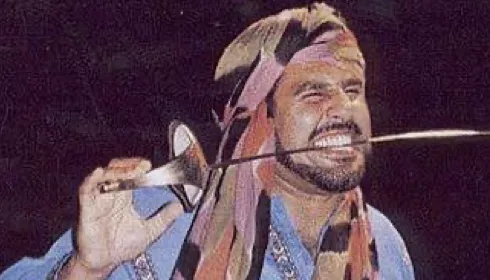
Tiger Jeet Singh has commented after a fan was injured during his rare public appearance in Japan on October 17, with the veteran wrestler placing responsibility on the individual who remained in front of him during Singh’s entrance.
Singh appeared at Yoyogi National Stadium Gymnasium No. 2 in Shibuya, Japan, where he carried and swung the saber that has long been associated with his wrestling persona. During the entrance, the saber struck a fan on the forehand. Medical staff treated the man at the venue before an ambulance was called, and he was subsequently taken to a nearby hospital. The injury was described as minor.
The incident occurred during an event connected to Megumi Kudo’s 40th anniversary celebration. Kudo apologized after the fan was hurt, while Singh and his son, Tiger Ali Singh, both characterized the situation as an accident.
Singh Says Fan Needed To Move
Speaking following the incident, Tiger Jeet Singh gave a blunt assessment consistent with the confrontational persona he has presented throughout much of his career. He said the fan should not have remained directly in his path as he made his entrance with the saber.
For more background on this topic, read Steve Maclin Recalls Emotional Road to Adam Copeland Match at MLP Northern Rising.
“It was a mistake for him to be in front of me. It’s his fault. You know that, right? All he had to do was get out of my way.”
The comments will undoubtedly draw attention because the injury took place during a live wrestling appearance, where entrances are designed to create a close connection between performers and the audience. Yet they also reflect the longstanding danger attached to a presentation involving a physical prop, particularly when performers are moving through areas near spectators.
Singh’s saber is not simply an accessory brought out for a special occasion. It is one of the defining elements of his image, a visual symbol of the intimidating, wild and unpredictable presence that made him a memorable attraction in Japanese professional wrestling. That presentation has historically depended on an entrance that feels volatile and confrontational. In this case, however, the spectacle resulted in a fan needing medical attention.
Tiger Ali Singh Calls It An Accident
Tiger Ali Singh, who was present for the appearance, also addressed what happened. He said an announcement had been made to caution those nearby, and maintained that the fan had not moved despite the warning.
“The announcer was saying, ‘Please be careful!’ They were warning him it was dangerous, but he didn’t move out of the way. I’m sure he won’t make the same mistake again. Just like my father said, this was an accident.”
His comments add an important detail to the sequence of events: attendees were reportedly being told to use caution before the injury occurred. Tiger Ali Singh did not describe any intent to harm the fan, and his remarks aligned with his father’s position that the incident was accidental.
At the same time, the situation serves as a reminder that audience warnings, performer movement and venue procedures all matter when a wrestling entrance includes an object capable of causing harm. A crowd may understand the theatrical nature of a wrestler’s act, but the physical risks can become real very quickly when there is little distance between an active performer and fans at ringside or along an entrance route.
Medical Personnel Responded At The Venue
The fan was attended to by medical personnel at Yoyogi National Stadium Gymnasium No. 2 before an ambulance was summoned. He was then treated at a nearby hospital. The injury was reported to be minor, which is the most significant update regarding his condition following the incident.
There has been no indication in the available details of a more serious medical issue. The immediate response from venue medical staff and the decision to call an ambulance ensured the fan could receive further evaluation after being struck.
Even when an injury is ultimately deemed minor, an incident requiring on-site treatment and hospital care is an unsettling development for everyone involved. Fans attend wrestling events expecting physicality in and around the ring, but they are not participants in the performance. The responsibility to maintain a safe environment is especially important during entrances, celebrations and other moments when talent interacts with people outside the ring area.
A Rare Japanese Appearance For A Singular Wrestling Figure
The October 17 appearance was notable in its own right because Tiger Jeet Singh has made only rare appearances in Japan in recent years. Singh remains a uniquely recognizable figure to generations of Japanese wrestling fans, in large part because of the forceful persona he brought to the country during his career.
His image was built around intensity rather than subtlety. The saber, his aggressive demeanor and his willingness to create chaos around his entrances made Singh feel dangerous even within the deliberately heightened world of professional wrestling. That kind of character work helped make him stand apart, and it also explains why the weapon remains so closely tied to him decades later.
Professional wrestling has changed significantly in how it handles fan proximity, security and performer access. Modern shows often feature barricades, designated walkways, security personnel and repeated announcements intended to keep audience members from stepping into a performer’s route. Still, special appearances can bring different venue layouts and a different level of crowd anticipation, particularly when a legendary figure makes an uncommon return.
The atmosphere surrounding a milestone celebration can also be especially emotional. Fans may seek a closer look, a photograph or a memorable interaction with a veteran they rarely have the chance to see. Those impulses can create complications when a performer’s character presentation involves rapid movement or a prop such as Singh’s saber.
Megumi Kudo Offers An Apology
Megumi Kudo, whose 40th anniversary was being celebrated, apologized for the fan’s injury. Her response came after an occasion intended to honor her career was overshadowed by the entrance incident.
Kudo’s apology acknowledged the seriousness of a fan being hurt at an event held in connection with her anniversary. While Singh and Tiger Ali Singh stressed that the incident was an accident and that warnings had been issued, Kudo’s response reflected the concern expected when someone attending a wrestling event requires medical treatment.
The available information does not indicate that the injury affected the fan beyond the minor condition reported after hospital treatment. It also does not establish any further action or consequence stemming from the incident. What is clear is that a rare appearance by Singh, and an event meant to celebrate Kudo’s four decades in wrestling, generated an unexpected and troubling moment outside the ring.
The Balance Between Character And Safety
Wrestling thrives on recognizable entrances and characters. For many fans, those elements are as important as the matches themselves. A performer’s music, clothing, props and mannerisms can instantly communicate history and personality. In Singh’s case, the saber is inseparable from the character audiences have known for years.
But the same elements that make an entrance unforgettable can require careful management. A prop that looks dangerous as part of a performance can be dangerous in a literal sense if it comes into contact with someone nearby. Clear instructions, protected pathways and sufficient space are vital whether a performer is carrying a weapon-like prop, driving a vehicle, moving quickly through a crowd or engaging in an intentionally chaotic character entrance.
The October 17 incident does not change Singh’s place as an enduring figure in Japanese wrestling history, nor does it erase the celebratory purpose of Kudo’s anniversary event. It does, however, leave a clear lesson about the limits of proximity between fans and performers. Wrestling may invite audiences to feel close to the action, but there must remain a meaningful boundary when the action includes a swinging saber.
For now, the fan’s injury has been described as minor, Singh maintains that the individual should have moved out of his path, Tiger Ali Singh says warnings were issued, and Kudo has apologized. Those are the central facts from an incident that turned a nostalgic wrestling appearance into a safety concern that will likely remain part of the discussion around the event.

Darryl Polo
Darryl Polo is a passionate wrestling fan covering WWE, AEW, TNA and beyond. He loves great rivalries, breakout stars and the moments that keep fans talking long after the bell. How we work.