
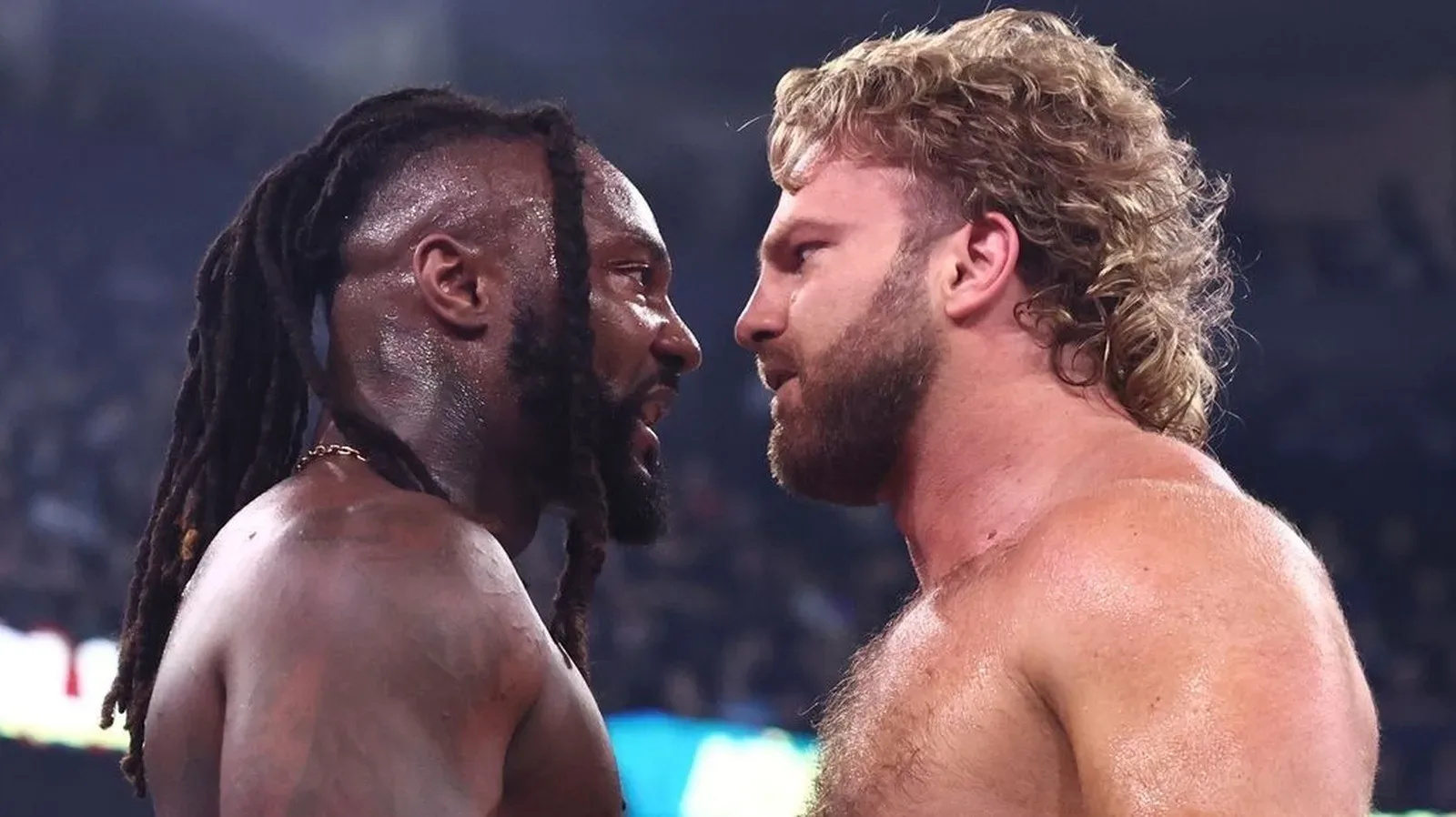
Swerve Strickland has set an enormous standard for the legacy of his rivalry with Hangman Adam Page. The AEW star does not simply want their conflict to be remembered as a defining program for the company. He wants it to earn a place in the broader conversation about the greatest rivalries professional wrestling has ever produced.
That is an ambitious aim, but it fits a feud that has consistently operated at an unusually intense emotional level. Strickland and Page have taken their issues far beyond conventional competitive animosity, turning their encounters into a story of resentment, revenge, fear and obsession. Their rivalry has featured actions that neither man can easily walk back, and its latest chapter has extended into AEW’s trios division.
Speaking in a recent interview, Strickland explained that the reaction generated when he and Page are positioned opposite one another is what tells him the rivalry has the potential to become something lasting.
“I hope one day it goes down as one of the greatest in wrestling history,” Strickland said. “I want it to be that big and that important and that impactful you know? Like when two guys tag in, and the entire arena stands up like as a wave of people standing up to see what happens next, that's when you know you've got something special, and that's when you know like that doesn't come around very often.”
For more background on this topic, read Don Callis Details the Mindset He Seeks When Building the Don Callis Family.
A feud built on deeply personal escalation
AEW has presented major rivalries with championship implications, athletic one-upmanship and faction warfare since the promotion’s launch, but the Strickland-Page issue has stood apart because of how personal it became. The conflict has repeatedly shown both men crossing lines that would be unthinkable in a more routine rivalry.
Page drinking Strickland’s blood and burning down Strickland’s childhood home established the scale of his rage. Strickland, meanwhile, invaded Page’s home while Page’s family was asleep and later choked him with a steel chain. Those moments ensured that their story could not be reduced to a disagreement over rankings, opportunity or a single loss.
The result is a rivalry where the audience has reason to believe almost any encounter can produce another escalation. It is not merely a matter of whether Strickland or Page will win a match. The central question has become what each man is willing to do to hurt the other, and whether either competitor can truly separate his own identity from the feud.
That atmosphere is a major part of why the rivalry has continued to command attention from AEW audiences. Wrestling fans are accustomed to heated promos and physical confrontations, but the most memorable feuds make viewers feel that the participants have found an opponent who can pull a completely different side out of them. Strickland and Page have repeatedly presented that dynamic.
Strickland sees vulnerability at the center of the story
For Strickland, the key is not violence for its own sake. He believes the effectiveness of the program stems from the fact that he and Page understand the emotional pressure points that make the other man react. In his view, their shared willingness to expose those feelings gives their rivalry a level of vulnerability that fans can recognize.
“We wear our hearts on our sleeves and we exploit the emotions from one another,” Strickland said. “We know what makes each other tick, we know what p***** them off and pushes it past that boiling level. We know it and the fans know it too. Now we have it to the point they're anticipating it, they're anticipating when the dynamite actually goes off because the fuse has already been lit, when does it actually blow up? That's where we can like take them on that ride with us no matter where we go.”
That description captures the essential tension behind their meetings. Both wrestlers have been portrayed as capable, dangerous and supremely confident, yet neither has been able to treat the other as just another opponent. Page knows how to force Strickland into an emotionally charged response, while Strickland knows exactly how to provoke Page into abandoning restraint.
It also helps explain why a tag-in can carry such weight in the trios setting. In many multi-person matches, a fresh wrestler entering the ring is a structural part of the contest. When Strickland and Page are involved, it can become the moment the building is waiting for. Their history means a brief face-to-face exchange has context before a move is ever thrown.
Strickland’s “fuse” analogy is particularly fitting for the way the feud has unfolded. The audience is not only reacting to the explosion when it arrives; fans are watching for every sign that it may be coming. A stare, a verbal jab or an attempt to deny the other man a direct confrontation can all function as another spark in a story that has taught viewers to expect volatility.
The importance of continuing without repetition
The trios division gives AEW a different framework for the rivalry, but it also presents a challenge. A great wrestling feud needs to retain its core identity while finding fresh ways to develop. Simply replaying the same confrontation can weaken what made it special. The task is to make every new chapter feel connected to the history without making the past seem like a substitute for a new idea.
Strickland and Page have a strong foundation for that because their animosity affects more than just one-on-one competition. Their issues can alter alliances, influence the strategy of their teammates and create instability in any situation where both men are forced to occupy the same ring. In a trios environment, a competitor may try to avoid the opponent he hates most, only to find that the structure of the match eventually forces the confrontation everyone anticipated.
That is where Strickland’s goal of creating a crowd-wide reaction matters. The biggest rivalries establish patterns of audience behavior. Fans do not need extensive explanation to understand why a particular confrontation is important; the history does the work. If the building rises when two wrestlers finally come face-to-face, it reflects years of accumulated emotional investment.
It is also a standard that goes beyond social-media discussion or short-term shock value. For a feud to be remembered across generations of wrestling fans, it must have defining images, but it must also have a coherent emotional thread. The audience has to understand why the hatred persists and why neither person can simply move on. Strickland’s comments suggest he sees that emotional logic as the strongest asset he and Page possess.
A defining rivalry for both competitors
For Page, the Strickland rivalry has revealed how far he will go when he feels he has been pushed into a corner. For Strickland, it has reinforced the calculating edge that makes him such a difficult opponent to predict, while also showing that he is not immune to Page’s attempts to get under his skin.
That mutual exposure is significant. Rivalries often become memorable when each wrestler forces the other to evolve or reveal a previously hidden dimension. The best ones do not exist separately from the characters involved; they change how the audience sees those characters. The Strickland-Page feud has done precisely that by making their conflict feel like an extension of who both men are rather than a temporary storyline obligation.
Of course, the ultimate place of any rivalry in wrestling history cannot be declared by either participant. It will be shaped by the full body of work still to come, the matches that define it, the moments fans continue to revisit and the long-term effect it has on both careers. Strickland is openly aiming for that kind of stature, and the continued presence of the feud in AEW’s trios landscape means the story is still being written.
What is already clear is that Strickland and Page have created a conflict that brings immediate anticipation whenever their paths cross. Their feud has been brutal, personal and emotionally exposed, with both men proving they know how to find the other’s breaking point. If they can continue building on that foundation while keeping each new encounter meaningful, Strickland’s hope of making it one of wrestling’s all-time great rivalries will remain a realistic one.
In pictures

Darryl Polo
Darryl Polo is a passionate wrestling fan covering WWE, AEW, TNA and beyond. He loves great rivalries, breakout stars and the moments that keep fans talking long after the bell. How we work.