
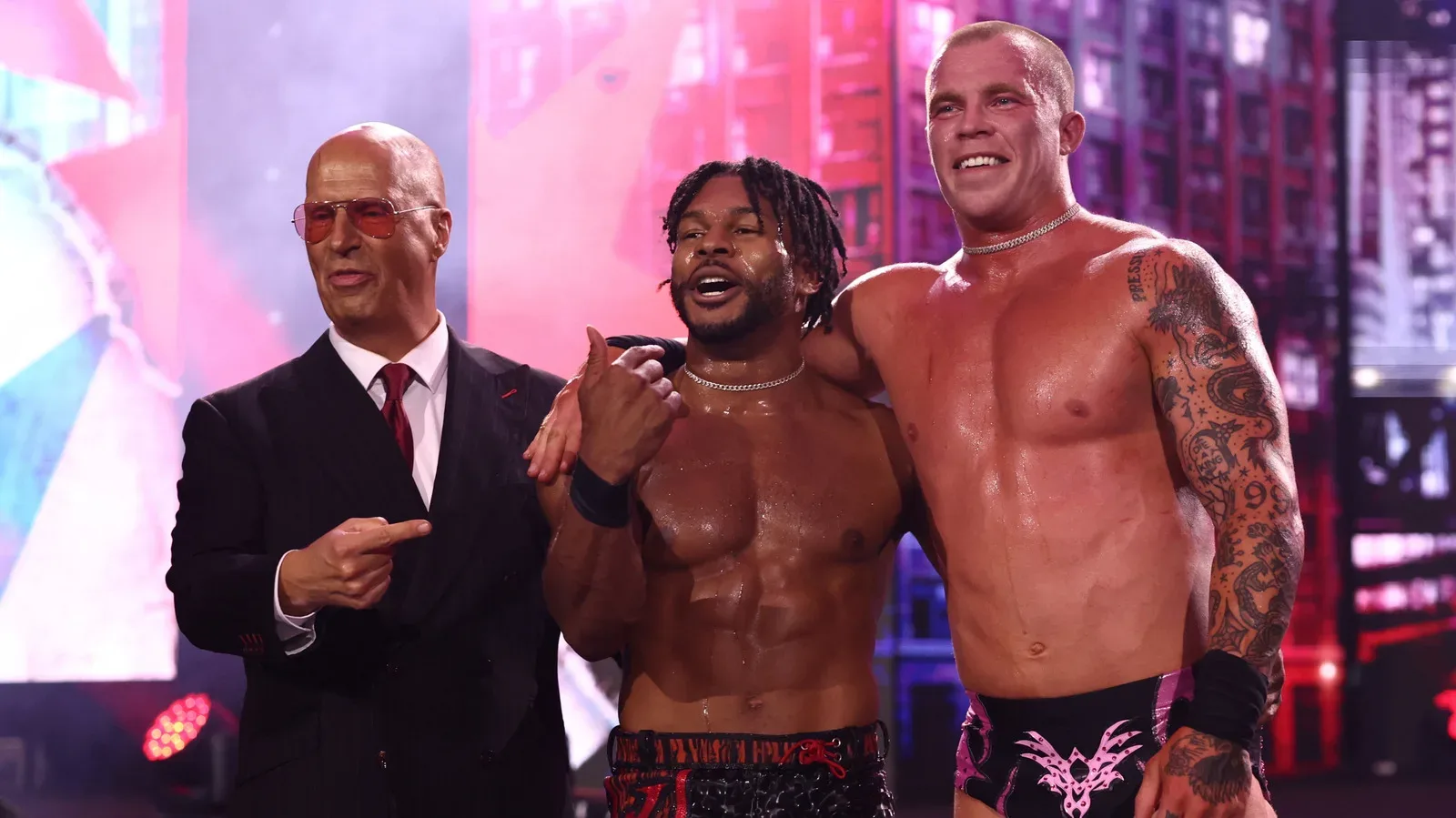
Don Callis has offered a clear explanation for how he evaluates potential additions to the Don Callis Family, insisting that the growing AEW faction is built around more than raw athletic gifts.
Speaking on Poisonrana, Callis addressed the size of his group and the perception that its expanding membership could mean nearly anyone is eligible to join. The Family has grown to 15 members when Callis himself is included, giving it a significant presence around AEW. Yet Callis maintained that he uses specific standards when deciding whether a wrestler belongs in his inner circle.
For Callis, the deciding qualities are rooted in a performer’s mentality rather than their visible physical tools. Athletic potential matters, but he believes it is only one part of a much larger equation.
“I think physical potential is one thing — a lot of people have that,” Callis said on Poisonrana. “Really, what I look for is a mental mindset and an emotional stability in a talent.”
For more background on this topic, read Matt Hardy Says TNA Has Become a Better Fit for The Hardys Than AEW.
That assessment helps explain the image Callis has tried to establish for the faction. The Don Callis Family is not presented simply as a collection of wrestlers who share a common enemy or temporarily unite for numbers. Callis views the group as an environment in which talent can be guided, challenged and, in his telling, elevated beyond the limitations that held them back before they arrived.
Callis pointed to Josh Alexander as an example of a wrestler he believes benefited from becoming part of the Family. In Callis’ view, Alexander had been struggling to find his footing before entering the group. He characterized Alexander’s previous situation as one affected by “imposter syndrome,” suggesting that the wrestler needed a stronger foundation around him to fully embrace his own standing.
The AEW manager argued that Family membership gives Alexander that foundation. Callis described the group as a support system, one designed to provide both confidence and a competitive standard. His comments framed the faction as a place where a wrestler does not merely receive backup in a confrontation, but is expected to develop by being surrounded by accomplished peers.
“Now he’s a part of something — now he’s got a support system,” Callis said, before highlighting the championship success associated with members of the group and taking credit for helping create those opportunities.
Callis has long made his own influence central to the Family’s identity. Whether he is speaking about championship ambitions, recruiting talent or directing the next move of a wrestler under his banner, Callis presents himself as the architect behind the operation. His comments regarding Alexander followed that familiar theme: the individual talent is important, but Callis believes his guidance and the group structure are what turn potential into sustained success.
Alexander’s place in the faction also fits the competitive philosophy Callis described. Rather than portraying a large group as a comfortable destination where members can coast on the strength of their allies, Callis said the depth of the Family should force every wrestler within it to prove themselves. A new arrival may gain access to a support structure, but they also enter a setting filled with peers who are competing for status, spotlight and the opportunity to represent the group at the highest level.
“The talent just in my faction, in my group, in my Family, is unprecedented in professional wrestling,” Callis said on Poisonrana.
Callis specifically named Kyle Fletcher and Konosuke Takeshita while discussing the standard Alexander now faces. He suggested that a wrestler who had previously been viewed as the standout figure in his own environment must approach the Family differently, because there are multiple performers who can credibly claim to be among the best in the world.
That internal pressure is central to Callis’ pitch. He described Alexander as someone accustomed to being the “big man on campus,” but now surrounded by wrestlers such as Fletcher and Takeshita. In Callis’ eyes, that creates an opportunity rather than a problem. Alexander must compete with the talent around him, and that competition can sharpen his focus while also raising his profile.
The remarks underline a notable distinction in Callis’ approach to faction leadership. Many wrestling groups are defined by loyalty first, with members expected to rally behind a leader and protect one another from outside threats. The Don Callis Family certainly operates as a unified force when its interests align, but Callis’ explanation places equal emphasis on internal standards. He wants wrestlers who can handle being part of a powerful collective without losing the drive to stand out within it.
That balance may be particularly important for a faction of its current size. With 15 members including Callis, the Family has enough bodies to create a broad network of alliances, but also enough talent for competition over attention and positioning to become unavoidable. Callis did not portray that as a weakness. Instead, he argued that the sheer level of talent in the group makes membership meaningful because nobody can assume their role is secure simply by being accepted.
His focus on emotional stability is also revealing. Professional wrestling frequently rewards confidence, aggression and an ability to perform under pressure, but Callis indicated he is looking for something more durable than charisma or athletic upside. He wants recruits who can withstand the demands that come with competing beside prominent names, absorbing scrutiny and managing the expectations associated with the Don Callis Family name.
In practical terms, Callis’ comments suggest he sees his role as part manager, part evaluator and part mentor. He is not only looking for wrestlers who can win matches. He is looking for performers who can respond to a challenging environment, accept direction and use the collective’s resources without becoming overwhelmed by the personalities around them.
Callis also suggested that the public has not necessarily seen the full reach of the Family’s operation. During the conversation, he claimed there are additional prospects connected to the group who have not yet been revealed. He did not identify those individuals or offer a timetable for when they may become known, leaving the possibility of future developments open without providing concrete details.
However, Callis was more definitive when discussing immediate recruitment. Despite teasing further prospects associated with the Family, he said he is not actively searching for additional members at this time. The current roster, in his view, is already substantial enough that there is no pressing need to keep adding names.
That stance is understandable given the scale Callis described. A faction can benefit from depth, especially when its members can be placed into different matchups and storylines, but constant additions can also dilute the significance of joining. By saying he is not presently looking for recruits, Callis positioned the existing Family as an established unit rather than an endlessly expanding open door.
It also reinforces the idea that Callis wants prospective members to meet more than a superficial standard. If physical potential is common, as he said, then the traits he values most become the traits that separate a possible recruit from someone merely looking for association with a powerful name. A wrestler must be mentally prepared, emotionally steady and willing to test themselves against a group filled with high-level competition.
For Alexander, that is the challenge Callis believes now lies ahead. The support system Callis described comes with expectations: perform, adapt and prove that a place in the Family is deserved. For Fletcher and Takeshita, their names being used as benchmarks further emphasizes how Callis wants the faction to be perceived—as a collection of talent where status is never simply handed out.
The Don Callis Family’s next moves may ultimately show whether that vision holds together at such a large scale. For now, Callis is presenting the group as both a destination and a proving ground: a place where wrestlers can find support, but only if they are prepared to meet the mental and competitive demands that come with standing beside the Family.
In pictures

Darryl Polo
Darryl Polo is a passionate wrestling fan covering WWE, AEW, TNA and beyond. He loves great rivalries, breakout stars and the moments that keep fans talking long after the bell. How we work.