Swerve Strickland has looked back on one of the most extreme moments in recent AEW history and made clear which part of it he would least like to repeat.
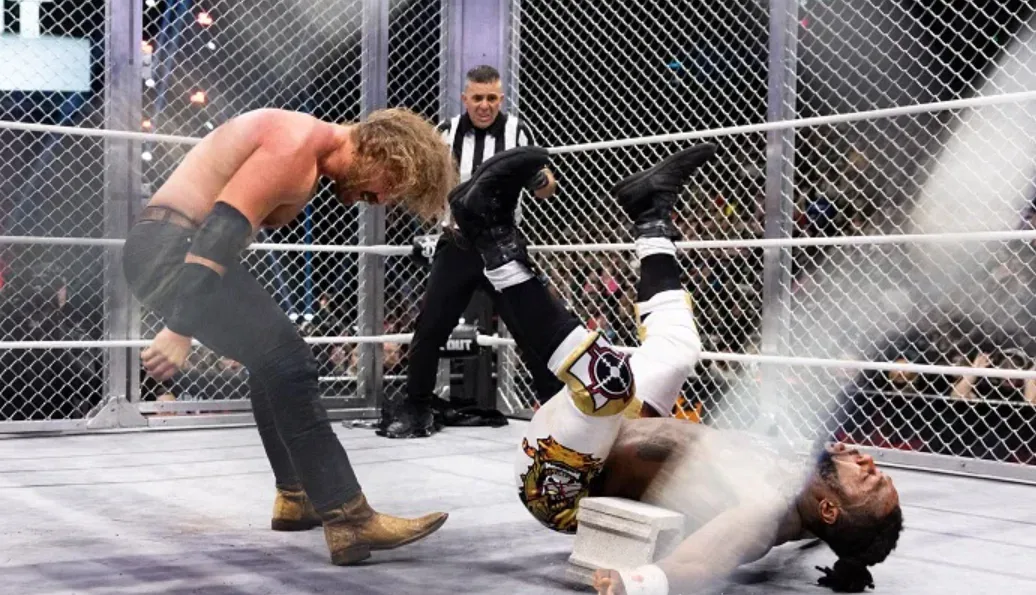
At AEW All Out 2024, Strickland and Hangman Page closed the event with a Lights Out steel cage match that took their bitter rivalry into especially violent territory. The bout featured a number of hardcore elements, including syringes and cinder blocks, as the two competitors delivered a match designed to reflect the escalating hostility between them.
For many viewers, the syringe imagery was among the most immediately unsettling aspects of the fight. But during an appearance on Hot 97, Strickland identified another spot as the one that truly stands above the rest when he considers the physical toll of his career: being powerbombed onto a legitimate cinder block.
“That wasn’t as bad as getting powerbombed on the cinder block. That was a full on real cinder block. That was probably the worst thing I’ve ever done. I was like, never again.”
For more background on this topic, read Matt Jackson Says Kenny Omega Will Return Stronger After AEW All In Loss To Will Ospreay.
It is a blunt assessment from a wrestler whose career has included a wide range of demanding matches, elaborate athletic sequences, and major high-pressure appearances. Strickland did not frame the cinder block moment as an illusion created by presentation or a harmless substitute used for effect. Instead, he stressed that the block was real, which helps explain why the spot has remained at the forefront of his mind well after the match.
The All Out encounter was not presented as a conventional contest. With the Lights Out designation and a steel cage surrounding the ring, the match was built to be a violent culmination of the issue between Strickland and Page. It existed in a corner of professional wrestling where rivalry, atmosphere, and the willingness to absorb punishment are as important to the presentation as holds, counters, and pinfall attempts.
That approach can produce defining scenes for the wrestlers involved, but it also requires performers to make immediate decisions about trust, timing, and the risks attached to a particular stunt. Strickland described the mental process he uses when confronted by a major spot in especially direct terms. Rather than allowing himself time to debate it, he said he has to clear away every thought and commit before doubt takes over.
“Nothing! It has to empty. I have to empty my mind because I can’t have any other thoughts. I’m like, do it before I just say no. Do it now. Because there’s a time and window before I come to my realization this is stupid.”
That explanation captures a tension that is familiar to wrestlers who work matches with dangerous physical components. The action may be carefully planned between performers, but the moment still demands a split-second willingness to follow through. Hesitation can disrupt timing, while fully recognizing the potential pain involved can make taking the step even harder. Strickland’s answer did not romanticize that calculation. He acknowledged the point at which common sense begins objecting and suggested that he needs to act before that internal alarm becomes impossible to ignore.
A Match Built Around Escalation
Strickland and Page’s All Out 2024 battle was shaped by the intensity of their rivalry. The steel cage kept the fight confined, while the Lights Out setting gave the participants room to push into a harsher style than a standard AEW match. Syringes, cinder blocks, and other brutal visual elements made the bout stand out as one of the promotion’s most severe recent main-event confrontations.
The powerbomb onto the cinder block became one of the match’s most talked-about images because it combined a familiar wrestling move with an object that offers little room for comfort. A powerbomb is already a move that depends on coordination between two wrestlers. Adding a cinder block changes the stakes of the landing dramatically, making the sequence feel much more alarming than an ordinary ring bump.
Strickland’s comments also distinguish the reality of the physical experience from what viewers may have initially focused on. The syringe spot naturally drew attention due to its visual shock value. Yet Strickland said that it was not as bad as the cinder block powerbomb. His perspective illustrates how what looks most disturbing on television is not always the spot that hurts the most or stays with a wrestler longest.
Professional wrestling relies on that divide between spectacle and experience. Fans see the finished match: the camera angles, the crowd reactions, the pacing, and the dramatic escalation. The wrestlers feel the impact, manage their positioning, and make the instantaneous judgments that allow a dangerous-looking sequence to happen in the first place. Strickland’s recollection offers a rare, uncomplicated look at the latter side of the equation.
Strickland’s Mindset in the Moment
There is also a revealing simplicity in Strickland’s description of mentally preparing for a major stunt. He did not describe a lengthy ritual or a complicated method for psyching himself up. Instead, he said he needs to empty his mind. The goal, as he explained it, is to avoid entertaining the thought that the spot may be a bad idea before it is time to execute it.
That mindset speaks to the unusual demands placed on a performer in a high-risk match. A wrestler must remain aware enough to protect themselves and their opponent, but not become so consumed by anxiety that they lose their timing or pull away from the planned moment. The balance is especially difficult in a bout like the one Strickland and Page had at All Out, where each escalating spot can create a fresh test of nerve.
His line about acting before reaching the realization that a decision is “stupid” is delivered with humor, but it also conveys the practical reality behind the performance. Wrestlers are not unaware of what can go wrong. In Strickland’s telling, the ability to move forward sometimes comes from refusing to dwell on those possibilities in the seconds before impact.
For Strickland, though, the conclusion appears to be firm. The cinder block powerbomb is the worst spot he has ever done, and his immediate reaction afterward was, “never again.” That does not erase the significance of the match or the role the spot played within the story AEW was telling. It does establish a clear personal line from the wrestler who took it.
The Lasting Image of All Out 2024
AEW’s Lights Out matches have often been positioned as opportunities for rivalries to go beyond traditional limits, and the Strickland-Page cage match carried that identity in emphatic fashion. The contest was meant to feel hostile, dangerous, and final in a way that ordinary rules could not contain. Its most extreme moments were central to that purpose.
Still, Strickland’s latest comments add another layer to the conversation around the bout. They are not simply a reflection on the spectacle or the crowd response. They are the words of the performer who absorbed one of its harshest impacts and now ranks it above everything else he has attempted in terms of how bad it felt.
Beyond his discussion of the All Out match, Strickland also spoke during the interview about the idea that stillness can be a source of power in performance. That thought fits the broader evolution of a wrestler who has become known for confidence, presence, and an ability to command attention in major situations. Yet the cinder block story is a reminder that much of wrestling’s power also comes from the physical commitment behind the performance.
Strickland’s comments do not minimize the planning and professionalism required to stage a match of that nature. If anything, they underline why those factors matter. A moment can be designed for maximum drama, carried out by experienced wrestlers, and still be exceptionally painful. In this case, Strickland has no hesitation in naming the cinder block powerbomb as the spot that pushed him further than any other.
For fans revisiting AEW All Out 2024, the match with Hangman Page remains a stark example of how far a personal rivalry can be taken inside the ring. For Strickland, it also remains the night he learned exactly which kind of impact he does not want to take again.
Darryl Polo
Darryl Polo is a passionate wrestling fan covering WWE, AEW, TNA and beyond. He loves great rivalries, breakout stars and the moments that keep fans talking long after the bell. How we work.