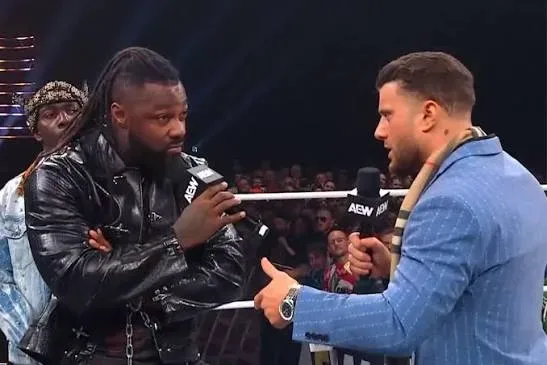
Swerve Strickland has offered a blunt assessment of MJF’s Heatseeker piledriver, naming it as the finishing move he considers the weakest in All Elite Wrestling.
During a rapid-fire interview with Don Chenz, Strickland was asked to identify the “wackest” finisher in AEW. Rather than pausing to weigh the options, the former AEW World Champion immediately singled out MJF’s signature move and tied his criticism to the Heatseeker’s association with Adam Cole.
“MJF. It sucks and it was stolen from Adam Cole. He stole all of his shit.”
View the referenced post on X
The remark is a concise but pointed shot at Friedman, whose use of the Heatseeker has long been connected to Cole’s version of the move. Strickland’s answer was not framed as technical criticism of the piledriver itself so much as a direct accusation that MJF has taken something identified with Cole and made it part of his own presentation.
For more background on this topic, read Austin Creed Says Big E Supported The New Level’s Decision To Join AEW.
In wrestling, a finishing move is more than a maneuver that ends a match. The best-known finishers become part of a performer’s identity, giving audiences an immediate visual cue that a match may be over. That makes questions of ownership, originality, and association especially useful ammunition when one wrestler wants to diminish another. By calling the Heatseeker both ineffective and borrowed, Strickland attacked the move’s credibility and MJF’s individuality at the same time.
Strickland Keeps the Focus on MJF
Strickland has never built his reputation on soft-spoken evaluations of his peers. His response to Don Chenz fit a persona that has consistently projected confidence, competitiveness, and a willingness to turn any opening into a verbal advantage. The question called for a quick answer, and Strickland delivered one that was likely to create conversation because it targeted one of AEW’s most recognizable names.
MJF is also a particularly natural target for that kind of criticism. Friedman’s on-screen identity has been built around arrogance and antagonism, and he has routinely presented himself as a wrestler who believes he is above the rest of the locker room. A claim that he “stole all of his shit” cuts against that image by portraying him not as an original, self-made star, but as someone relying on material associated with another wrestler.
The reference to Adam Cole adds another layer to the jab. Cole and MJF have shared a major on-screen history in AEW, making any comparison between their styles, moves, and identities more charged than it would be between two unrelated roster members. Strickland did not expand on the comment or offer examples beyond the Heatseeker, but he made his intended point clear: he sees MJF’s use of the piledriver as derivative of Cole.
That does not necessarily mean the remark signals an imminent program between Strickland and Friedman. Nothing in the exchange confirmed a match, confrontation, or storyline direction involving the two. However, in a promotion where major personalities regularly trade verbal barbs outside the ring as well as in televised promos, the response gives fans another piece of ammunition for any future interaction between the former AEW World Champions.
The Heatseeker at the Center of the Debate
The Heatseeker is one of the moves most closely associated with MJF’s big-match offense. The piledriver is generally presented as a decisive, dangerous attack, and its use helps distinguish the closing stretch of Friedman’s matches. But Strickland’s comments underline a familiar wrestling conversation: a move can be effective in the ring while still being judged by fans and peers through the lens of who made it famous or who is most strongly associated with it.
Adam Cole’s own history with the maneuver makes that debate unavoidable. Strickland’s criticism was specifically aimed at the perception that MJF adopted a move already connected to Cole. In that sense, his answer was less about debating whether a piledriver can finish a match and more about challenging whether the Heatseeker belongs in MJF’s arsenal as a defining element.
Finishing moves frequently evolve as wrestlers move between promotions, alter their characters, or adapt to changing opponents. Variations of classic moves are common throughout professional wrestling. Still, there is a difference between a move being broadly recognizable and a move carrying a particularly strong association with one active performer. Strickland leaned heavily into that distinction in his answer.
The exchange also speaks to the importance of presentation. MJF has used the Heatseeker as a major punctuation point in his matches, while Cole’s association with a similar piledriver remains part of how many viewers assess the move. Strickland’s phrasing turned that overlap into an insult, arguing that the connection weakens MJF’s claim to it rather than enhances it.
MJF Has Been Absent From AEW Television
Friedman’s most recent AEW appearance came on the September 2 edition of AEW Dynamite. During that promo, MJF said he would be getting payback in the near future. The exact form of that promised retaliation, as well as the timetable for his next appearance, has not been established here.
That final televised statement gives Strickland’s comments added timing. MJF has already indicated that he intends to settle a score, and Strickland’s public dismissal adds another insult to the list of remarks that could follow Friedman when he returns to AEW programming. Whether MJF addresses Strickland specifically remains uncertain, but the champion-level history of both men ensures that any direct response would draw attention.
For Strickland, the interview answer requires no elaborate setup to resonate. He named a prominent rival-level figure, rejected one of that wrestler’s signature weapons, and invoked another major AEW name in the process. It is the kind of compact statement that can live independently from an active storyline while still carrying obvious potential for future television.
What a Future Strickland-MJF Collision Could Mean
Both Strickland and MJF have operated at the top of the AEW landscape, and both have established themselves as wrestlers capable of carrying high-pressure promos as well as major matches. That shared stature makes even a brief verbal exchange feel more substantial than a routine roster critique.
Strickland’s comments also create a simple foundation for escalation if the two ever cross paths. MJF could reject the idea that the Heatseeker is borrowed, argue that results are what matter, or direct the discussion back at Strickland’s own in-ring identity. Strickland, meanwhile, has already placed his position on the record: he does not view the Heatseeker as impressive, and he believes MJF’s use of it is inseparable from Adam Cole.
No additional details were offered regarding a possible match between the two men, so it would be premature to treat the interview as confirmation of AEW plans. For now, it stands as an unfiltered opinion from Strickland, delivered in a format designed to produce a fast and memorable answer.
Still, the line is likely to linger because it touches on three names with significant AEW history. Strickland made MJF the immediate target, used Cole as the basis for the criticism, and centered the entire exchange on a move that has become an important part of Friedman’s match-ending repertoire.
Whether MJF chooses to answer remains to be seen. What is clear is that Strickland was given an opportunity to name AEW’s least impressive finisher and chose not to hedge. He went straight for MJF, declared the Heatseeker a poor move, and accused Friedman of taking from Adam Cole in the process.
Darryl Polo
Darryl Polo is a passionate wrestling fan covering WWE, AEW, TNA and beyond. He loves great rivalries, breakout stars and the moments that keep fans talking long after the bell. How we work.