
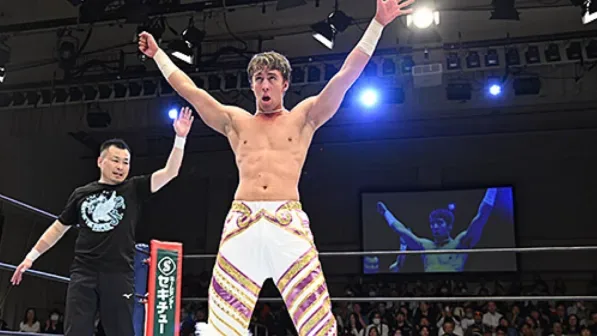
Nick Wayne’s AEW character has continued to take on a more distinct personality in recent weeks, with the young wrestler incorporating the cadence, slang, and self-assured attitude associated with modern livestream culture. Wayne has now explained that the direction was not the result of an elaborate pre-planned pitch. Instead, it began with a simple realization while he was filming material in Miami.
Wayne discussed the evolution of his presentation during an interview with Joey Karni, explaining that he was working on a vignette when the visual setting gave him an idea. The combination of a camera crew, a nighttime Miami backdrop, a bright production light, and his own wardrobe made him feel as though he was filming the kind of content associated with prominent streamers.
“The bragging rights about beating Chris Jericho is like a big staple of mine. But as far as like the streamer-esque kind of younger lingo terms, I was just filming in Miami one time and they were just recording and I was just walking and talking and I was like, I feel like a streamer right now,” Wayne said.
Wayne elaborated that the visual of walking through Miami late at night while dressed in a suit and followed by a camera crew naturally suggested a different way for him to speak on television. Rather than forcing the concept, he began experimenting with younger slang and streamer-style phrasing to see whether it fit the character. It did, and the idea became a recurring part of his presentation.
For more background on this topic, read Jamie Hayter Confirms She Is Not Injured Following AEW Full Gear Absence.
“Like I just have like a camera crew and walking in Miami and it’s like late at night, one bright light like just on me. I was in like a suit. I was like, I feel like a streamer right now. So I was like, maybe I just like drop some like terms and just like, you know. You know, see what’s up, and it just stuck, you know what I mean? So, yeah, now we’re here. Now we’re here.”
A Character Moving Beyond One Major Accomplishment
Wayne’s victories over Chris Jericho remain an essential piece of his AEW identity. Beating Jericho twice gives Wayne an accomplishment he can repeatedly invoke, particularly for a performer still early in his career and looking to establish himself among AEW’s deeper roster. In wrestling, a victory over a decorated name can define a character’s credibility for years, and Wayne has understandably treated those wins as valuable bragging rights.
At the same time, Wayne’s comments show an awareness that a major result alone is not necessarily enough to sustain a television character. A wrestler needs recognizable traits, a consistent voice, and a perspective that gives audiences an immediate sense of who that person is whenever they appear. The streamer influence has given Wayne an additional layer beyond simply reminding viewers of what he has accomplished in the ring.
The approach also fits the wider reality of a wrestling audience that spends significant time online. Livestreaming is a familiar form of entertainment for many viewers, and the style has its own recognizable language: direct-to-camera confidence, quick reactions, casual flexing, and the sense that the performer is broadcasting their life in real time. Wayne has drawn from that energy without needing to turn the concept into a literal streaming program.
His description of the moment in Miami is notable because it centers on atmosphere rather than a detailed creative blueprint. He saw the production setup, understood the tone it created, and connected it to a modern pop-culture archetype. That kind of instinct can be especially useful for a wrestler seeking to make short promos and vignettes feel more natural. Rather than delivering lines in a generic wrestling cadence, Wayne can approach the camera with a presentation rooted in something recognizable to him.
The Miami Setting Helped Shape the Tone
Miami has long been a setting that lends itself to high-gloss wrestling visuals. Its nightlife, architecture, bright lights, and luxury-minded image can instantly create a sense of confidence and excess on camera. For Wayne, the location apparently offered the right environment to experiment with a more current and image-conscious persona.
The detail that he was wearing a suit also matters to the overall picture. Wayne was not describing a casual video-game stream or an ordinary social-media clip. He was walking through Miami dressed for a polished wrestling vignette, but the camera arrangement still made him feel like a streamer. That blend has helped create a presentation that can feel both elevated and contemporary: Wayne is projecting status while using a looser, younger form of communication.
AEW vignettes have often served as a useful stage for wrestlers to refine aspects of their characters away from the immediate pace of a live match. A backstage interview or in-ring confrontation has limited time to establish personality. A cinematic or location-based segment can provide more room to test wardrobe, tone, body language, and speech patterns. Wayne’s account indicates that the streamer element emerged precisely through that process of filming and observing what felt appropriate in the moment.
That organic development may be important as the character continues to evolve. Audiences can usually tell when a performer is comfortable with the way they talk and present themselves. Wayne did not say that he was handed a rigid streamer role to perform. His explanation instead suggests that he found an element that felt natural during production, experimented with it, and saw the idea gain traction.
Wayne Continues to Build His Own Voice
Wayne’s development is especially significant given the prominent names around him in AEW. Working in an environment that includes established stars and wrestling legends presents enormous opportunities, but it also creates pressure for younger talent to avoid being defined solely by their associations. Wayne’s wins over Jericho are central to his story, yet his current character work is aimed at ensuring there is more to his identity than a pair of notable victories.
He has also spoken in the same interview about what it has been like to work with major figures including Christian Cage and Jericho. Those experiences place Wayne close to performers with decades of television knowledge, promo experience, and character work. Still, the Miami anecdote demonstrates that developing a persona also requires individual instincts. A wrestler can learn from veterans while still finding a voice shaped by their own generation and interests.
The streamer-inspired language gives Wayne a way to emphasize youth without making youth itself the entire gimmick. He can present himself as a confident wrestler who understands current culture, speaks in a way that separates him from older stars, and uses his record against Jericho as proof that the confidence is not empty. That is a useful combination for a rising talent: a recognizable style supported by a tangible achievement.
There is also room for the character to keep changing. Wayne did not portray the streamer influence as a finished formula. He said he decided to try dropping certain terms and see how they landed, before the idea ultimately stuck. That suggests a presentation still open to refinement as he receives more television time and finds new ways to connect his verbal style to rivalries, matches, and larger storylines.
An Example of Vignettes Creating Opportunity
Wayne’s explanation is a reminder that some of wrestling’s most effective character details begin with small creative observations. Not every successful trait needs to arrive through a major storyline reveal. Sometimes the right location, wardrobe, lighting, and camera movement can point a performer toward an idea that makes their act more specific.
For Wayne, the late-night Miami shoot supplied that moment. The setting made him feel like a streamer, and he followed that feeling by introducing language that reflected it. The concept has since become part of the way audiences see him, while his two victories over Jericho remain the accomplishment at the heart of his on-screen confidence.
As Wayne continues his AEW run, that balance will be worth watching. The Jericho wins give him a powerful foundation, while the streamer-influenced personality gives him a contemporary delivery system for talking about them. Together, they offer a clearer picture of a young wrestler trying to establish an identity that is both credible in the ring and memorable whenever the camera turns toward him.

Darryl Polo
Darryl Polo is a passionate wrestling fan covering WWE, AEW, TNA and beyond. He loves great rivalries, breakout stars and the moments that keep fans talking long after the bell. How we work.