
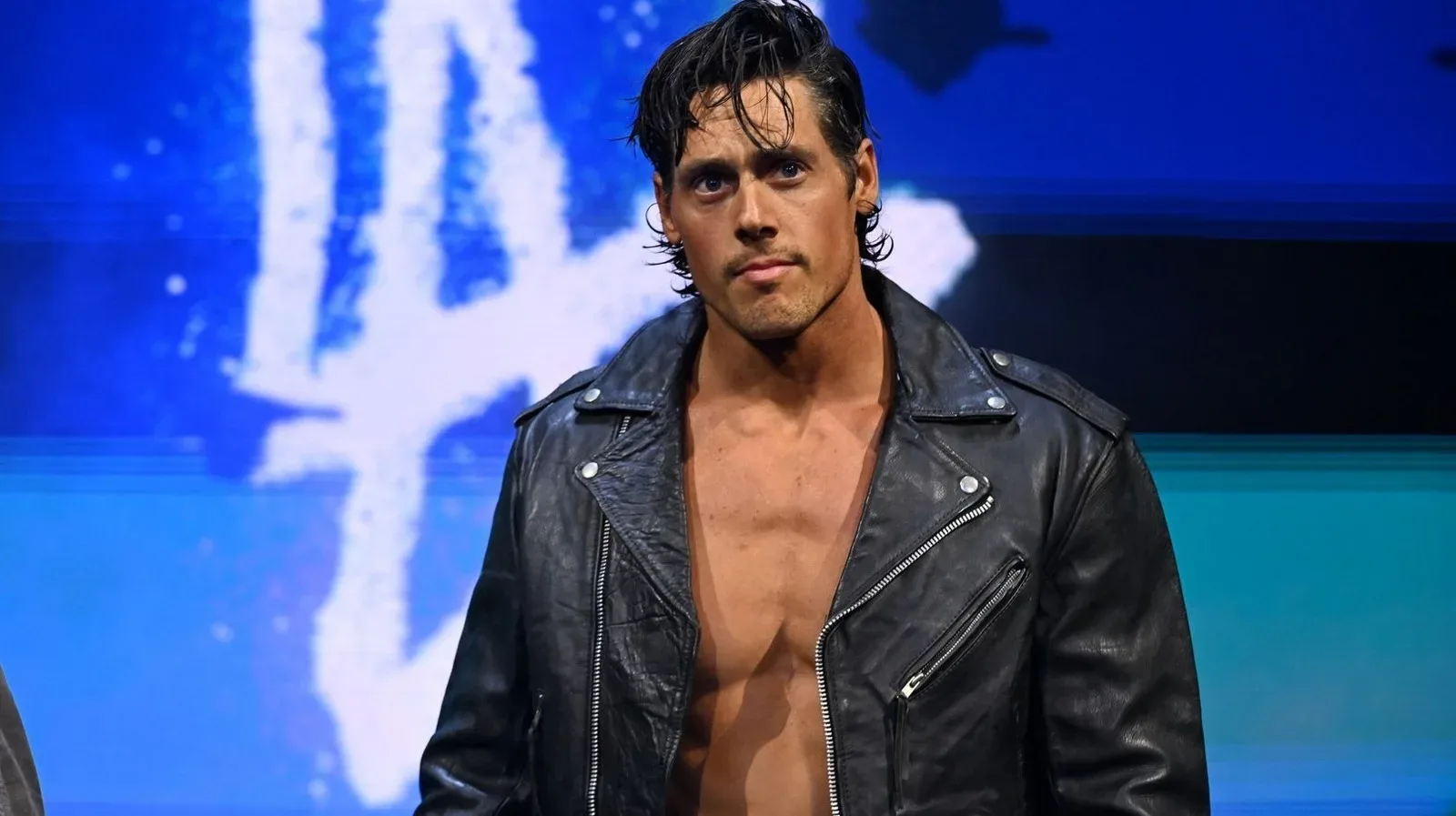
Steven Borden has reflected on the frightening incident that halted his AEW pay-per-view debut at All Out, describing why he felt compelled to return to the ring in the demanding environment of Blood & Guts rather than take a more gradual route back.
Borden teamed with Darby Allin at All Out against Kevin Knight and Kyle Fletcher in a tag match with significant implications: the winning team would ultimately earn a shot at the AEW tag team titles. The bout was cut short after Borden and Knight collided while airborne. Medical personnel, including Doc Sampson, checked on Borden in the ring before the match was stopped.
The concern immediately extended beyond the arena. Tony Schiavone later said Borden had been taken to a local hospital, while it was reported that he was stretchered out following the incident. During the post-show media scrum, AEW President Tony Khan said Borden was awake and that his tests, including a CT scan, had come back positive.
That update brought relief after an unsettling end to a major career moment for Borden. His first AEW match on pay-per-view had been positioned as an opportunity to compete alongside Allin in a contest that could have quickly moved the pair into the tag title picture. Instead, attention shifted entirely to Borden's condition and the decision to call the match before it could continue.
For more background on this topic, read Kyle Fletcher Says Acting Appeals to Him, But Wrestling Remains His Priority.
Borden Describes A Physically Unusual Situation
Speaking with Going Ringside, Borden addressed how he viewed what happened at All Out. He acknowledged the seriousness of an injury involving the head, even as he explained that he did not experience the kind of physical pain that might have accompanied an injury to his neck or back.
“I guess it would be called an injury. Obviously the brain is pretty important. But physically it’s a weird one because the moment I woke up, I felt okay. You know, I didn’t hurt my back or my neck. So I feel fine. And I think for me, you don’t want to run from difficult things or pressure.”
The remarks, made to Going Ringside, underline the distinction Borden drew between feeling physically capable and recognizing that the situation required appropriate concern. The stoppage at All Out was not treated as something to ignore simply because Borden did not believe he had suffered pain in other areas of his body. AEW’s in-ring medical response, the hospital visit and the subsequent testing all reflected the seriousness with which the episode was handled.
For Borden, however, the aftermath also presented a mental test. A difficult in-ring experience can create hesitation for any wrestler, particularly when it occurs in a match that ends abruptly and requires medical attention. His comments make clear that he did not want the incident to become something he avoided or allowed to define his next step in AEW.
Back For A Blood & Guts Challenge
Borden returned last month and challenged the Don Callis Family to a Blood & Guts match, immediately placing himself back into one of AEW’s most physically and psychologically taxing match settings. The choice stood in sharp contrast to the idea of quietly re-entering competition in a low-pressure situation.
Blood & Guts is built around escalating danger, team warfare and confinement inside a cage structure. It is not a match format associated with caution or a tentative approach. By returning in connection with that challenge, Borden signaled that he was prepared to meet the pressure of wrestling again directly.
Allin supported that mindset when discussing Borden’s return. In Allin’s view, a wrestler coming back from an injury should not approach the ring with excessive hesitation. Instead, he suggested that there is value in committing fully to the comeback, which is what he saw Borden doing in connection with Blood & Guts.
That perspective is especially notable given Allin’s proximity to the situation. He was Borden’s tag team partner at All Out, was in the match when it was called off and has since been part of Borden’s return to the conflict with the Don Callis Family. Allin was not offering a detached observation; he had seen the incident unfold firsthand and then watched Borden choose to step back into AEW’s high-intensity environment.
Confronting The Pressure Of Returning
Borden compared the mental hurdle of getting back into the ring to struggling through public speaking. In that comparison, the way to overcome a bad experience is not to avoid the setting forever, but to get back in front of people and do it again. It is a simple analogy, but one that explains why he did not view a major match like Blood & Guts as an inappropriate place to resume his AEW story.
There is an important balance in that approach. Returning with confidence does not erase the need for medical evaluation or make the All Out incident less serious. Borden’s own comments recognized the importance of the brain and the significance of what occurred. But confidence and careful medical oversight are not mutually exclusive. His comments instead focused on the personal challenge that follows once a wrestler has been cleared to continue.
The All Out sequence was a reminder of how quickly a wrestling match can change. Borden and Knight were attempting an aerial exchange when the collision occurred, and the bout was stopped before its planned result could be reached. In a business where performers routinely push through difficult conditions, the visible intervention of medical personnel and the decision to end the match made the moment stand out.
AEW subsequently provided encouraging information through Khan’s comments at the media scrum. Borden being awake and receiving good test and CT scan results was the key news after the show. Those details did not change the fact that the match had ended in alarming fashion, but they offered reassurance at a point when there were understandable questions about Borden’s status.
What The Return Says About Borden
Borden’s decision to challenge the Don Callis Family did more than place him in a major AEW match environment. It also framed his return around an active choice to move forward. Rather than allow the All Out stoppage to leave his role undefined, he reappeared with a clear target and a willingness to enter a confrontation with substantial stakes.
The Don Callis Family has provided a formidable opposing side for that statement. Challenging the group to Blood & Guts immediately raises the scale of the rivalry and puts Borden in a match built on teamwork, endurance and nerve. The circumstances are different from the tag match at All Out, but the emotional point of the return is clear: Borden did not want to retreat from a difficult moment.
His public-speaking comparison also speaks to a broader reality for wrestlers. The physical component of a comeback is only part of the equation. Returning after a scary incident means managing memories of the moment, the expectations of an audience and the natural uncertainty that comes with performing again. Borden’s answer was not to pretend those pressures did not exist. It was to face them.
That does not mean Blood & Guts becomes a test of recklessness. The match will remain a major challenge because of its format and because of the opposition involved. But Borden’s explanation suggests that he sees the challenge as a necessary part of rebuilding momentum. In his view, running from pressure would only allow the All Out experience to carry more weight than it should over his future.
A Major Moment After An Abrupt Debut
The circumstances surrounding Borden’s AEW pay-per-view debut ensure that All Out will remain a notable chapter in his early run. The match with Allin against Knight and Fletcher had title-shot implications, yet it will be remembered for the collision, the medical stoppage and the concern that followed. There was no conventional finish to analyze and no completed path toward the tag title opportunity. The priority became Borden’s well-being.
His return changed the conversation. Rather than leaving his next move in doubt, Borden made an immediate statement by challenging the Don Callis Family. With Allin emphasizing the importance of going full force rather than tiptoeing back, the two have presented a unified view of what this comeback should look like.
Borden’s account does not minimize the incident at All Out. It acknowledges that an issue involving the brain is serious while also explaining why, from his own physical perspective, he felt ready to confront the pressure of competing again. The move toward Blood & Guts turns that outlook into action.
For Borden, the next chapter is therefore not simply about being back in AEW. It is about proving to himself that a frightening interruption does not have to become an obstacle he cannot move past. After an All Out debut that ended far differently than planned, he has chosen one of the most intense settings available to continue that process.
In pictures

Darryl Polo
Darryl Polo is a passionate wrestling fan covering WWE, AEW, TNA and beyond. He loves great rivalries, breakout stars and the moments that keep fans talking long after the bell. How we work.