
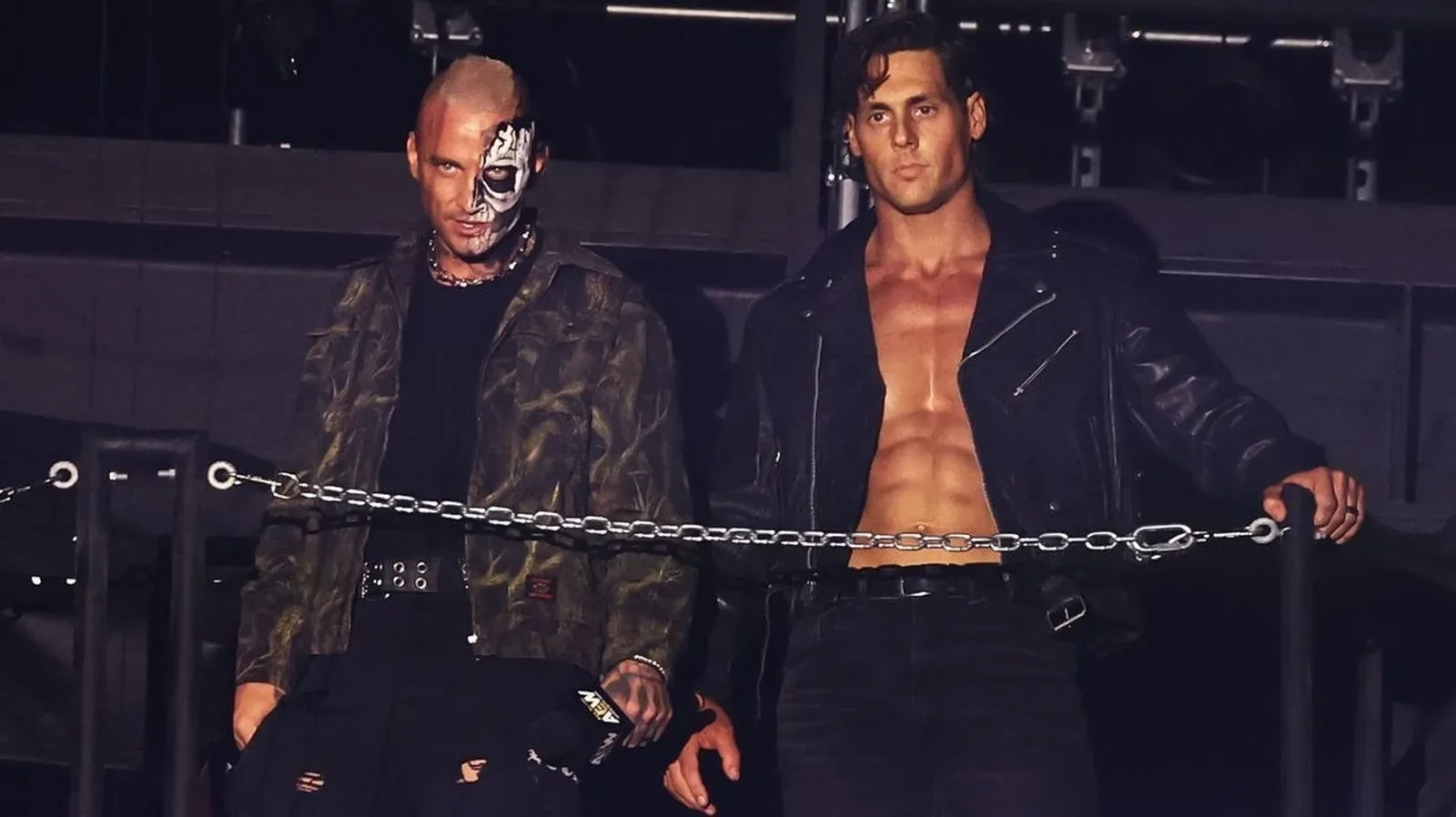
Steven Borden’s path into professional wrestling was not built on an immediate decision to follow his father Sting into the industry. Instead, Borden spent years away from wrestling while establishing himself in another field. By the time he felt drawn toward the ring, he was managing a rapidly growing sports technology company and facing what he described as a particularly difficult moment to change course.
That did not stop him from doing exactly that.
Speaking on AEW Close-Up, Borden opened up about leaving behind his professional life in sports technology in order to pursue wrestling full-time. The decision came after he tried to carry both responsibilities at once, balancing long work weeks with the training needed to develop as a wrestler. Ultimately, he concluded that splitting his attention would keep him from reaching the level he wanted in either pursuit.
“I was managing a sports technology company for quite a while and we were growing pretty quickly, and I didn't, again, run from wrestling for so long,” Borden said on AEW Close-Up. “So obviously I didn't plan on feeling the pull in, but when I was pulled into it, it was probably maybe the worst time if you just objectively look at my life.”
For more background on this topic, read Brian Cage Recalls Landing Steven Spielberg’s ‘Disclosure Day’ Wrestling Role.
Borden’s comments underline how significant the choice was. He was not stepping away from an unsuccessful situation or looking for a new direction after a career setback. His company was approaching what he believed could be an important stage of growth. Yet the pull toward wrestling became strong enough that he could no longer treat it as a side pursuit.
For a wrestler at the start of his career, the realities of training are demanding even without another full-time role. Ring training, physical conditioning, travel, recovery, character development, and the process of learning how to work in front of live crowds all require sustained attention. Borden found that his existing workload left little room for that commitment.
“We were sort of like on the precipice of good things happening with the company, I couldn't do both, and something that Darby and I talked about actually on the way to Blood and Guts in Greensboro, I was telling him this is killing me,” Borden said. “It's like 80 to 90 hours a week of work, trying to train, and I just realized that I couldn't be good at both.”
The conversation with Darby Allin was especially relevant given Allin’s role in Borden’s transition into AEW. Borden initially made his wrestling debut in October 2025, and within roughly a year he had reached AEW’s main roster with Allin’s help. The association put Borden in a major spotlight early in his development, while also connecting his own emerging identity to one of AEW’s most distinctive performers.
Allin has long been known for an all-in approach to his craft, making him a natural person for Borden to speak with as he weighed the difficulty of his schedule. Borden did not present the choice as a simple or painless one. The sports technology company represented years of effort and a future that appeared promising. Wrestling, however, was the direction he ultimately wanted to pursue.
“Wrestling was what I wanted to do and kind of just walked away from all of that, and I'm glad I did,” Borden said.
That final assessment is notable because Borden’s first year in wrestling has not been without adversity. A move to a major company’s main roster can bring enormous visibility, but it also comes with the physical risks inherent to the profession. Borden experienced that reality at AEW All Out 2026, when he suffered a serious concussion during a tag team match alongside Allin against Kyle Fletcher and Kevin Knight.
The bout was stopped because of the injury. In an industry where performers often pride themselves on toughness, the stoppage served as a serious reminder that health has to take priority when a concussion is involved. Borden has since made a full recovery and is said to be doing very well, though there is currently no confirmed word on when he will return to the ring.
A Career Choice With Personal and Professional Stakes
For Borden, wrestling carries an unavoidable family connection. Sting’s career made him one of the best-known figures in modern professional wrestling, with decades of accomplishments across multiple eras of the industry. That legacy gives Steven Borden immediate name recognition, but it also creates expectations that few newcomers have to confront.
His account on AEW Close-Up makes clear that he did not rush into trying to capitalize on that connection. He specifically noted that he had stayed away from wrestling for a long period before feeling called to it. His eventual arrival was therefore the result of a personal decision made after building another career, rather than a straightforward continuation of a family business.
That distinction matters as Borden continues to establish himself. Being Sting’s son will remain part of the public conversation around him, particularly within AEW, where Sting’s final run and retirement were emotionally significant moments for the company and for Allin. But Borden’s ability to build a sustainable wrestling future will depend on his own development, his health, and the experience he gains once he is cleared to resume performing.
His willingness to leave a demanding leadership position also illustrates the level of investment behind his decision. Borden was not merely attempting a few training sessions while keeping his established work life intact. He recognized that his 80- to 90-hour work weeks, combined with wrestling training, were not a formula for success. Rather than continue at a pace he described as overwhelming, he chose one path.
There is no guarantee in professional wrestling, especially for a performer who remains early in his career. A full-time commitment does not eliminate the challenges of learning the business, earning crowd support, avoiding injury, or finding the right role on television. Borden’s concussion at All Out is a particularly stark example of how quickly a wrestler’s momentum can be interrupted.
Still, he has already taken meaningful steps in a short period of time. From his October 2025 debut to joining AEW’s main roster with Allin’s support, Borden has advanced quickly. His recovery following the All Out injury is another necessary step before the next phase of that progression can begin.
What Comes Next for Borden in AEW
The immediate priority remains Borden’s return only when he is ready. No in-ring timetable has been announced, and a careful approach is especially important after a serious concussion. His eventual comeback will offer AEW an opportunity to continue developing a young talent whose background, family history, and relationship with Allin have already made him a subject of considerable interest.
When Borden does return, the central question will be how he turns that interest into a clear identity as a performer. He has the benefit of proximity to experienced names and a high-profile mentor in Allin, but he will still need the match repetitions and confidence that come only with time. His first year has brought both an unusually fast rise and an unwelcome health setback.
For now, Borden’s own words provide the clearest measure of where he stands. He walked away from a growing company and a career that demanded nearly all of his time because wrestling was the pursuit he could not ignore. The decision carried risk, but after making it, he says he is glad he did.
That conviction will be important as he works toward his next AEW appearance. Borden has already chosen wrestling over the security of the life he previously built. His task once he returns will be to keep building a career that is distinctly his own.
In pictures

Darryl Polo
Darryl Polo is a passionate wrestling fan covering WWE, AEW, TNA and beyond. He loves great rivalries, breakout stars and the moments that keep fans talking long after the bell. How we work.