
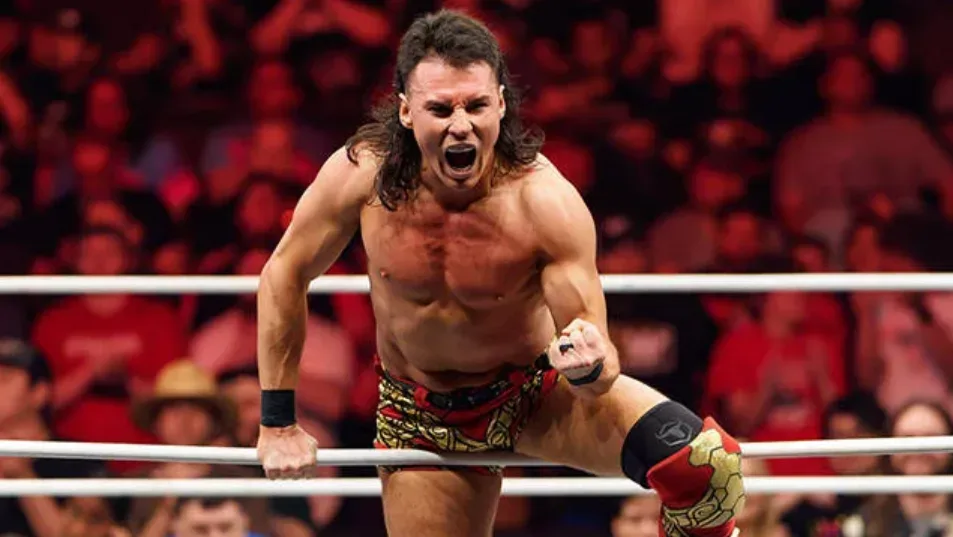
Speedball Mike Bailey has made it clear that superstition has no place in their approach to professional wrestling.
Speaking about the demands of preparing for a career that runs throughout the calendar year, Bailey explained that they do not rely on traditions, pre-match rituals, lucky items, or other superstitious habits. Instead, the AEW wrestler pointed to a foundation built over nearly two decades, as well as the ongoing work required to preserve their body while performing at a high level.
For Bailey, the reality of wrestling is rooted in repetition, conditioning, experience, and the ability to remain physically functional despite the unusually demanding schedule that comes with the profession. It is an outlook that reflects both the long road they traveled before arriving in AEW and the confidence they have in the preparation that brought them there.
“So the difficult part about pro wrestling is being able to do it year-round, right? We have no off-season. We do Dynamite on Wednesday, Collision on Saturday, and it never stops. So part of being a good professional wrestler is keeping your body intact while putting it through the hardest thing imaginable.”
For more background on this topic, read Kyle O’Reilly Calls Jon Moxley AEW’s Locker Room Leader.
Wrestling’s Year-Round Physical Challenge
Bailey’s comments underline one of the central realities of modern professional wrestling: there is little room for an extended reset. A wrestler can be required to train, travel, appear on television, wrestle, recover, and begin the process again almost immediately. For an AEW performer appearing within a weekly television environment, the work is not framed by a traditional offseason in which the body can be fully removed from competition.
That places a premium on consistency. The preparation cannot simply begin on the day of a match, and recovery cannot be treated as an afterthought once a bell rings. Bailey described body maintenance as an essential element of being successful in the ring, particularly because the sport asks performers to work through a level of physical punishment that is difficult to replicate elsewhere.
The distinction matters when considering Bailey’s answer about superstition. Rather than viewing a match-day action as something that could alter the outcome of a performance, they see their results as the product of the many years already invested in the craft. The decisive work, in Bailey’s view, has been done over time: developing skills, gaining experience, traveling, learning how to handle the demands of the profession, and preparing the body for repeated competition.
Professional wrestling has long had room for personal routines. Some wrestlers have spoken publicly about rituals that help them focus or settle nerves before a match. Others carry habits through an entire career because they associate those habits with confidence or success. Bailey does not dismiss the intensity of match preparation, but their own process is not tied to that kind of belief.
“I’m a Complete Skeptic”
When asked directly whether there are superstitions or traditions involved in their preparation for wrestling, Bailey gave an emphatic answer.
“Absolutely not. I’m a complete skeptic. I have no, like, traditions or superstitions. I believe that, again, I have traveled the entire world. It took me 19 years to make it to AEW, and now I’m here because I’m one of the best wrestlers in the world. So there’s nothing that I do during the day that can affect my performance at this point. I have 20 years of preparation.”
It is a statement driven by self-belief, but it is also specific about where that belief comes from. Bailey did not present their AEW position as the result of chance. They connected it to global travel, extensive experience, and a career-long process of development.
Bailey’s reference to taking 19 years to reach AEW is particularly revealing. The line frames their current position as the culmination of a long pursuit rather than an overnight breakthrough. By the time they reached this stage of their career, Bailey believes the important preparation had already taken place across years of matches and accumulated knowledge.
That does not mean preparation is over. Their earlier remarks about keeping the body intact make clear that the work remains ongoing. The difference is that Bailey does not see a particular action during the day as capable of changing what they can do between the ropes. The confidence comes from a much broader base: 20 years of preparation and the experience of wrestling around the world.
Confidence Built on Experience
There is a practical quality to Bailey’s perspective. A wrestler may have a routine that brings comfort, but Bailey’s answer suggests that comfort alone cannot substitute for the physical and technical work required to succeed. In a profession defined by live performance, timing, conditioning, athletic execution, and the need to adapt in real time, there is little substitute for being ready.
Bailey’s wording also puts the spotlight on the scale of the profession’s demands. Wrestling performance is not merely about having a single strong night. It is about being able to produce under difficult conditions, repeat that performance, and then recover well enough to do it again. The lack of an offseason is therefore not just a scheduling issue. It affects training choices, recovery priorities, and the discipline needed to stay capable across an entire year.
For Bailey, being a professional wrestler means managing the contradiction at the heart of the job: protecting the body while also putting it through punishing physical work. That balancing act is not glamorous, but it is vital. It also helps explain why their answer is so dismissive of ideas based on luck. The tools that matter are the ones developed over years and maintained through a sustained commitment to the profession.
Bailey’s response should not be read as saying that preparation itself is unimportant. In fact, it argues the opposite. Their stance is that preparation is enormously important, but its value is found in the full body of work that precedes a match rather than in a ceremonial act immediately before it. The training, travel, ring time, conditioning, and ability to endure a continuous schedule are what shape performance.
An AEW Career Defined by Forward Momentum
Bailey’s comments arrive as they continue looking ahead in AEW. In a recent vlog, Bailey discussed moving closer to winning singles gold in the promotion. That ambition gives additional context to the confidence expressed in the interview. Bailey sees themself as a wrestler with the credentials and preparation to compete at the highest level, and a singles championship remains a significant target.
There is no guarantee in wrestling, particularly in a promotion where opportunities can be shaped by competition, momentum, and the demands of weekly programming. Still, Bailey’s outlook is unmistakably focused on what can be controlled. Rather than looking for an advantage in superstition, they are placing faith in their work and in the ability they have developed over a lengthy career.
That mindset is consistent with the way Bailey described the road to AEW. They did not identify one ritual, one lucky break, or one defining moment as the reason they arrived. They identified time. Nineteen years of pursuing a place in AEW, and 20 years of preparation, are the numbers Bailey emphasized.
It is a useful reminder that the visible part of a wrestler’s career is often only the latest chapter. Television matches and championship pursuits are what audiences see most clearly, but they are supported by the less visible work of staying prepared, preserving physical condition, and continuing to improve without a true seasonal break.
No Lucky Charms, Only Preparation
Bailey’s stance may run against some of wrestling’s colorful traditions, but it is not difficult to understand. In a business where schedules are demanding and bodies are tested constantly, a performer’s most reliable resource is the preparation they can carry with them into every match.
For Speedball Mike Bailey, that preparation is not a matter of a special tradition on the day of a show. It is the result of a career’s worth of work. They are a skeptic, they have no wrestling-related superstitions, and they do not believe a daily ritual can change their performance at this stage.
What Bailey does believe in is the experience earned through travel, the confidence built through years in the ring, and the discipline required to keep going in a profession that, as they put it, never stops. With singles gold in AEW among the goals ahead, Bailey’s message is simple: there is no secret ritual behind the performance. There is only preparation.

Darryl Polo
Darryl Polo is a passionate wrestling fan covering WWE, AEW, TNA and beyond. He loves great rivalries, breakout stars and the moments that keep fans talking long after the bell. How we work.