
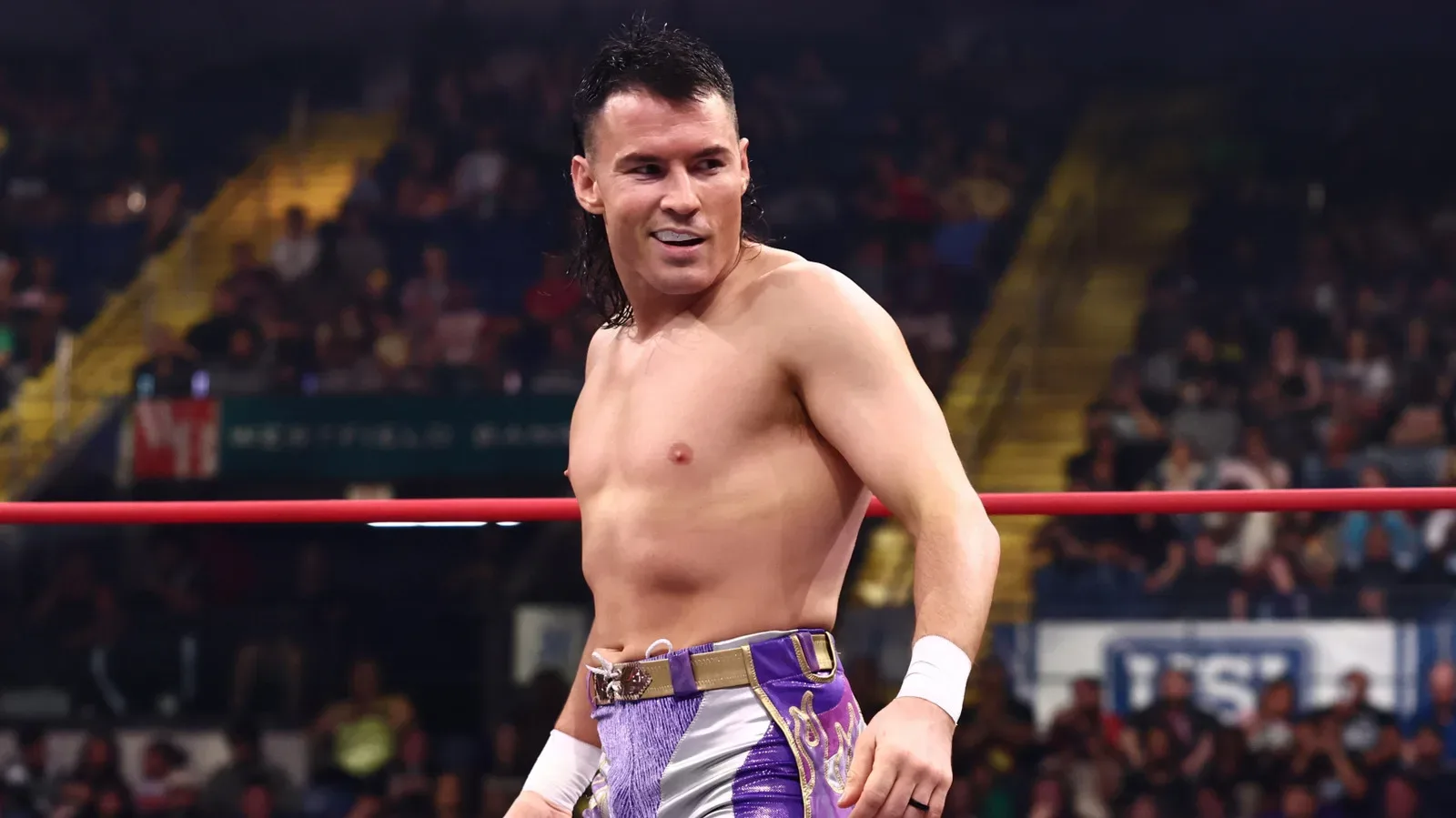
“Speedball” Mike Bailey’s route to becoming one of professional wrestling’s most distinctive high-energy performers was not built on the belief that he naturally matched the image he saw on television. Instead, Bailey says his earliest certainty about wrestling was eventually tested by the realities of growing up, the expectations attached to the industry, and the question of whether there was room for an athlete who did not resemble the conventional stars presented on major programming.
Bailey discussed that personal journey during a fan Q&A on his YouTube channel, reflecting on a dream that started when he was only seven years old. The Canadian wrestler recalled watching wrestling and feeling an immediate connection to it, envisioning himself as part of the business rather than simply an audience member.
“This is what I’m going to do. I’m going to be the world’s most famous pro wrestler,” Bailey said. “I was just watching wrestling on TV at the time and be like, ‘Ah. This is where I belong ... I’m going to be doing exactly that.’”
That confidence did not disappear, but it became more complicated as Bailey got older. As he approached the point of beginning formal training, he began to question whether his goal was attainable. The wrestlers he had grown up seeing on television established a physical standard that did not feel familiar to him, and that realization forced him to look at his ambition from a more practical perspective.
For more background on this topic, read Swerve Strickland Names Tyler, The Creator as His Dream Creative Collaborator.
“As I got older, as I kind of grew into my adult body, and realized I did not look like the people who were wrestling on TV at the time,” Bailey said, “I kinda had to take a good, long look and be like, ‘Yeah, maybe this isn’t super realistic of a career.’”
Finding a Different Vision of What Wrestling Could Be
For Bailey, the independent wrestling scene provided a crucial answer to those doubts. Exposure to promotions and performers outside the biggest television platforms showed him that there was more than one route to success in professional wrestling. He specifically pointed to Ring of Honor as part of the broader independent landscape that introduced him to wrestlers whose careers felt more relatable.
That discovery was particularly meaningful because it did not merely offer Bailey examples of wrestlers with different styles. It showed him performers who had developed professional careers without first fitting the long-established visual mold of the industry. Bailey identified Quebec standouts Kevin Steen and El Generico as two especially important figures in that realization.
Steen, now known worldwide as WWE’s Kevin Owens, and El Generico, now Sami Zayn, became major names through their work across independent wrestling before both eventually reached WWE. Their history included extensive work in Canada and the United States, along with defining runs in Ring of Honor and numerous other independent promotions. For a young Bailey, their success helped demonstrate that individuality, connection with crowds, and the ability to deliver inside the ring could create opportunities.
“[They] did not fit the mold and were making their living as professional wrestlers,” Bailey said. “The way they did their career was very different. They made their livings as independent wrestlers, and they did for many years before they got signed. By the time they did, the wrestling landscape was very, very different.”
The importance of Bailey’s observation goes beyond the individual careers of Owens and Zayn. Wrestling has always contained a wide range of performers, but the visibility of independent wrestling gave aspiring talent more ways to see themselves in the business. Rather than believing success required following one prescribed path, wrestlers could study different markets, promotions, styles, and audiences. Bailey’s eventual career has become a strong example of that same independent-minded approach.
A Career Built Through a Distinctive Style
Bailey has developed into a highly regarded performer by making his differences central to his presentation. His “Speedball” identity is tied to a rapid, striking-heavy style that emphasizes kicks, pace, flexibility, precision, and resilience. That approach has made him stand out across a wide variety of environments, where his matches often balance explosive athleticism with an ability to create a clear emotional struggle against opponents of dramatically different sizes and styles.
His journey has taken him through numerous promotions and scenes, reinforcing the same point he made about the independent wrestling ecosystem. Bailey did not need to become a copy of the performers he watched as a child. Instead, he found success by sharpening the traits that made him different and by proving that his style could connect with audiences in multiple settings.
Among his major accomplishments, Bailey is a former three-time TNA X-Division Champion. The X-Division has long been associated with innovation, speed, athletic risks, and performers whose work does not always fit traditional heavyweight expectations. Bailey’s success in that championship picture was therefore a natural reflection of his strengths, but it also represented another major milestone for a wrestler who once wondered whether his body type would make a wrestling career unrealistic.
Bailey has also established himself in AEW, where he has held the AEW World Trios Championship twice. The trios division places a premium on chemistry, timing, and the ability to keep a match moving while sharing the ring with multiple wrestlers. Those are areas in which Bailey’s quickness and adaptability have made him a valuable presence. His title success in AEW adds another significant chapter to a career defined by making the most of opportunities across different wrestling environments.
The Independent Scene’s Lasting Influence
Bailey’s reflections underline why the independent scene remains so influential, even for wrestlers who later reach nationally televised promotions. Independent wrestling functions as both a proving ground and a creative space. It allows wrestlers to develop a voice, work varied opponents, travel between regions, and learn what elements of their act can consistently resonate with fans.
For Bailey, it also served as a source of representation. Seeing Steen and Generico succeed did not mean Bailey expected to repeat their exact careers. Their significance was that they made professional wrestling appear possible in a new way. They had carved out a living while operating outside the narrow set of assumptions Bailey had drawn from television wrestling. Their achievements gave him evidence that the business had room for people who could bring something different to the ring.
That is a meaningful lesson for any performer entering wrestling with doubts about fitting a perceived template. The industry still prizes presentation, physicality, and larger-than-life personas, but its definition of what a successful wrestler can look like has expanded through the work of generations of talent. Fans now encounter wrestling through national television, streaming platforms, social media, independent events, international promotions, and archival footage. That access makes it easier for aspiring wrestlers to discover styles and career models that might have been far less visible in earlier eras.
Bailey’s story also stresses the difference between having a childhood dream and finding a workable professional plan. At seven, he saw wrestling and knew that it was where he wanted to belong. Later, he had to confront uncertainty and reassess what he thought the job required. The independent wrestling he encountered gave him a more complete picture of the industry, one where success could be built over time and where an unconventional performer could make a sustainable career.
From Doubt to a Place on Major Stages
There is an understandable symmetry in Bailey now discussing that journey as an accomplished wrestler. He is no longer simply the young fan watching others and wondering whether he could belong. He is a former three-time X-Division Champion, a two-time AEW World Trios Champion, and a recognizable performer whose style has earned appreciation from audiences across the wrestling world.
His career does not erase the concerns he felt before training. Rather, it gives those doubts greater context. Bailey did not describe a straightforward road in which early confidence automatically made the outcome inevitable. He described a moment when he questioned the possibility of the entire pursuit, followed by the discovery of wrestlers who changed his understanding of what was possible.
That makes his comments about Kevin Steen and El Generico particularly notable. Both performers became influential examples for countless wrestlers, but Bailey’s account captures the effect their independent work had before their later mainstream success. In his view, the important lesson was not only that they would eventually be signed. It was that they had already made careers for themselves by doing things differently.
Bailey’s own body of work now carries a similar message. A wrestler does not have to fit every old expectation to make an impact. A unique style can be an advantage rather than a limitation, especially when backed by discipline, versatility, and the willingness to grow through experience. For Bailey, the dream that began in front of a television at seven years old endured because independent wrestling helped him see a route forward.
As his accomplishments in TNA and AEW show, that route has led to championship success. More importantly, it has allowed “Speedball” Mike Bailey to become the kind of wrestler he needed to see when he was deciding whether a career in the ring was truly possible.
In pictures

Darryl Polo
Darryl Polo is a passionate wrestling fan covering WWE, AEW, TNA and beyond. He loves great rivalries, breakout stars and the moments that keep fans talking long after the bell. How we work.