
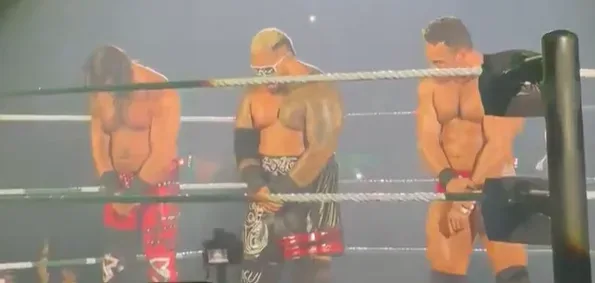
WWE’s tour stop in Chile delivered one of the kinds of scenes that can only truly happen at a live event: a group of top stars dropping the usual rivalries and presentation for a lighthearted tribute in the middle of the ring.
During Saturday night’s WWE live event in Chile, Solo Sikoa was joined by Seth Rollins and LA Knight for a recreation of Too Cool’s iconic dance. With Jey Uso’s entrance music playing in the building, the three performers took the opportunity to play to the crowd with moves closely associated with the beloved WWE trio of Rikishi, Scotty 2 Hotty and Grand Master Sexay.
The moment took on additional significance because of Solo’s family connection. Rikishi, Solo’s father, was a central part of Too Cool’s popularity during WWE’s Attitude Era and into the early 2000s. His pairing with Scotty 2 Hotty and Grand Master Sexay turned a post-match dance routine into one of the company’s most recognizable crowd-pleasing staples. Decades later, the sight of Rikishi’s son joining Rollins and Knight for the dance gave the Chilean crowd an unexpected nod to that history.
View the referenced post on X
Jey Uso then entered the ring, with the group continuing the celebration and joining in on the “Yeet” energy that has become closely tied to Jey’s current WWE persona. It was a celebratory scene rather than a conventional in-ring confrontation, and the fans in attendance received a moment distinctly tailored to the more flexible atmosphere of an untelevised WWE card.
For more background on this topic, read Oba Femi Explains Why Invincible Wrestling Characters Do Not Connect With Him.
A live-event moment built for the crowd
WWE live events have long operated differently from weekly television. While matches and major championship developments can still matter, the performers have greater room to respond to the local audience, extend entrances, work in humor and create interactions that are unlikely to fit within the format of Raw or SmackDown.
That freedom was evident in Chile. Solo Sikoa is generally positioned as an imposing and serious figure on WWE programming, particularly through his connection to The Bloodline story. Seeing him take part in a playful dance segment was therefore a noticeable departure from his usual on-screen presentation. The connection to Rikishi ensured that it did not feel entirely random, even as it showed a lighter side of Solo that fans do not regularly see on television.
Rollins and Knight were fitting partners for the bit. Both have established themselves as performers who can connect with a crowd through personality as much as through their in-ring work. Their willingness to join Solo for the tribute helped turn a quick reference into a full-ring celebration. Once Jey arrived, the moment also became a meeting point between several generations and branches of WWE’s most enduring family lineage.
The segment did not require a storyline explanation. It was simply a chance for the wrestlers to entertain an enthusiastic international crowd and recognize a piece of WWE history in the process. In that respect, it captured one of the principal appeals of touring live events: the possibility that fans will see an unplanned or unusual moment that does not happen the same way anywhere else.
The lasting legacy of Too Cool
Too Cool remains one of the most memorable acts of its era because it combined a simple idea with enormous crowd participation. Scotty 2 Hotty and Grand Master Sexay initially found success as a dancing tag team, but the act reached another level once Rikishi became closely associated with them. Their in-ring celebrations, music and dance routines were routinely among the biggest reactions of the night.
Rikishi brought a major personality change to the group. His entrance into the Too Cool orbit gave the act an added layer of spectacle, while his dance moves became a signature part of the routine. For fans who watched that period, the image of Too Cool celebrating after a victory remains inseparable from the energy of WWE’s late-1990s and early-2000s programming.
That legacy has continued to surface through the careers of Rikishi’s family members. Jey Uso, in particular, has made crowd interaction a major component of his own presentation, with “Yeet” becoming a recurring call-and-response moment at WWE events. Solo has generally taken a different path in character, emphasizing intensity and a more guarded demeanor. Saturday’s dance in Chile briefly brought those contrasting identities together through the shared connection to Rikishi.
For Rollins and Knight, participating in the tribute also demonstrated the respect WWE performers often show toward memorable acts from earlier generations. Neither needed to be part of the Anoa’i family to understand the audience response that a Too Cool reference could generate. The dance is instantly recognizable to long-time viewers, but its easy, energetic nature also makes it accessible to fans who may know the reference primarily through clips, video games or family memories of WWE programming.
Solo Sikoa and Jey Uso share a rare celebratory scene
The involvement of both Solo and Jey was notable given the layered history surrounding their WWE characters. Their family links are central to the broader Bloodline saga, one of the defining narratives in modern WWE. The story has frequently been driven by fractured allegiances, questions of leadership and deeply personal confrontations between relatives.
At a live event, however, those story tensions can be set aside for the sake of a crowd-pleasing moment. The Chilean audience saw Solo embrace a tribute to his father’s legacy before Jey joined the celebration. Rather than presenting another chapter of conflict, the segment offered a brief family-centered connection in front of an international audience.
That distinction is part of what makes non-televised events valuable to dedicated fans. WWE television is designed to advance stories with carefully structured timing, while a live event can allow talent to acknowledge the atmosphere in the building without needing to create a permanent storyline consequence. A dance between Solo, Rollins and Knight may not alter any ongoing rivalries, but it gives attendees a memorable image tied specifically to the Chile show.
Jey’s arrival also provided a natural conclusion. His music was already fueling the moment, and the continued “Yeet” celebration linked the Too Cool tribute to a modern WWE crowd ritual. It blended nostalgia with the present-day audience participation that has helped make Jey one of WWE’s most interactive live-event performers.
Chile crowd receives a memorable WWE tour stop
International live events often produce some of the loudest and most distinctive audience reactions on WWE’s calendar. Fans outside the United States do not always receive the same volume of shows as major domestic markets, making each tour stop a significant occasion. That environment can encourage wrestlers to take extra time with a crowd and find unique ways to make a show feel special.
The Too Cool tribute was one such moment in Chile. It was not built around a championship angle, a major television promo or a storyline reveal. Instead, it was a celebration of WWE’s past, an acknowledgment of Solo Sikoa’s father and an opportunity for Seth Rollins, LA Knight and Jey Uso to share an entertaining exchange with the audience.
Saturday’s card also produced a WWE Women’s World Title change, ensuring the event carried notable consequences beyond the dance segment. But for many fans, the image likely to circulate most widely from the evening will be Solo, Rollins and Knight putting aside their usual personas long enough to honor Too Cool.
It is precisely the sort of spontaneous-feeling memory that has become synonymous with WWE live events. The matches matter, the championships matter and the stars matter, but a night on tour can also be defined by a few minutes of music, dancing and a crowd eager to enjoy something it may never see repeated on television.

Darryl Polo
Darryl Polo is a passionate wrestling fan covering WWE, AEW, TNA and beyond. He loves great rivalries, breakout stars and the moments that keep fans talking long after the bell. How we work.