
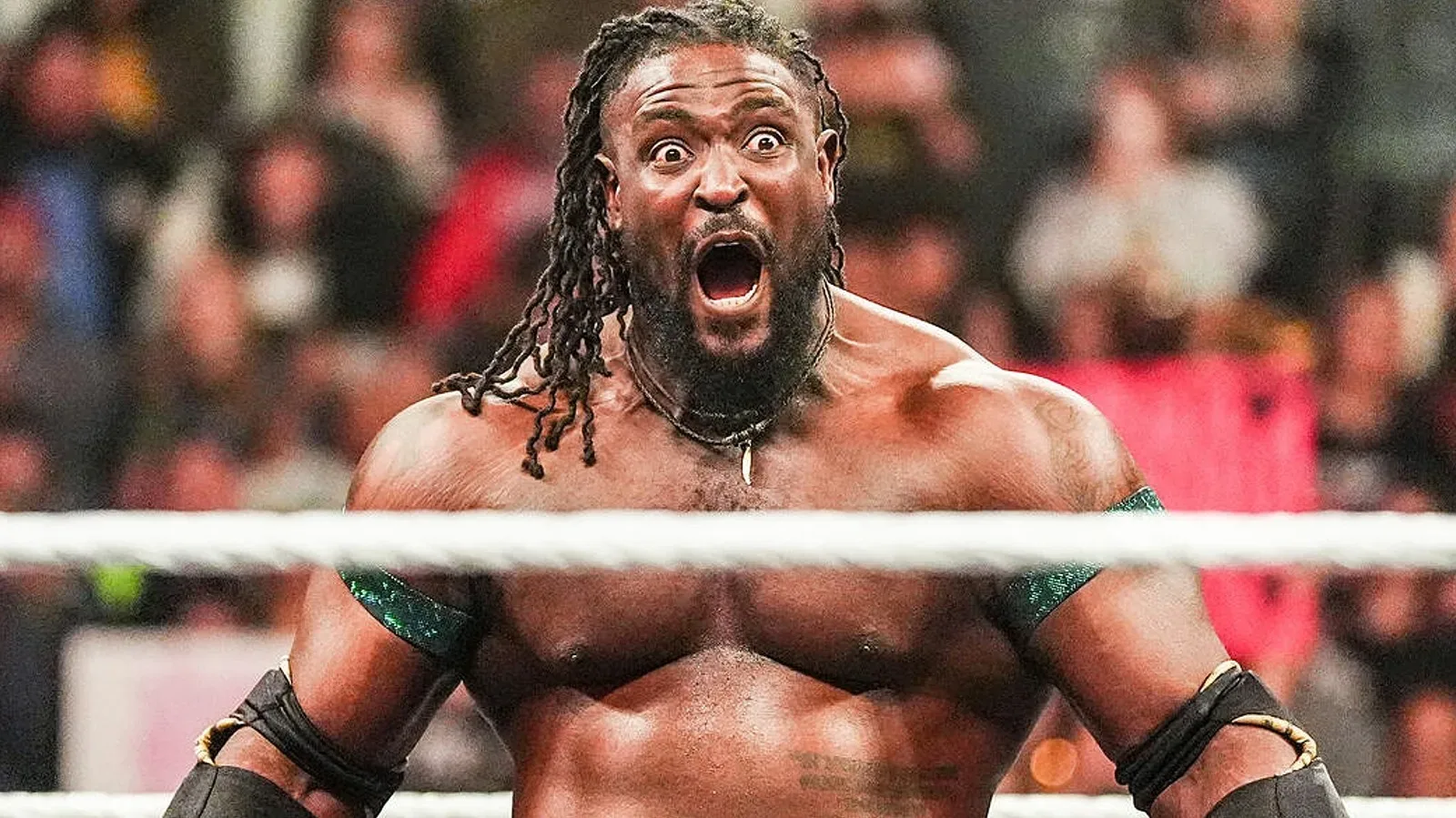
Oba Femi has built his WWE identity around dominance, physicality and the imposing presence of an “African Warlord,” but the powerhouse does not believe that dominance should ever mean a character has no limits.
Speaking about his approach to professional wrestling character work, Femi explained that he has little interest in portraying an untouchable figure who never struggles or reveals any weakness. In his view, the strongest wrestling characters are not those who simply overpower everyone in every situation. They are the ones who can make an audience understand what drives them, what affects them and why their biggest victories matter.
“I think that stems from my disdain of, like, characters who are too strong,” Femi said. “I've never liked them. I think if you are too strong and you have no weaknesses, and you're just all that, then nobody cares.”
That perspective is notable coming from Femi, whose presentation has been centered on extraordinary athletic ability and a powerful, intimidating demeanor. He has overwhelmed a long list of opponents during his WWE run, and his size, explosiveness and confidence have made him one of the company’s most distinctive modern prospects. Yet Femi recognizes that a dominant act still needs adversity to remain compelling.
For more background on this topic, read Omos Builds His Waffle House Scrap Pack Around Lesnar, Lashley, Benjamin And MVP.
Why limitations make a dominant character stronger
Professional wrestling has always relied on the balance between larger-than-life presentation and emotional relatability. A wrestler can be portrayed as a monster, a champion, a prodigy or an almost superhuman athlete, but the audience needs a reason to invest beyond the idea that the performer is impressive. Femi’s point is that perfection can flatten that investment.
If a character is capable of doing anything at any moment and is never meaningfully challenged, then even spectacular accomplishments can lose their impact. There is no tension in waiting to see whether that wrestler can survive, adapt or overcome because the answer feels predetermined. The result may be dominance, but it is not necessarily drama.
Femi described the issue in straightforward terms: when a character performs great feats without difficulty, those feats stop generating the reaction they otherwise could. Wrestling’s biggest moments frequently depend on resistance. A triumph is amplified by the possibility of failure, while a defeat can become meaningful if it reveals something new about a performer.
That does not mean Femi is looking to move away from the aura that has made him successful. His character remains proud, forceful and highly self-assured. Instead, he is emphasizing that confidence and humanity can exist together. A wrestler does not need to be reduced in order to be vulnerable; vulnerability can simply mean allowing the audience to see that stakes, setbacks and emotional moments have consequences.
“I'm not afraid to show personality and be a human being,” Femi said. “Even though you're superhuman, you're still human within all of that. So that's how I think about that.”
Femi’s presentation has room for more than brute force
Femi’s comments offer a useful window into the thought behind his on-screen work. His persona is designed to feel formidable, and his physical tools naturally support that goal. But his character is not meant to be a silent force who merely enters, destroys opponents and leaves. His promos, reactions and interactions are all opportunities to show a different dimension of the performer behind the imposing image.
For a wrestler who is frequently framed as a dominant threat, that approach can be particularly valuable. A character with enormous upside can become repetitive if every storyline follows the same formula. Giving that character room to show pride, frustration, humor, irritation or competitive urgency creates more potential directions for feuds and major matches.
Femi’s WWE record also supports the broader point he is making. He has not been presented as someone with a perfect record, and that matters. Losses, close calls and difficult challenges establish that even a wrestler with exceptional power can be pushed to his limits. Those moments do not necessarily weaken a star. If handled properly, they can provide the foundation for larger victories later.
The most enduring dominant characters have often been those who retained a sense of humanity amid their overwhelming presence. They could appear unbeatable one night while still showing anger after a setback, desperation during a crisis or satisfaction after enduring a hard-fought win. Femi’s stated philosophy fits that model: preserve the extraordinary qualities, but do not remove the emotional reality.
The Bron Breakker impression showed another side of Femi
Femi has already shown that he is willing to incorporate personality into his WWE work in unexpected ways. During a brief promo segment with Bron Breakker, Femi delivered an especially accurate impression of the second-generation standout. The moment allowed Femi to display comedic timing and observation without changing the core seriousness of his own character.
Rather than presenting the impression as something that required extensive study, Femi said it came naturally from working around Breakker in the same locker room. He explained that he was not repeating Breakker’s words verbatim, but that he knows Breakker well enough to understand and reproduce his cadence.
That distinction is important. An effective impression is not only about copying a voice. It requires recognizing the rhythms, energy and mannerisms that make another personality recognizable. Femi’s ability to do that gave the segment an extra layer, while also demonstrating that he has paid close attention to someone positioned as a major rival.
For Femi, moments like that can help keep an intimidating persona from becoming one-note. Humor does not have to undercut a wrestler’s credibility when it is used with the right purpose. In this case, the imitation served as a form of disrespect toward Breakker, allowing Femi to needle an opponent while showing confidence in his own ability to control the verbal exchange.
It also reinforced the idea behind Femi’s comments on character work. The “African Warlord” image may be the centerpiece, but it does not have to define every facial expression, promo or reaction. Showing wit and awareness can make the broader presentation feel more complete.
Femi sees a major difference in motivation
The tension between Femi and Breakker is not just about two high-level athletes seeking the same place at the top of WWE. Femi believes their motivations are fundamentally different.
“I know I'm in that position that he wants, but he wants it for the wrong reasons,” Femi said. “I think he wants it because he thinks it's his birthright.”
That statement frames the rivalry around more than championships or main-event opportunities. Femi is presenting himself as a wrestler who has earned his status through his own development and performance, while viewing Breakker as someone influenced by the expectations attached to his family name and background.
Breakker’s second-generation credentials are undeniably part of his identity, but Femi’s criticism is designed to question the mindset behind them. In wrestling, a feud often gains depth when both sides believe they are fighting for a place that represents something larger than a title. Femi’s view is that the main-event spot should be occupied by the wrestler who understands its responsibility and has truly worked to claim it.
That is also where Femi’s outlook on weakness and humanity becomes relevant. He does not appear to be arguing that a top star must be modest or passive. His own character is clearly driven by ambition and belief in his abilities. The difference, as Femi sees it, is whether that belief is grounded in growth and competition or in an assumption that a certain position is owed.
A character philosophy built for long-term growth
Femi’s comments reveal an awareness that the most important wrestling characters evolve. A powerful introduction can establish a performer quickly, but sustaining momentum requires new layers. Audiences respond when a character has something to protect, something to prove and something to lose.
For Femi, the goal is not to abandon the superhuman qualities that make him stand out. It is to ensure there is a person within the powerhouse. His character can remain physically overwhelming and intensely confident while still reacting to pressure, respecting a difficult challenge or revealing the emotion that comes with a major setback.
That balance may become increasingly important as Femi continues to pursue bigger opportunities in WWE. The higher a wrestler rises, the more difficult it becomes to rely on presence alone. Main-event stories demand conflict that reaches beyond a simple comparison of strength. They require personality, motivation and an emotional hook that gives the audience a reason to care about the outcome.
Femi has made clear that he understands that challenge. He wants his character to feel exceptional, but not empty. He wants the audience to see a larger-than-life athlete, but also someone who can be affected by the same competitive stakes that define wrestling at its best.
In that sense, Femi’s disdain for the completely invincible character is not a rejection of dominance. It is an argument for making dominance mean something. The greatest displays of power land harder when the audience knows there is a real struggle underneath them—and when the wrestler delivering them feels human enough for viewers to take the journey with them.
In pictures

Darryl Polo
Darryl Polo is a passionate wrestling fan covering WWE, AEW, TNA and beyond. He loves great rivalries, breakout stars and the moments that keep fans talking long after the bell. How we work.