
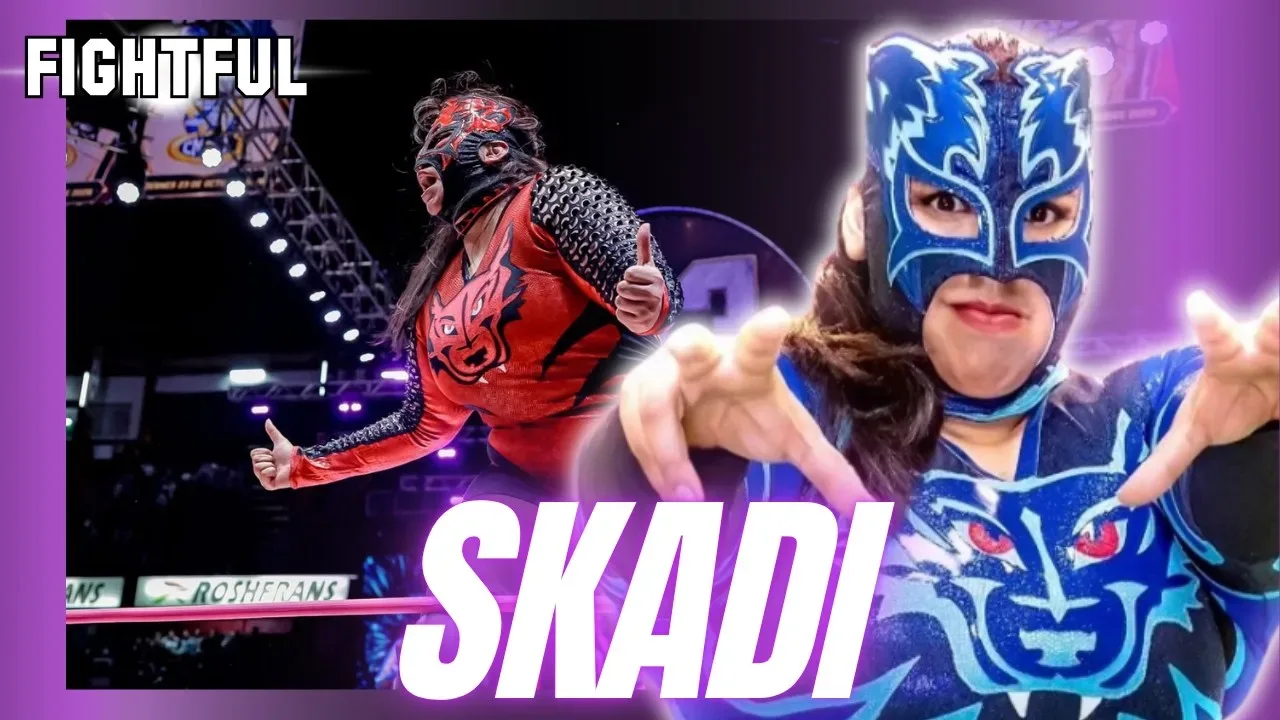
Skadi has spoken candidly about the pressure, pride and personal responsibility that come with being the daughter of Marcela, one of the defining names in the history of women’s wrestling in Consejo Mundial de Lucha Libre.
Marcela’s standing in Mexican wrestling is substantial. During her career, she accumulated numerous championships and established the record for the most CMLL World Women’s Championship reigns with five. Her résumé also included extensive international travel, including trips to Japan, while she worked in an era when women were given far fewer opportunities and far less time to establish themselves on major cards.
For Skadi, that history has created a unique challenge. She is not simply pursuing a career in the same profession as a famous relative. She is attempting to make her own mark while carrying a surname that immediately brings comparisons to a performer widely regarded as one of Mexico’s greatest female wrestlers.
In a recent interview, Skadi acknowledged that following Marcela has been difficult from the very beginning. She explained that she was aware early on of the scale of the expectations attached to her family connection and initially did not want her identity in wrestling to be defined solely by being Marcela’s daughter.
For more background on this topic, read Marina Shafir Added to CMLL Amazonas Grand Prix, Replacing Shotzi on Team World.
“The truth is, it’s been a pretty tough journey,” Skadi said. “I was blessed with a mom who wasn’t like anyone else. I had a mom who is Mexico’s greatest female wrestler, who opened so many doors for us.”
That distinction matters in a profession built around legacy, lineage and reputation. Family connections are a central part of lucha libre culture, but they can bring both visibility and scrutiny. A recognizable name can provide an introduction to audiences, yet it can also leave a wrestler being measured against accomplishments that took an entire career to build.
Skadi said she understood that reality from the outset. Marcela was not merely an established wrestler in the family; she was a record-setting champion whose career had taken her around the world. As a result, Skadi knew that fans and observers could evaluate her through the lens of what her mother had already achieved rather than through her own development.
Comparisons Across Different Generations
Skadi stressed that the ongoing comparisons do not fully account for the differences between her and Marcela. While she has immense respect for her mother’s accomplishments, she believes their careers should not be treated as identical paths. They are different people working in different generations, with different experiences, perspectives and circumstances around them.
“Even today, there are still a lot of comparisons—that I don’t have her career, that I don’t have her experience,” Skadi said. “But we’re different people with totally different careers from different generations.”
It is a reasonable distinction, particularly given the changes women’s wrestling has undergone in CMLL and throughout Mexico. Marcela worked through periods in which women often had to fight for limited space on wrestling cards. Skadi pointed to the contrast between that environment and the current landscape, where women can headline shows and appear in multiple matches on a card.
That progress does not erase the standards associated with Marcela’s name. If anything, it provides a clearer illustration of what earlier wrestlers had to overcome. Skadi credited her mother as an important figure in establishing a path for later generations of women, describing the struggle to convince audiences that women belonged in professional wrestling when opportunities were limited to only a few minutes of action.
For Skadi, the emotional impact of that association has been real. She said the expectations have taken a significant physical and mental toll because there can be a feeling that she is required to become the same kind of wrestler her mother was. Her answer, however, is not to reject Marcela’s legacy. It is to honor it without surrendering her own individuality.
“Suddenly you feel like you have to be them,” Skadi said. “I feel like people demand too much of us to be like them, even though we’re totally different.”
That is a sentiment many second-generation wrestlers can understand, but Skadi’s circumstances carry particular weight due to Marcela’s place in CMLL history. Five CMLL World Women’s Championship reigns is a benchmark that speaks to sustained success rather than a single notable moment. It represents a level of consistency, trust and championship stature that naturally makes any comparison daunting.
Marcela’s Guidance Beyond the Ring
Despite the pressure, Skadi made clear that Marcela has been a source of support rather than an impossible standard imposed at home. She described the freedom her mother gave her to continue pursuing what she loved, while also recognizing the value of the guidance and discipline Marcela provided along the way.
Skadi recalled that her mother was willing to step in when necessary, including telling her when something was not important for her career. Looking back, Skadi said that intervention helped her understand the business and her own path more clearly. It is a reflection of the balance between allowing a younger wrestler to grow independently and offering the kind of perspective that can only come from years spent navigating the profession.
That relationship gives Skadi’s comments a tone of gratitude rather than resentment. She openly addressed the burden of comparisons, but she also emphasized how proud she is that Marcela is her mother. In Skadi’s view, the legacy is not a label to escape. It is an honor that demands care, hard work and respect.
“She’s not just anyone; she’s the wrestler,” Skadi said. “And I feel like I’m doing a good job; I think I’m going to carry on her legacy with great honor.”
Her comments also recognize a broader responsibility. Carrying on a legacy does not necessarily mean duplicating another wrestler’s title totals, travel schedule or in-ring style. It can mean understanding the doors that were opened before her, continuing to work seriously, and helping ensure that the next generation receives opportunities that were more difficult to secure in the past.
A Legacy Still Being Written
Skadi’s reflections arrive at a time when CMLL’s women’s division has continued to receive meaningful visibility. Her comments on Marcela’s era underline how important that visibility is. Main events and cards with more than one women’s match are not simply scheduling decisions; they are signs of a continued evolution that was shaped by wrestlers who worked to prove the division’s value.
Marcela’s record and longevity place her among the foundational figures in that evolution. Skadi’s role is naturally different. She is part of a new generation, dealing with modern expectations while still being connected to one of the most accomplished champions in CMLL women’s history.
Rather than pretending that connection is easy, Skadi has acknowledged its complexity. There is pride in being Marcela’s daughter, but there is also the difficult work of becoming Skadi in her own right. Her remarks show an awareness that the comparisons may never disappear entirely. What she can control is the effort she puts into her career and the respect she brings to the legacy she inherited.
Skadi also discussed a match with Olympia ahead of the finals of the 2026 CMLL Amazonas Universal Championship Tournament during the same interview. That conversation adds another reminder that her focus remains on the present as well as the past. She is continuing to compete, develop and take part in CMLL’s current women’s scene while carrying the lessons of a historic career with her.
For Skadi, Marcela’s legacy is both a challenge and a source of strength. The comparisons are demanding, but so is the standard of excellence that made those comparisons inevitable. Her aim is not to recreate her mother’s career move for move. It is to make Marcela proud while building a path worthy of the name she represents.

Darryl Polo
Darryl Polo is a passionate wrestling fan covering WWE, AEW, TNA and beyond. He loves great rivalries, breakout stars and the moments that keep fans talking long after the bell. How we work.