
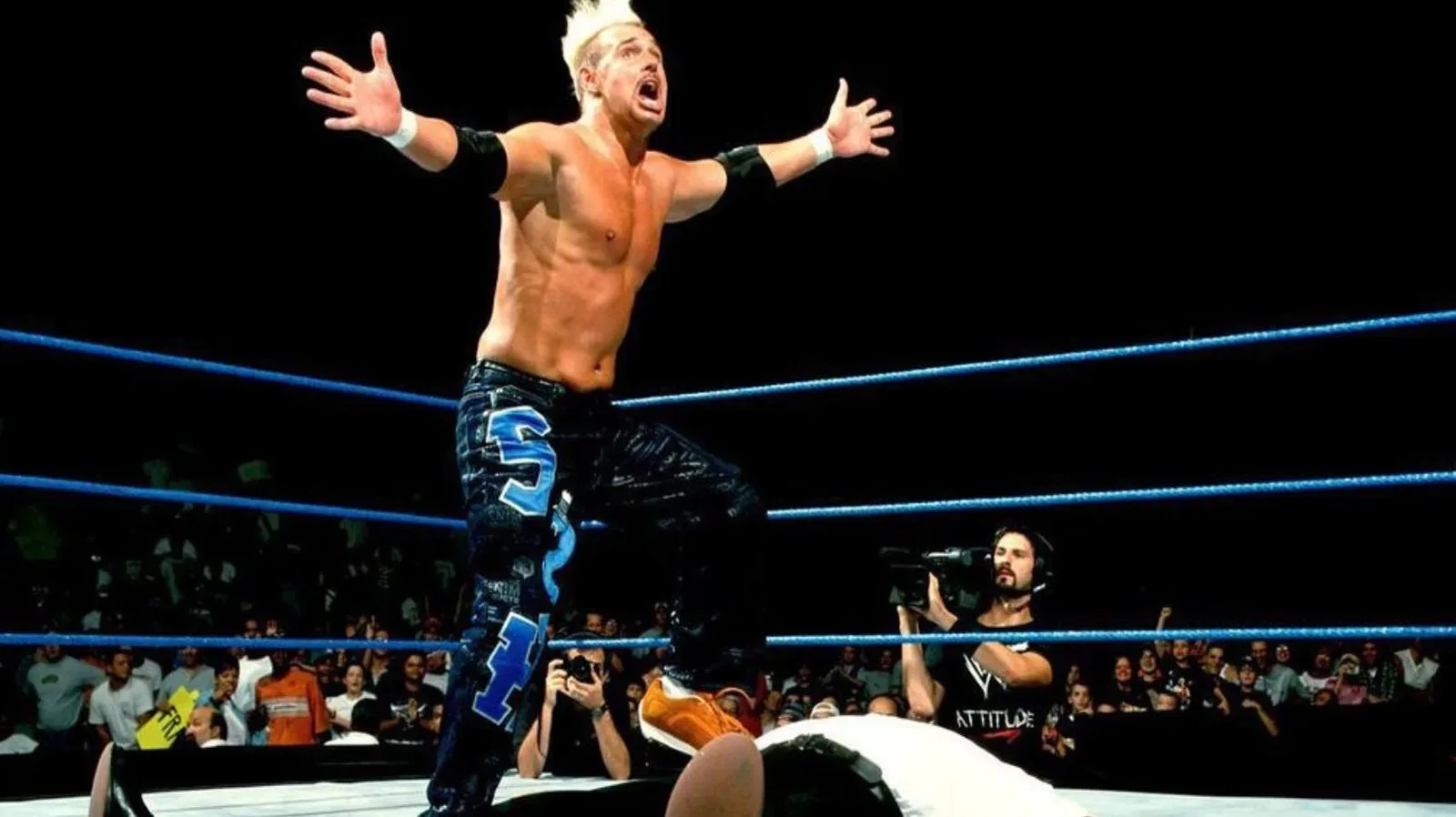
Few moves in WWE history have been as instantly recognizable, audience-driven, or joyfully absurd as The Worm. For Scott Garland, better known to generations of fans as Scotty 2 Hotty, the signature sequence was more than a memorable finishing flourish. It became the centerpiece of one of the most popular acts of the late Attitude Era and a lasting symbol of the connection Too Cool built with WWE crowds.
Garland recently looked back on the unlikely evolution of The Worm during an appearance on Insight with Chris Van Vliet. The former WWE star explained that the move had existed in his life long before it reached a WWE ring. He learned how to perform the motion as a fourth grader, years before anyone could have imagined it would eventually be accompanied by a roaring arena chanting its name.
That origin is part of what makes the story stand out. The Worm was not presented as a carefully designed corporate creation or a move built through an elaborate long-term plan. It was something Garland knew how to do, something he began testing in front of live crowds, and something that gradually found the right place once his character and presentation changed.
From Too Much to Too Cool
Before Too Cool became one of WWE’s most beloved acts, Garland teamed with Brian Lawler, the wrestler known as Grandmaster Sexay, under the name Too Much. The team was an early-stage version of what would later become a far more defined act, with Garland recalling that he started slipping The Worm into his entrance at house shows.
For more background on this topic, read David Finlay Says WWE Was Once Part of His Plan Before 11-Year NJPW Run.
Those non-televised events offered an important opportunity. House shows have long been a place where performers can feel out their connection with an audience, test a small change to a match or entrance, and learn whether a particular mannerism has potential. Garland recognized that fans were responding when he dropped to the mat and performed the dance-like move after getting into the ring.
The response alone did not immediately make it a major WWE staple. The key was finding the proper character framework. When the team shifted into the Too Cool identity, the move suddenly made much more sense. Too Cool was loud, energetic, colorful and built around rhythm, dancing and a sense of fun that separated the act from much of the company’s more confrontational presentation at the time.
Within that setting, The Worm was not simply a random athletic novelty. It became an extension of Scotty 2 Hotty’s persona. He would build momentum by hitting the ropes, dropping down and moving across the ring before adding striking gestures and, eventually, the famous finishing elbow drop. The entire routine gave fans time to anticipate the payoff, participate in the moment and react before the elbow ever landed.
Jerry Lawler Helped Give the Move Its Name
One crucial step in turning The Worm from an entertaining move into a crowd ritual came on an episode of Raw. Garland recalled hearing commentator Jerry Lawler identify the sequence by spelling out “W-O-R-M.” When Garland later listened back to the broadcast, he understood immediately what that call could do for the presentation.
Giving the move a simple name was vital. Wrestling audiences are especially effective at turning a repeated phrase, gesture or sound into part of a performer’s identity. A move can be visually spectacular, but when fans know exactly when it is coming and have a clear chant to attach to it, the reaction can become much bigger than the physical act itself.
Garland asked Lawler to continue using the call in hopes that the audience would pick it up. It did. Within roughly a month, the fans were joining in. That development transformed the sequence from a performer-led spot into a shared experience between Scotty 2 Hotty and the crowd.
That participation was central to The Worm’s enduring appeal. The move was never meant to be judged solely as a conventional high-impact wrestling maneuver. Its power came from anticipation. The crowd knew the routine, knew when to make noise, knew the elbow drop was coming, and eagerly played its role in creating the atmosphere around it.
The Too Cool Formula Connected Across WWE
Too Cool’s rise from 1999 through 2001 was one of the era’s clearest examples of a group developing momentum through personality and audience interaction. Garland and Lawler had chemistry as a team, while the addition of Rikishi gave the act an even larger presence and helped make its post-match and entrance dances a regular highlight.
The trio’s dancing was easy for crowds to understand and enjoy immediately. It did not demand complex backstory or a lengthy explanation. Fans could see three wrestlers celebrating, hear the music, recognize the movements and react with them. As the group’s popularity surged, Too Cool became a dependable source of positive energy on WWE programming during a period often defined by volatile rivalries and rapidly changing storylines.
The Worm fit naturally within that formula because it carried the same mix of comedy, confidence and showmanship. It was flashy without needing to be overly complicated. It also allowed Garland to slow the pace at a key moment in a match, draw the audience in and then deliver the final blow after the building had reached a peak reaction.
In professional wrestling, a move’s effectiveness is not always determined by how dangerous it looks or how difficult it is to execute. Timing, character and crowd investment can make a relatively simple move feel enormous. The Worm remains an excellent example. The elbow drop was the technical conclusion, but the reaction was generated by every beat that came before it.
An Organic Moment Rather Than a Planned One
Garland described the success of The Worm as something that fell into place rather than something he could have mapped out in advance. That distinction matters in wrestling, where performers and creative teams can spend extensive time trying to manufacture the next breakout catchphrase, gesture or viral moment. Sometimes those efforts work. Just as often, the biggest connections happen when a wrestler notices an honest reaction and follows it.
The Worm’s path reflects that process. Garland had a skill from childhood. He tried it in a low-pressure live-event setting. Fans gave him feedback through their reaction. His evolving Too Cool persona created a more suitable home for it. A commentator supplied a memorable verbal cue. The fans then made it their own.
No single element alone would necessarily have created a phenomenon. Together, they produced one of the most recognizable sequences of its generation. The move was as much about the audience learning the rhythm as it was about Garland performing it.
That is why The Worm has retained its place in WWE nostalgia long after Too Cool’s initial run. Fans who watched the group at its peak remember the chant, the buildup and the feeling of seeing an entire arena invest in a deliberately playful moment. It remains tied to an era, but it has also outlasted that era because the central idea is timeless: give an audience a clear reason to participate, and they can turn a good spot into an unforgettable one.
Garland’s Advice for Emerging Wrestlers
Looking back, Garland used the story to offer a broader lesson for younger talent. His message was to experiment. Wrestlers cannot always predict which aspect of their presentation will resonate, and waiting for a guaranteed idea can mean missing opportunities to discover something special.
That does not mean every new gesture, move or character trait will succeed. Wrestling is filled with concepts that receive little reaction or disappear quickly. But Garland’s experience illustrates why performers benefit from paying attention to live crowds and being willing to adjust. An idea that receives a modest response in one setting may become far more meaningful once it is paired with the right character, story or audience cue.
For Scotty 2 Hotty, the payoff was extraordinary. The Worm became inseparable from his WWE identity, helped fuel Too Cool’s popularity, and gave fans an enduring ritual they still associate with one of the company’s most entertaining trios. It started as a childhood ability and a house-show experiment. It ended as a defining piece of WWE history.
In pictures

Darryl Polo
Darryl Polo is a passionate wrestling fan covering WWE, AEW, TNA and beyond. He loves great rivalries, breakout stars and the moments that keep fans talking long after the bell. How we work.