
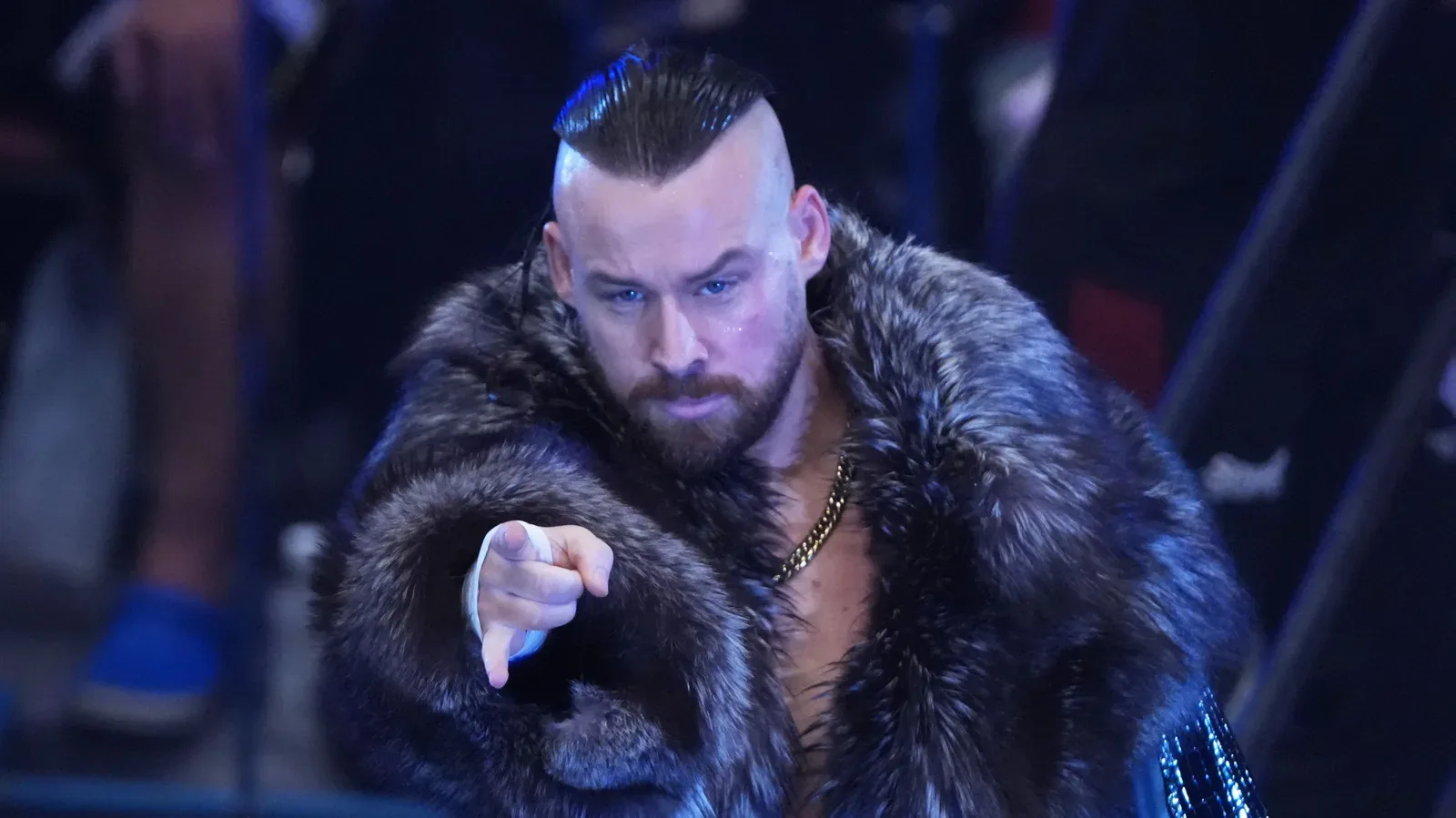
David Finlay’s professional wrestling career could have followed a very different route.
With Fit Finlay as his father and a long-established WWE producer and trainer, a WWE destination appeared natural for David Finlay long before he became a major name in New Japan Pro-Wrestling. His younger brother, Brogan Finlay, is now competing in NXT under the name Uriah Connors, adding another direct family connection to WWE. But David Finlay ultimately built the most defining stretch of his career elsewhere, spending 11 years with NJPW before later arriving in AEW alongside Bullet Club War Dogs stablemates Gabe Kidd and Clark Connors.
That path was not initially the plan. Speaking on Talk Is Jericho, Finlay recalled sitting down with his father as a teenager to map out the steps he would take toward a possible WWE career. The framework involved amateur wrestling, time learning in Europe, a short stay in Japan, and then a potential move into WWE’s developmental system.
“When I was fifteen, I sat down with my dad and was like ‘No, this [wrestling] is what I want to do with my life,’” Finlay said on Talk Is Jericho. “He was like ‘Alright. Here’s the plan. You should do amateur wrestling,’ which Nattie Neidhart also told me to do that. And I did. And then from there, it was like ‘Alright. You’re going to go to England and Germany for a bit. And then go and do the [New Japan] Dojo for six months, And then go to ‘NXT’ or FCW, whatever it was at the time.’ And then six months in Japan turned into eleven years, cause I loved it so much.”
For more background on this topic, read Drew McIntyre Sees ‘Great Presence’ in Elijah Holyfield After Agent Of Shadows Scene.
The story provides a revealing look at how Finlay’s journey diverged from what might have seemed like an obvious wrestling-family trajectory. The plan was not presented as a shortcut based solely on his surname. It included foundational amateur experience and time in England and Germany before Japan entered the picture. Even the proposed NJPW Dojo stop was meant to be part of a broader developmental process rather than the place where he would establish himself for more than a decade.
Instead, the appeal of Japan changed the equation. Finlay’s intended six-month experience became an 11-year run, and that decision allowed him to develop a résumé that would have been difficult to predict when he first discussed wrestling as a future career at age 15.
A New Japan Career Defined by Major Championship Success
Finlay did not win the IWGP World Heavyweight Championship during his NJPW tenure, but his accomplishments with the company still placed him among its most decorated competitors of his generation. His run included two reigns as IWGP Global Champion, and he holds the distinction of being the inaugural champion in that title’s history.
He also won the 2025 New Japan Cup, one of the promotion’s most important annual tournaments. Tournament victories can reshape a wrestler’s standing quickly in NJPW, where a successful run through a bracket carries both prestige and a clear statement of momentum. For Finlay, adding the New Japan Cup to his championship record reinforced the level he reached after choosing to remain in Japan rather than use the dojo period as a brief waypoint.
Beyond the Global title and New Japan Cup, Finlay captured the NEVER Openweight Championship and held the IWGP Tag Team Championships with Juice Robinson. Those accomplishments reflect the variety of roles he occupied during his years in the company. His success came in singles competition, in the tag division, and in title scenes built around different styles and levels of physicality.
The full arc is especially notable considering the uncertainty that naturally surrounds any young wrestler’s early plan. At 15, Finlay had a roadmap that pointed toward WWE developmental, whether it was called FCW at the time or later became associated with NXT. Yet wrestling careers are rarely linear, and Finlay’s own account illustrates how a wrestler’s priorities can change once they experience a new environment and discover where they feel most motivated.
For Finlay, the NJPW Dojo was evidently more than a temporary learning stop. It became the foundation of his professional identity. The fact that he described loving the experience enough to stay for 11 years speaks to the impact the company and its system had on him at a pivotal stage of his career.
Family Connections Made WWE Seem Like the Logical Destination
There were several reasons WWE looked like a likely eventual landing spot for Finlay. Fit Finlay’s stature as a longtime producer and trainer gave David a close view of the industry and of WWE’s developmental expectations. The advice outlined by Finlay was also methodical: establish athletic credentials through amateur wrestling, gain experience abroad, develop further in Japan, and then make the move to the WWE system.
Finlay also mentioned that Nattie Neidhart encouraged him to pursue amateur wrestling. That detail emphasizes how the guidance he received was centered on creating a strong base before chasing the highest-profile opportunities in the business. The early advice was not merely about where to work; it was about developing the tools to succeed once the opportunity arrived.
Brogan Finlay’s current NXT run as Uriah Connors further underlines the family’s continuing WWE ties. David Finlay’s decision to spend his prime NJPW years in Japan therefore was not the result of a lack of connection to WWE. Rather, it was a personal choice shaped by what he found once he reached New Japan.
That distinction matters. Wrestling legacies can create expectations, particularly when a parent has an extensive career in the industry. But Finlay’s account shows that he and his father initially approached the process with a plan, while remaining open enough for the experience itself to determine where the journey would go. Japan became the place that held his interest and offered the career he wanted to pursue.
Finlay Has Carried That Momentum Into AEW
Finlay’s NJPW success is now part of the backdrop for his current AEW chapter. He is wrestling in AEW alongside Kidd and Connors, his longtime stablemates in the Bullet Club War Dogs. The group’s connection has remained central as Finlay moves into a new promotional setting after the lengthy New Japan tenure that shaped his career.
In April, Finlay, Kidd, and Connors won the AEW World Trios Championships. The victory gave Finlay immediate championship success in AEW and provided another major accomplishment alongside the stablemates with whom he has been closely associated. It also added a new dimension to the career of a wrestler whose early plans once centered on a possible move through WWE developmental.
The trios title win does not erase the importance of Finlay’s NJPW history; it makes that history even more relevant. He arrives in AEW with the experience of an 11-year run in Japan, major singles championship credentials, tournament success, and a proven partnership with the men beside him in the War Dogs. Those elements have made his transition into AEW a continuation of an established career rather than a fresh start.
Finlay’s reflection is ultimately a reminder that the most logical destination is not always the one that becomes most meaningful. WWE was part of the plan he discussed with his father as a teenager, and the steps toward that destination were clearly laid out. However, one planned six-month detour in the NJPW Dojo became the defining chapter of his career.
From becoming the first IWGP Global Champion to winning the New Japan Cup and now holding AEW World Trios Championship success with Kidd and Connors, Finlay’s path has been shaped by embracing the unexpected turn. His story is not one of abandoning a plan without direction. It is the story of a wrestler finding that the opportunity meant to prepare him for the next step had become exactly where he belonged.
In pictures

Darryl Polo
Darryl Polo is a passionate wrestling fan covering WWE, AEW, TNA and beyond. He loves great rivalries, breakout stars and the moments that keep fans talking long after the bell. How we work.