
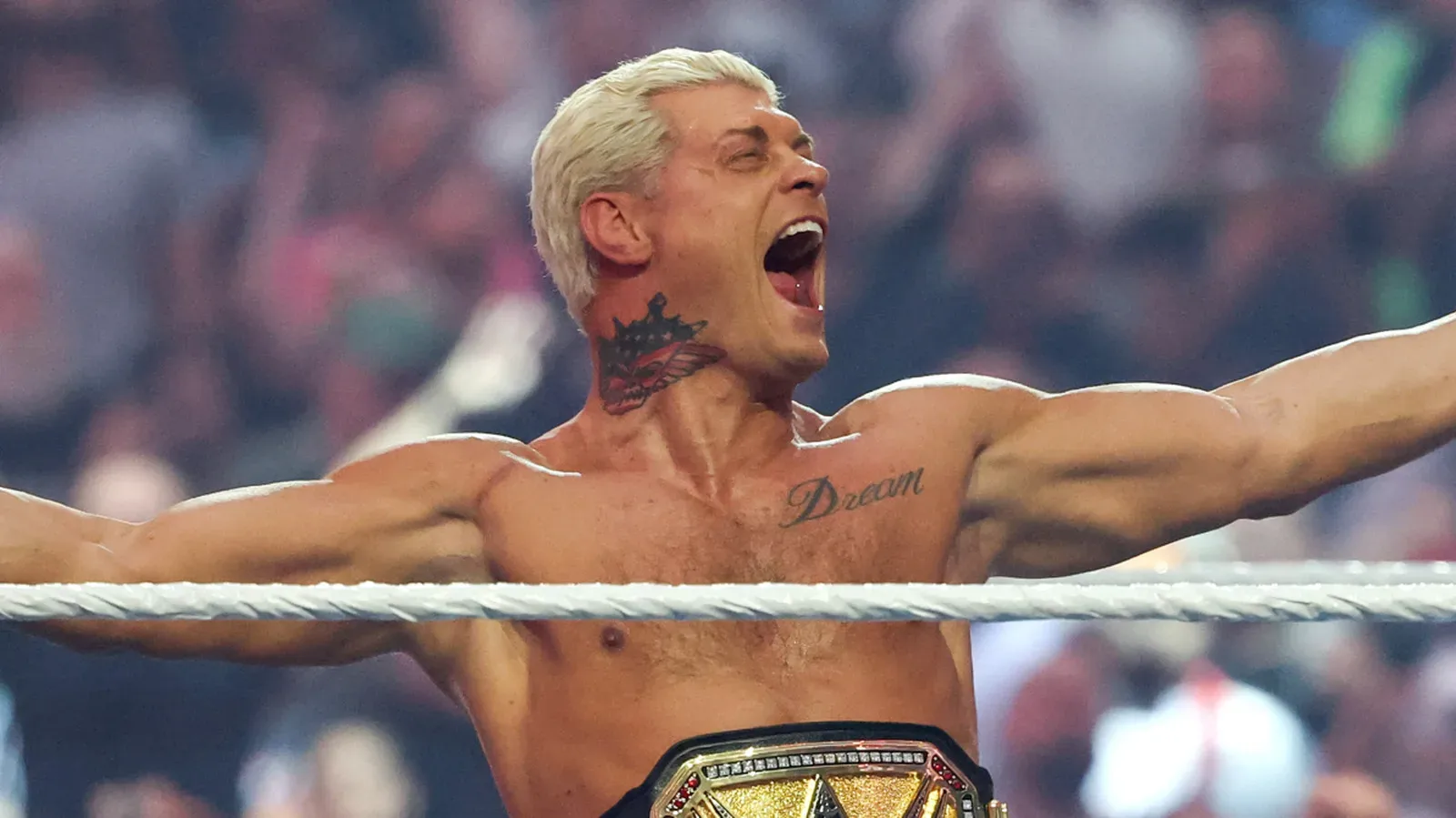
Cody Rhodes has never had much choice but to address the American Nightmare logo tattooed prominently on the side of his neck. It is one of the most recognizable pieces of body art in modern professional wrestling, a design that immediately identifies Rhodes whether he is entering a WWE stadium, appearing on a red carpet, or promoting a major Hollywood release.
Now, while making media appearances ahead of Street Fighter, Rhodes has offered more context on how the tattoo came to be and why the design carries a particularly fitting connection to the film. Speaking on Last Meals, Rhodes explained that the logo was born out of a desire to establish an identity separate from his past association with Bullet Club during his stint in New Japan Pro-Wrestling.
The tattoo itself first became a major talking point when Rhodes unveiled it at AEW Revolution in 2020. Its placement, size, and visibility generated immediate debate among fans and fellow wrestlers alike. But more than six years later, Rhodes can point to a run of enormous professional achievements that makes the controversial ink inseparable from the era in which he transformed himself into one of wrestling's leading stars.
A New Identity After Bullet Club
Rhodes' time outside WWE was central to the creation and growth of the American Nightmare character. After leaving WWE in 2016, he wrestled for a wide range of promotions and developed a more self-directed version of his presentation. That journey included a significant run with Bullet Club in New Japan Pro-Wrestling, where he worked alongside several of the group’s major figures during a period when the faction remained a powerful international brand.
For more background on this topic, read John Cena Recalls Hornswoggle Hotel Burger Story After WWE’s Ireland Travel Delay.
While Bullet Club helped place Rhodes in front of a larger global audience, he explained that he eventually wanted imagery that was distinctly his own. The group’s familiar skull-and-guns aesthetic was not something he wanted to retain as the defining visual statement of his next stage.
“I wanted to get away from that, no disrespect, I just wanted my own logo,” Rhodes said on Last Meals.
That desire to create an independent symbol became a significant part of the American Nightmare presentation. Rather than being just a shirt design or a piece of entrance imagery, the logo evolved into a visual shorthand for Rhodes’ career reinvention. It represented the performer who had stepped away from his former WWE identity, taken control of his direction, and positioned himself as a central name in the wider wrestling industry.
Rhodes’ story has often been framed through legacy. As the son of Dusty Rhodes and brother of Dustin Rhodes, he entered the business carrying one of wrestling’s most famous family names. The American Nightmare concept, however, gave him a signature that was unmistakably his. The tattoo made that statement permanent.
The Street Fighter Influence Behind The Logo
The timing of Rhodes’ latest explanation is notable because of his involvement with Street Fighter. While discussing the tattoo during the film’s promotional tour, Rhodes revealed that the American Nightmare logo was influenced by Shadaloo, the villainous organization tied to M. Bison in the long-running video game franchise.
Rhodes described the American Nightmare mark as being “a bit derivative” of Shadaloo and M. Bison’s emblem. That influence was not an accidental similarity noticed years later. It was part of the design conversation from the beginning, with Rhodes using the imagery as a reference point for the artist who created the logo.
“So, when doing the American Nightmare logo, it’s a bit derivative of Shadaloo, which is one of the main villains of the Street Fighter canon and M Bison’s logo,” Rhodes said on Last Meals.
Rhodes also pointed to a specific visual connection viewers can find in the movie. He noted that imagery related to that inspiration can be seen in the Burlesque Hall sequence, where M. Bison welcomes attendees to his World Warrior tournament. For Rhodes, the film provides an especially personal full-circle moment: a franchise that helped inspire the symbol attached to his wrestling identity now intersects with his expanding acting career.
The connection also reflects how carefully Rhodes has constructed the American Nightmare brand. His presentation has long blended traditional American wrestling imagery with theatrical, comic-book, gaming, and pop-culture influences. The logo’s skull motif, red-white-and-blue palette, and aggressive visual style have been used across apparel, entrance gear, promotional materials, and major-event staging. It has become an essential part of how WWE presents Rhodes as a top-level attraction.
From AEW Revolution To WWE’s Top Championship
When the tattoo appeared at AEW Revolution 2020, it became one of the night’s most immediate conversation points. At the time, Rhodes was an executive vice president and a major on-screen figure in AEW, and the ink made an already bold character presentation even more distinctive. Reactions were mixed, as they often are whenever a high-profile performer makes a permanent aesthetic choice that cannot be hidden easily on television.
Rhodes has never suggested that everyone needs to love the look. In fact, he acknowledged on Last Meals that he can understand the criticism surrounding both the logo and where it was placed. But his perspective on the decision is shaped by what followed.
“I’ll say it’s a regret because of maybe the logo itself, because of its size and its placement, but it’s been nothing but a career on an upwards trajectory ever since,” Rhodes said.
That trajectory is difficult to dispute. Rhodes returned to WWE at WrestleMania 38 in 2022, entering with the American Nightmare identity fully formed rather than attempting to revive one of his previous WWE personas. The return immediately positioned him as a major player, and his story soon became centered on pursuing the championship that had eluded his family.
Rhodes ultimately reached the top of WWE by capturing the Undisputed WWE Championship. He has since held that title three times, adding championship accomplishments to a résumé that already included high-profile work across WWE, AEW, New Japan Pro-Wrestling, Ring of Honor, and the independent scene. The same logo once viewed as an unexpected and divisive visual choice now accompanies one of the company’s most marketable stars.
His rise has also extended beyond wrestling. The Street Fighter media tour underscores the increasing crossover appeal Rhodes has developed as a WWE headliner. A wrestler appearing in a major studio adaptation does not erase the importance of his in-ring work, but it does demonstrate the kind of cultural visibility that comes with being presented as one of WWE’s premier figures.
A Tattoo That Became Part Of The Story
Rhodes calling the tattoo a regret, even conditionally, is consistent with the candid way he has discussed it over the years. The admission is not a rejection of the American Nightmare brand or of the career it has represented. Instead, it reflects an awareness that neck tattoos are not subtle decisions and that the particular design has always drawn strong opinions.
Yet the tattoo’s visibility may also be part of why it has endured as a defining feature. Wrestling stars are often identified by instantly recognizable traits: a hairstyle, a robe, a catchphrase, a gesture, a color scheme, or a piece of entrance music. Rhodes’ American Nightmare logo is now firmly in that category. It is visible the moment he turns his head, and it has become as much a part of his image as his elaborate ring jackets, dramatic entrance, and the family legacy that drives much of his WWE narrative.
There is also a larger lesson in the path Rhodes has taken. The logo began during a period when he was deliberately separating himself from an established faction identity and forging a personal brand. That independent vision helped carry him through AEW and eventually back to WWE, where he returned as a more complete, more confident, and more commercially established version of himself.
Whether fans consider the neck tattoo an inspired branding move or an understandable aesthetic regret, Rhodes’ own conclusion is straightforward. The period since he committed to the American Nightmare symbol has included the most successful years of his career. With his WWE championship history continuing to grow and Street Fighter adding another major platform to his profile, the design’s connection to his upward path is now impossible to separate from the story.
In pictures

Darryl Polo
Darryl Polo is a passionate wrestling fan covering WWE, AEW, TNA and beyond. He loves great rivalries, breakout stars and the moments that keep fans talking long after the bell. How we work.