
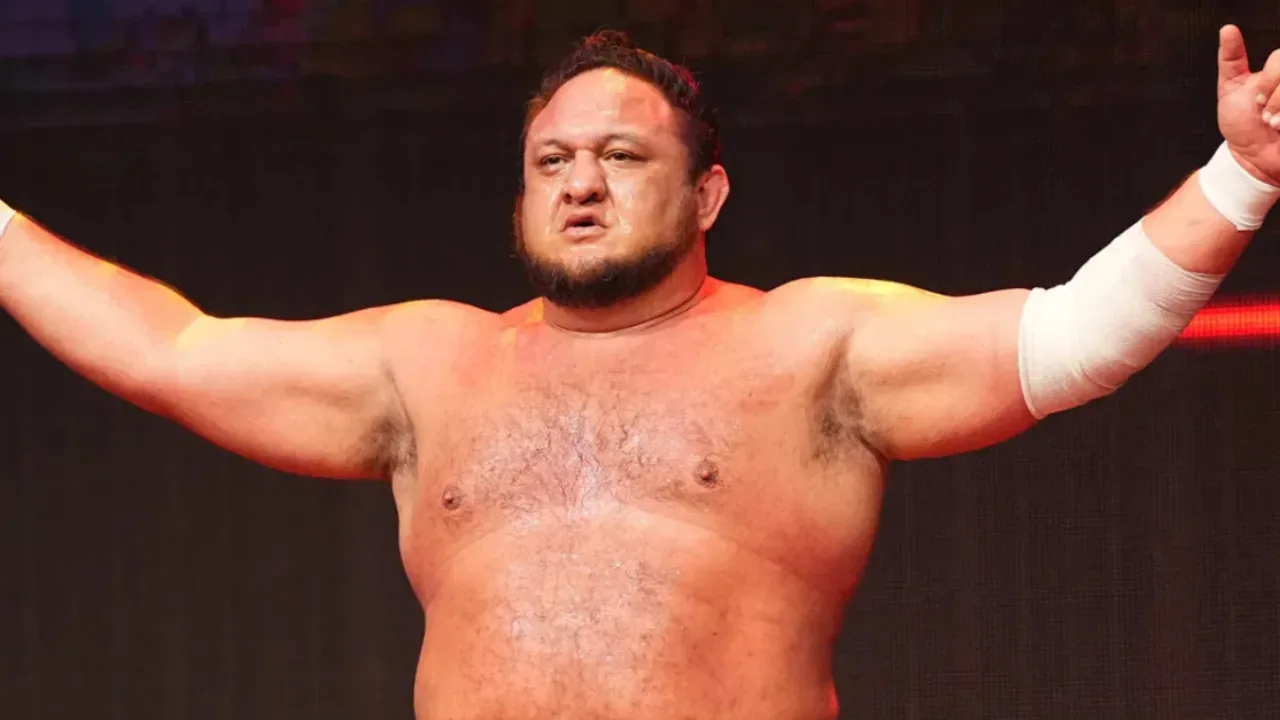
Samoa Joe believes the current generation of professional wrestlers has raised the bar in an area that can be difficult to measure but impossible to ignore: technical proficiency.
Speaking about the evolution of performers and what today’s wrestlers may do better than the generation he came through with, Joe singled out adaptability and coordination as two of the clearest improvements. In his view, modern talent is operating with a broader and more refined set of skills than was commonly seen in earlier eras, particularly as wrestling has continued to expand beyond a style traditionally centered on larger heavyweights.
“I think adaptability and coordination are way better than they’ve probably been in years,” Joe said. “I think that you get a lot of people who have maybe more of a natural aptitude, but maybe less physical potential.”
Joe’s observation is not a dismissal of the wrestlers who helped shape previous generations. Instead, it speaks to the changing demands placed on performers. Pro wrestling has always required athletic ability, timing, toughness, charisma and an understanding of how to construct a match. But the balance between those qualities has shifted as the talent pool has grown more varied and as wrestlers have had more opportunities to learn different approaches to the craft.
For more background on this topic, read Tommaso Ciampa Embraces AEW’s ‘Unicorn’ Role as a Character Chameleon.
A modern wrestler may be expected to work comfortably with opponents of vastly different sizes and styles, adjust to a rapidly changing match environment, maintain precise positioning during complicated exchanges and establish a believable struggle while protecting both participants. The coordination Joe referenced is central to all of that. It is not simply about executing a difficult maneuver. It is about knowing where to be, when to move, how to communicate and how to make the sequence serve the larger story in the ring.
Joe Sees a Clear Change in Wrestling’s Skill Set
Throughout his career, Samoa Joe has been widely associated with an intense, physical and highly credible in-ring approach. His work has often blended hard strikes, submission wrestling, power offense and a patient sense of escalation. That background gives his perspective on technical growth particular weight, because he has competed across multiple styles and against performers with dramatically different strengths.
Joe framed the current trend through the lens of natural aptitude and physical potential. The distinction is important. A wrestler may not fit the traditional image of the biggest or most physically imposing star, yet still possess exceptional movement, timing, body control and the instinct to adapt to an opponent. Joe suggested that more wrestlers today arrive with those kinds of abilities.
“I think that’s kind of the best way to put it,” Joe continued, discussing performers with “more of a natural aptitude, but maybe less physical potential.”
For decades, heavyweight wrestling often revolved around size, power and the idea that physical dominance was the most direct route to credibility. Those elements remain valuable, and larger wrestlers continue to be important parts of the industry. However, Joe believes the increased prominence of wrestlers from different physical backgrounds has contributed to a higher collective level of technical execution.
The result is a landscape in which performers can draw from more tools. Technical wrestling is no longer limited to traditional holds and counters, nor is athletic wrestling limited to spectacular movement. A wrestler’s technical ability can be seen in the small details: the ability to transition from a takedown to a control position, sell the effects of an earlier attack, change strategy after a failed attempt, create space for an opponent, or keep a crowd invested while a match takes an unexpected turn.
The MMA Comparison
Joe compared the trend to mixed martial arts, where he sees different skill patterns across weight divisions. He noted that lighter weight classes can feature a greater concentration of technicality and skill, as well as more closely matched contests in which fighters can absorb punishment differently than competitors in larger divisions.
“I think you kind of see the same trend in MMA where it’s like, you know, in the lighter weight classes, you’re going to see a lot more technicality,” Joe said. “You’re going to see a lot more skill. You’re probably going to get, you know, a bit closer matchups where, you know, guys can take a bit more punishment just along those weight classes.”
The comparison helps explain the distinction Joe is making. He is not arguing that one type of wrestler is inherently better than another. Rather, he is describing what happens when an industry is no longer defined primarily by one physical archetype. When the range of body types, athletic backgrounds and stylistic influences broadens, the ring product can become more layered.
In wrestling, that can mean a match changes from a power contest into a grappling exchange, then becomes a strike-heavy battle, then shifts again when one participant identifies an opening. The best performers make those changes feel natural. They do not just display moves; they respond to circumstances. That capacity to respond is at the heart of Joe’s comments on adaptability.
Coordination also becomes increasingly valuable in a more diverse ring environment. Wrestlers must establish trust quickly, particularly when working with opponents they may not regularly face. They need to recognize an opponent’s rhythm, adjust their own pacing and create sequences that are both compelling and safe. The more intricate the action becomes, the more essential those fundamentals are.
Moving Beyond a Predominantly Heavyweight Model
Joe contrasted the present day with an earlier period that he described as being more predominantly driven by a heavyweight style. In that environment, he said, audiences saw less of the kind of proficiency that is more visible now.
“Whereas, you know, in the past, it being predominantly dominated by a more heavyweight style, you know, you saw less that proficiency,” Joe said. “So I think just, you know, the technicality probably is a lot higher than it’s been.”
That conclusion captures the core of his assessment: the overall technicality of the current generation is likely higher than it has been before.
It is a significant statement from a wrestler whose own career has spanned major changes in how audiences consume the product and how performers develop. Wrestlers today have more exposure to styles from around the world, more footage to study and more examples of successful performers who do not necessarily fit a single established mold. Those factors do not remove the importance of fundamentals. If anything, they make them more necessary.
A wrestler with a large offensive arsenal still needs to understand pacing. A fast-paced athlete still needs to know when to slow down. A technically sound grappler still needs to communicate emotion and urgency. And a physically dominant heavyweight still needs opponents and match structures that make their power meaningful. Joe’s comments recognize that modern performers are increasingly being asked to combine those elements rather than specialize in only one.
Adaptability Remains the Defining Trait
The emphasis on adaptability may be the most revealing part of Joe’s answer. Technical wrestling is often discussed in terms of holds, counters or complex sequences, but adaptability is what allows technique to function under pressure. A performer may enter a match with a plan, but the crowd reaction, opponent’s style, match pacing and the flow of the action can all require immediate changes.
That is especially true in a wrestling world with many distinct approaches. Some matches are built around power. Others hinge on speed, aerial offense, submissions, striking or a slower psychological structure. A versatile wrestler must be able to recognize what a particular match needs and help bring that version of the contest to life.
Joe’s view is that the present generation is particularly strong in this area. Greater coordination helps performers execute at a high level; greater adaptability helps them ensure that execution has purpose. Together, those traits can make a match feel less like a predetermined collection of moments and more like a contest that develops in real time.
As wrestling continues to evolve, the debate over styles, sizes and eras will always remain part of the conversation. Joe offered a measured answer rather than a declaration that the past has been surpassed in every respect. His point was more specific: today’s wrestlers, as a group, appear to have an elevated technical baseline.
For a business built on constant reinvention, that may be one of the clearest signs of progress. The industry still values presence, toughness and larger-than-life personalities. But in Samoa Joe’s estimation, the wrestlers stepping into the ring now are doing so with a level of coordination, adaptability and technical skill that stands out from what came before.

Darryl Polo
Darryl Polo is a passionate wrestling fan covering WWE, AEW, TNA and beyond. He loves great rivalries, breakout stars and the moments that keep fans talking long after the bell. How we work.