
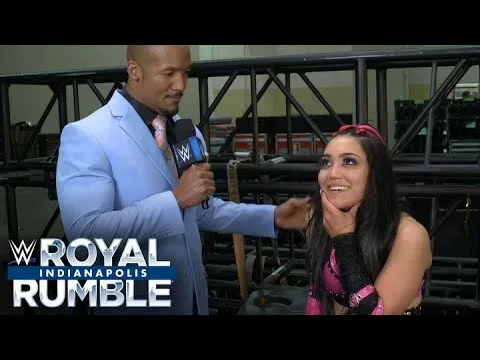
Roxanne Perez knows better than most WWE Superstars what it means to spend a long time inside a Royal Rumble match. The former NXT standout has appeared in multiple Women’s Royal Rumbles during her WWE run, including a landmark 2025 performance in which she lasted more than an hour and set a new record for the longest time spent in the match.
That kind of statistic can sound exhausting from the outside. A Royal Rumble is built around survival, with competitors entering at intervals, eliminations capable of happening at any moment, and the ring becoming increasingly crowded as the match develops. For a wrestler who remains active through much of that process, the physical demands are obvious. Yet Perez says the experience does not register as an hour-long grind while she is actually performing.
Speaking with Allenownz Wrasslin, Perez addressed a question she has repeatedly received about whether the time drags when she is in a Rumble for an extended period. Her answer was that the match moves much faster from inside the ropes than it appears to viewers watching the clock.
“So people have asked me that a lot about like, if when I’m in the ring in the Rumble, if it feels like it’s so long or I’m like counting the minutes. But honestly, as soon as the Rumble ends, I’m like, ‘that literally felt like 10 minutes.’ It feels, it goes by so fast. There’s so many things happening. So many women coming out, so many- you’re constantly just trying to throw someone over. So like it’s, you’re constantly just like going, going, going, going. So by the time it ends, you’re just like, whew, that was fun.”
For more background on this topic, read Eric Bischoff Examines Why Bill Dundee Never Became a WWE In-Ring Star.
The Royal Rumble’s Unusual Pace
The Royal Rumble format creates a distinctly different challenge from a traditional singles match or even a standard multi-person bout. Wrestlers are not only trying to maintain awareness of their immediate opponent. They also have to monitor every person in the ring, identify potential elimination threats, react to new entrants, and adjust when the match’s numbers and dynamics suddenly change.
Perez’s description underscores why the clock can become secondary once the bell rings. The match is designed to keep changing. New arrivals alter alliances, open opportunities for confrontations, and force the existing participants to find new positioning. A wrestler standing close to the ropes can become vulnerable in an instant, while someone who seems to be recovering may have to immediately react to another competitor arriving in the match.
For Perez, the attention required to navigate that environment appears to erase the sense of elapsed time. Her focus is not on counting down the minutes or measuring how long she has survived. It is on the next exchange, the next arrival, and the immediate objective of preventing elimination while looking for a chance to send another wrestler over the top rope.
That explanation also reflects the difference between the audience experience and the performer experience. Fans can follow entry numbers, keep track of the match’s running time, and compare a competitor’s survival with established records. Inside the ring, there is no comparable opportunity to step back and assess the duration. The work continues as long as a wrestler remains in the match.
A Record-Setting 2025 Showing
Perez’s comments carry additional weight because of what she accomplished in the 2025 Women’s Royal Rumble. Lasting more than an hour is an achievement that requires conditioning, timing, composure, and an ability to remain involved in a contest that is constantly evolving. Her performance established a new record for the longest time in the match, adding a major Royal Rumble credential to her WWE resume.
Longevity records are especially notable in a match where survival itself is the central story. A competitor can make a significant impression with a quick elimination or a memorable encounter, but remaining in the Rumble deep into its runtime asks for a different kind of performance. The wrestler must stay credible amid a changing field and remain alert enough to avoid a sudden exit long after the opening stages have passed.
In Perez’s case, the accomplishment also reinforced her ability to perform on WWE’s biggest stages. The Royal Rumble has long been one of the promotion’s signature events, and the women’s match offers its own combination of established names, rising performers, surprise possibilities, and high-pressure moments. A record-setting endurance performance ensures that a wrestler’s name remains tied to the event’s history.
Still, Perez’s own perspective is strikingly less analytical than the statistics surrounding the match. While a record can make an hour in the ring sound monumental, she characterized the final feeling as one of rapid motion and enjoyment. The length mattered on paper, but the experience itself was dominated by the steady stream of activity happening around her.
Why the Action Never Stops
Perez pointed specifically to the number of moving parts involved in a Rumble. Women are entering, opponents are being targeted for elimination, and the ring is continually shifting. In that setting, slowing down is rarely an option. Even brief moments of recovery can be interrupted by a new entrant, a developing confrontation, or another wrestler looking to capitalize near the ropes.
The need to constantly pursue eliminations is a key part of that process. Unlike a conventional match that ends through a pinfall or submission, the Royal Rumble’s objective is immediate and highly visible: throw opponents over the top rope and watch both feet hit the floor. Every attempt carries risk. A wrestler trying to eliminate somebody is often exposed to being pushed out themselves, particularly with multiple competitors operating in close quarters.
That environment demands constant decision-making. Who is positioned near the ropes? Who is vulnerable? Who might be able to assist with an elimination, and who could turn on you as soon as the opportunity arises? Perez’s remarks present the Rumble as a match where the body and mind remain occupied from beginning to end, leaving little room to consider how long the contest has lasted.
It also helps explain why fans often remember a Rumble through sequences and moments rather than simply through its total runtime. Entrants arriving one after another, wrestlers narrowly escaping elimination, confrontations between familiar rivals, and the final rush toward the winner all give the match momentum. For someone surviving through many of those phases, the experience can blur into a rapid succession of necessary reactions.
Perez’s Rumble Experience Continues to Build
Perez has become increasingly familiar with the unique spotlight that comes with the Women’s Royal Rumble. Her appearances have given her the opportunity to share the ring with a wide range of WWE talent, including names from different eras and corners of the roster. She previously discussed having a moment with Nikki Bella in a Royal Rumble match, another example of the event creating encounters that may not occur in ordinary week-to-week competition.
Those interactions are part of what gives the Royal Rumble its lasting appeal. The match can place wrestlers together who have limited history, revive rivalries, or introduce a newer talent to a broader audience through a single exchange. Perez’s 2025 endurance record is the most measurable element of her Rumble history, but the match’s constant arrivals and changing personnel also create the memorable personal moments that competitors take away from the night.
Her comments offer a useful performer’s-eye view of an event fans often evaluate through numbers. Viewers can see that a wrestler lasted over an hour and naturally imagine every minute of fatigue. Perez does not dismiss the demands of the match, but her recollection centers on the pace, the movement, and the fun of surviving a situation where there is always another task demanding attention.
For Perez, an extended Royal Rumble run apparently does not feel like an extended wait for the finish. It feels like a burst of action. By the time the final bell sounds, the wrestler who spent more than an hour fighting to stay in the match can look back and feel as though only 10 minutes have passed.

Darryl Polo
Darryl Polo is a passionate wrestling fan covering WWE, AEW, TNA and beyond. He loves great rivalries, breakout stars and the moments that keep fans talking long after the bell. How we work.