
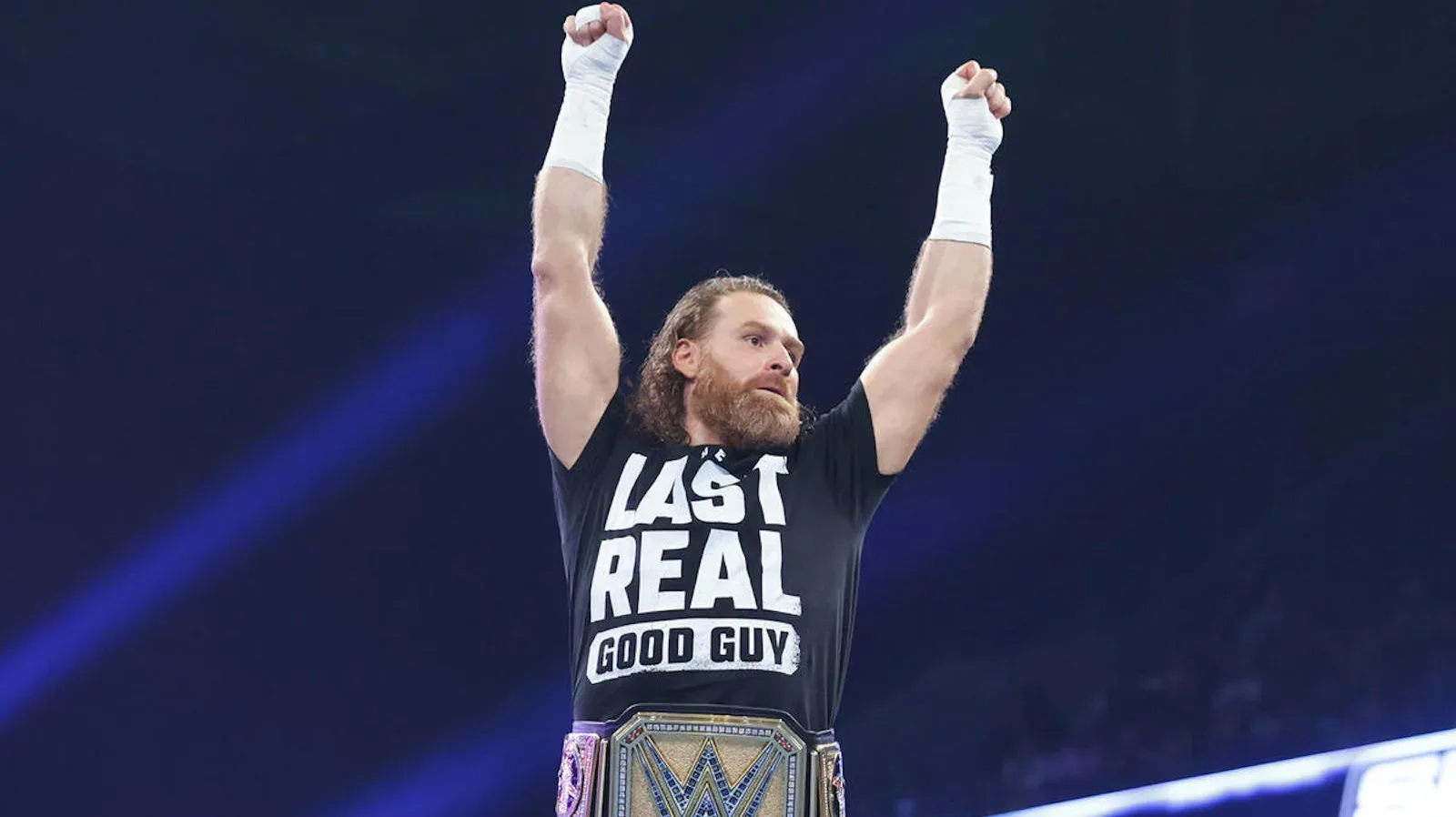
Sami Zayn has built his WWE identity around a trait that can be difficult to measure but impossible to miss: an unwavering belief in his own perspective. As the WWE Undisputed Champion, Zayn continues to present himself as “The Last Real Good Guy,” a label rooted in his conviction that he sees the world, the locker room and his own place in the company more clearly than those around him.
That certainty has long been a central part of Zayn’s character. He has repeatedly maintained that he does not receive the respect, recognition or appreciation his accomplishments warrant. Whether he is addressing fellow WWE Superstars, responding to crowd reactions or reflecting on his championship status, Zayn approaches the subject with the same basic argument: he believes his actions and intentions are routinely misunderstood.
In a recent interview with WWE, Zayn expanded on that mindset and identified self-awareness as both a strength and a burden. He described himself as someone with strong intellectual instincts, heightened emotional sensitivity and a deeply held moral compass. In Zayn’s view, carrying all three qualities at once can make ordinary interactions and decisions much more difficult.
“It is very hard to get through the day sometimes when you are a little bit too smart for your own good and you feel a little too strong and you’re too aware of your surroundings,” Zayn said.
For more background on this topic, read WWE Roster Reportedly Left Saudi Arabia Before Riyadh Missile Attack.
The statement fits neatly within the champion’s current presentation. Zayn does not merely want to be seen as successful. He wants to be recognized as sincere, principled and uniquely equipped to understand the stakes of the situations around him. That distinction matters to him. His self-image is not limited to being a champion who won a major title; he sees his championship reign as evidence that his inner qualities have carried him through challenges that other competitors may not fully comprehend.
A Champion Defined by Conviction
Zayn’s “Last Real Good Guy” moniker is designed to frame him as a wrestler whose sense of right and wrong remains intact in an environment where self-interest often dominates. In WWE, championships can be pursued through alliances, manipulation, shortcuts and opportunism. Zayn, however, views himself as motivated by something more substantial. He believes his values are genuine, even when others question his methods, his conclusions or his tendency to speak at length about his own merits.
That is where the tension in Zayn’s comments becomes important. His belief that he is unusually perceptive can make him sound isolated from the people around him. He acknowledged that he can be “almost jealous” of those who seem able to move through life without constantly processing every emotional or moral implication of a situation. For Zayn, blissful ignorance can appear easier than living with persistent awareness.
He nevertheless sees a connection between that burden and his success. Rather than treating his sensitivity as an obstacle that held him back, Zayn suggested it may be one of the reasons he stands as WWE Undisputed Champion. His argument is that the qualities that make his day-to-day existence difficult are also the qualities that set him apart from the rest of the roster.
“It’s one of the only explanations for how a guy who looks like me, who acts like me, who talks like me, who thinks like me, who believes in what he believes in the way I do, ends up with this championship because it doesn’t make sense,” Zayn said. “It doesn’t make sense, but those are the intangibles that led me to this.”
The quote captures the essence of Zayn’s championship persona. He openly recognizes that he does not fit a conventional mold, yet he presents that very fact as proof of his singular value. In his estimation, he has not reached the top despite being different. He has reached the top because the traits that distinguish him from his peers ultimately gave him an advantage.
The Value of the Intangibles
Wrestling is full of measurable attributes. Size, strength, speed, in-ring experience, championship history and win-loss records all shape how competitors are evaluated. Zayn’s comments focus instead on the less tangible components of success. He is emphasizing awareness, feeling and belief as the things that have made the difference for him.
That approach also allows Zayn to turn perceived vulnerabilities into reasons for confidence. Being overly emotional can be portrayed as a weakness. So can overthinking, sensitivity to criticism or an intense concern with how one is viewed by others. Zayn sees those tendencies differently. He believes they have made him more alert to his surroundings and more determined to defend the standards he considers important.
His use of the word “disaster” to describe the combination of intelligence, emotional sensitivity and morality is telling. Zayn is not claiming that his outlook makes life easy. He is arguing that it has created a complicated existence—one in which he notices too much, feels too much and cares too much to simply ignore what he considers wrong. But within that complication, he sees the foundation of his identity.
For a WWE champion, that outlook can be a powerful source of motivation. Zayn’s belief in his own uncommon perspective gives every challenge an added layer. An opponent is not simply trying to take his title; that opponent may also represent a threat to the values Zayn believes he protects. Criticism is not just criticism; it can be interpreted as another example of people failing to understand what he brings to WWE.
Why Zayn’s Perspective Matters
Zayn’s confidence has always existed alongside an insistence that others are underestimating him. That combination can be combustible. A Superstar who feels overlooked often has a point to prove, while a champion who believes his values are superior to those of his peers may become even more resolute when challenged.
It also creates room for Zayn’s opponents to question his self-assessment. His confidence can be framed as conviction, but it can also be challenged as self-importance. His emotional investment can be viewed as passion, but rivals may see it as volatility. His claim to moral clarity can be presented as admirable, yet it invites others to argue that Zayn is too certain that his own interpretation is the only one that matters.
Those contradictions are central to what makes Zayn compelling in his current role. He does not portray himself as flawless. Instead, he presents his most difficult traits as proof that he carries a heavier emotional and intellectual load than the average person. He believes that burden has isolated him at times, but he also believes it has helped make him champion.
For Zayn, the WWE Undisputed Championship is more than a symbol of victory. It is validation. He sees the title as evidence that someone who thinks, speaks and acts as he does can still rise above every expectation. His explanation may not satisfy everyone in the locker room, and it may not change the minds of those who already doubt him. But Zayn is not particularly interested in softening his view to make it easier for others to accept.
Instead, the champion is embracing the idea that self-awareness comes with a cost. He believes it can make life harder, create frustration and leave him feeling separated from those who are less concerned with the emotional and moral dimensions of their choices. At the same time, he believes those very qualities are the intangibles that carried him to WWE’s highest position.
As “The Last Real Good Guy,” Sami Zayn remains committed to that contradiction. In his eyes, being misunderstood is not a sign that he needs to change. It is simply another consequence of seeing things more clearly than everyone else—and another reason he believes he deserves to stand at the top of WWE as its Undisputed Champion.
In pictures

Darryl Polo
Darryl Polo is a passionate wrestling fan covering WWE, AEW, TNA and beyond. He loves great rivalries, breakout stars and the moments that keep fans talking long after the bell. How we work.