
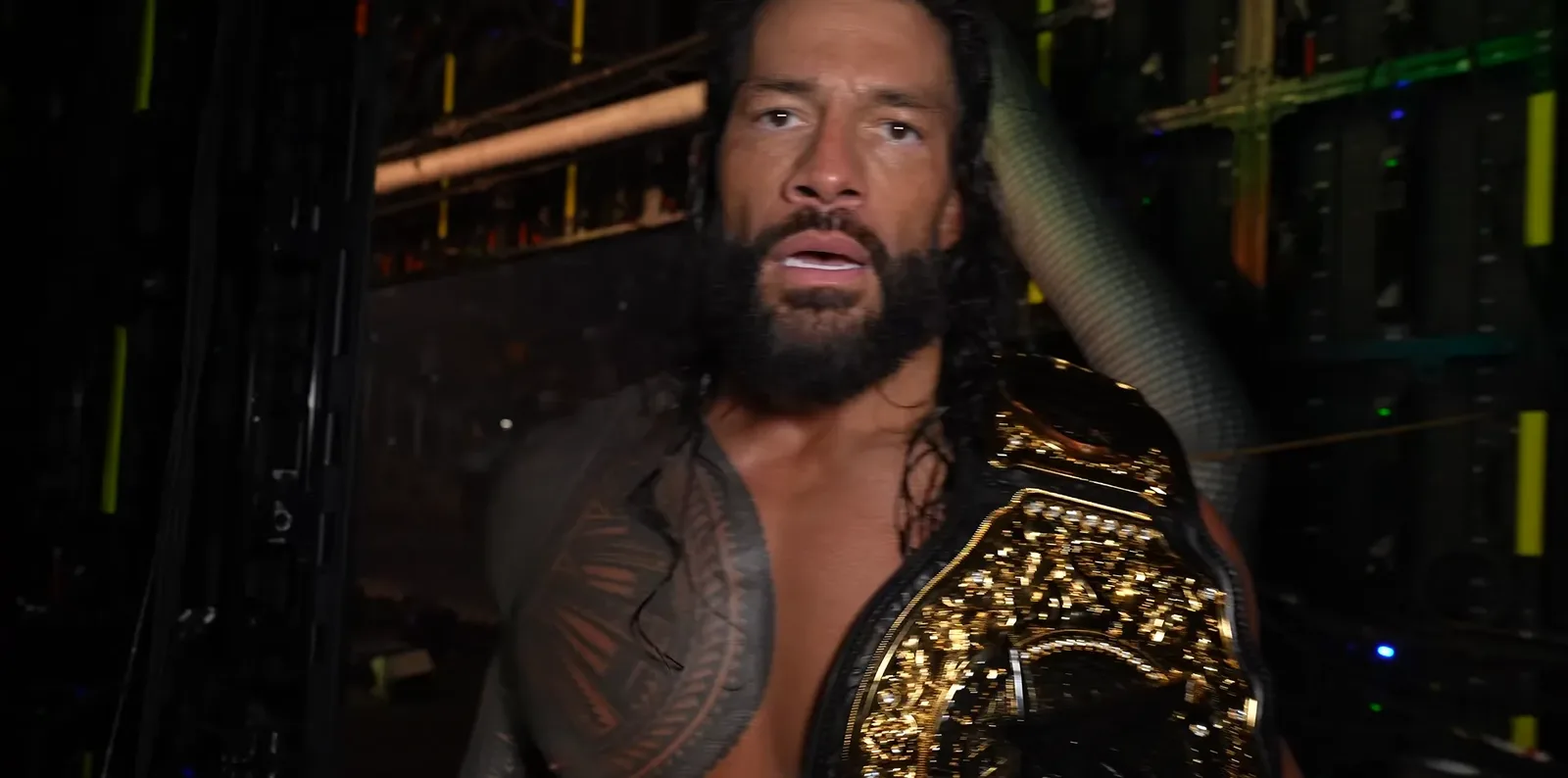
Roman Reigns has never been shy about presenting himself as WWE’s measuring stick, but the former Undisputed WWE Champion has taken that mindset beyond his on-screen persona in new comments about the current locker room.
While discussing his experience filming the upcoming Street Fighter movie with Sam Roberts, Reigns compared the collaborative nature of a movie set with the competitive atmosphere he feels exists in professional wrestling. Reigns said the cast in Australia came together with a clear understanding of their individual roles. In wrestling, however, he believes too many performers carry themselves as though they have reached the same level of accomplishment and influence he has.
“There’s a great camaraderie in wrestling. I mean, being one of the boys, I can’t even explain it because I’m in the small fraternity, I’m in that 1%. Honestly, that should just be for us,” Reigns said.
Reigns used his movie co-stars Noah Centineo and Andrew Koji as examples while explaining the distinction he sees between a collaborative ensemble and the wrestling business. He said he did not arrive on set trying to act as though he were one of the film’s other actors, because everyone involved understood what they were there to contribute. That, in his view, is not always the dynamic in WWE.
For more background on this topic, read Roman Reigns Says WWE Metrics Have Always Backed His Position, Compares Big Dog Merch to LA Knight.
“The difference is I wasn’t running around thinking I’m Noah, you know what I mean? There’s plenty of dudes in the locker room that are running around thinking they’re Roman Reigns, thinking they’re of my level. It’s crazy. It’s just ridiculous. Look in the mirror and look at all your stuff, everything that comes with your life. Look at your bank account, all the stuff. We’re not the same.”
Roman Reigns draws a line between collaboration and competition
The comments fit the attitude that has defined Reigns’ most celebrated WWE run. Since returning in 2020 and adopting the Tribal Chief character, Reigns has been positioned as the central figure of a generation. The character’s dominance was not merely built around victories. It was built around control: of his family, of championship opportunities, of the weekly television conversation, and often of the people placed in his orbit.
That presentation eventually produced one of the most significant championship reigns of the modern WWE era. Reigns held the Universal Championship for more than 1,300 days, unified WWE’s top men’s titles at WrestleMania 38, and became the centerpiece of The Bloodline story. Cody Rhodes ended Reigns’ historic title run at WrestleMania 40, but Reigns’ standing as one of WWE’s defining attractions did not disappear with the championship.
In his comments, Reigns did not identify any particular WWE names as the people he believes are overstating their status. Instead, he spoke broadly about the culture of ambition in the locker room. It is a pointed perspective from someone who has spent years at the top of the company’s hierarchy and who has routinely framed himself, both in character and out of character, as a singular attraction.
Reigns said there was no similar confusion while filming Street Fighter. He described the cast’s process as one built around each person complementing the others in pursuit of the same objective.
“I didn’t run around thinking I’m Noah or Andrew. No, I’m here to work with them, compliment them, make the very best combination or collaboration to create the best film. There’s no confusion here, we all understand who we are and what we’re trying to do and we all came together that way in a perfect way. But in wrestling, it just can’t be had that way.”
That distinction speaks to the unusual structure of wrestling. WWE is a team environment in the practical sense: wrestlers, producers, writers, referees, trainers, crew members and executives all work toward putting on a weekly live television product. Yet performers are also competing for television time, major matches, championships, merchandise opportunities, audience investment and the company’s confidence in them as featured stars.
Reigns acknowledged his football background and said that background will always make him see value in teamwork. At the same time, he stressed that wrestling is different because of how personally he views his place within the medium.
“Look, I come from football, so I’m always going to look at a teamwork aspect but wrestling is different. That’s my craft, I own that shit. That is mine, you know what I mean? Like mine. I don’t give a shit about any of them, it’s mine.”
The path from divisive reactions to the Tribal Chief
Reigns also addressed when he began to embrace this level of ownership over his presentation. His answer pointed back to the period before the COVID-19 pandemic, when he was still being portrayed as WWE’s top heroic star despite a sustained and vocal split in audience reaction.
For years, Reigns was a leading figure on WWE programming after first breaking out as part of The Shield alongside Seth Rollins and Dean Ambrose. His rise to the top of the singles division came with enormous expectations, but it also came with repeated resistance from portions of the live audience. Even when Reigns was presented as WWE’s chosen centerpiece, some fans rejected the way the role was being framed.
One especially memorable moment from that period involved Baron Corbin pouring dog food on Reigns during their storyline rivalry. Reigns referenced that angle directly while explaining that he had reached a point where he no longer felt creatively aligned with his portrayal.
“Probably when I was born, but it doesn’t click until — honestly, before COVID hit and I left, I had dog food all on me, it was just one of those situations where I just wasn’t creatively — I just wasn’t in line. I didn’t like what I was doing. I didn’t like the way I was portrayed. It was just time to take complete ownership and the proof is in the pudding.”
Reigns stepped away from WWE programming in 2020 as the pandemic changed the landscape of the industry. When he returned later that year, the shift was immediate. He aligned with Paul Heyman, defeated “The Fiend” Bray Wyatt and Braun Strowman to win the Universal Championship, and began the Tribal Chief era that transformed his career.
The return allowed Reigns to work from a different creative foundation. Rather than being asked to win over audiences as a straightforward heroic lead, he became an arrogant, controlling champion who demanded acknowledgement. The role drew on his real family lineage, incorporated the Anoa’i family into a major long-term story, and gave him a voice and pacing that felt substantially different from his earlier WWE presentation.
His point about “complete ownership” is central to understanding why that run resonated. Reigns has consistently emphasized the importance of presentation, character detail, match placement and protecting the value of major appearances. His reduced schedule during the latter stages of his title reign also reinforced the sense that a Roman Reigns appearance was an event rather than another routine part of a crowded weekly lineup.
Reigns remains a defining WWE presence
There is an obvious degree of character within Reigns’ blunt assessment of the locker room. WWE has long benefited from performers speaking with confidence and presenting themselves as bigger than their peers. Reigns’ public comments also echo the aura of the Tribal Chief, a character who does not treat peers as equals and does not accept challenges to his authority quietly.
Still, his remarks also reflect the results he pointed to. Reigns’ title reign, the commercial strength of The Bloodline, his main-event positioning at multiple WrestleManias and his move into a major film project have given him a résumé few active WWE performers can match. Whether other talent agree with the tone of his assessment is a separate question, but Reigns has made clear that he sees a significant divide between aspiring to be at the top and actually establishing that status.
The Street Fighter production has given Reigns an opportunity to work alongside talent from outside wrestling, and he described that environment as a successful collaboration. In WWE, he sees the same environment through a more territorial lens. To Reigns, wrestling is not simply another job or a collective creative exercise. It is the craft that defines him, and he is unwilling to surrender his claim over the space he has built at its highest level.
That outlook should not surprise anyone familiar with Reigns’ work over the past several years. The Tribal Chief was never designed to blend into the group. Reigns’ latest comments make it clear that, from his perspective, neither is the man behind the character.

Darryl Polo
Darryl Polo is a passionate wrestling fan covering WWE, AEW, TNA and beyond. He loves great rivalries, breakout stars and the moments that keep fans talking long after the bell. How we work.