
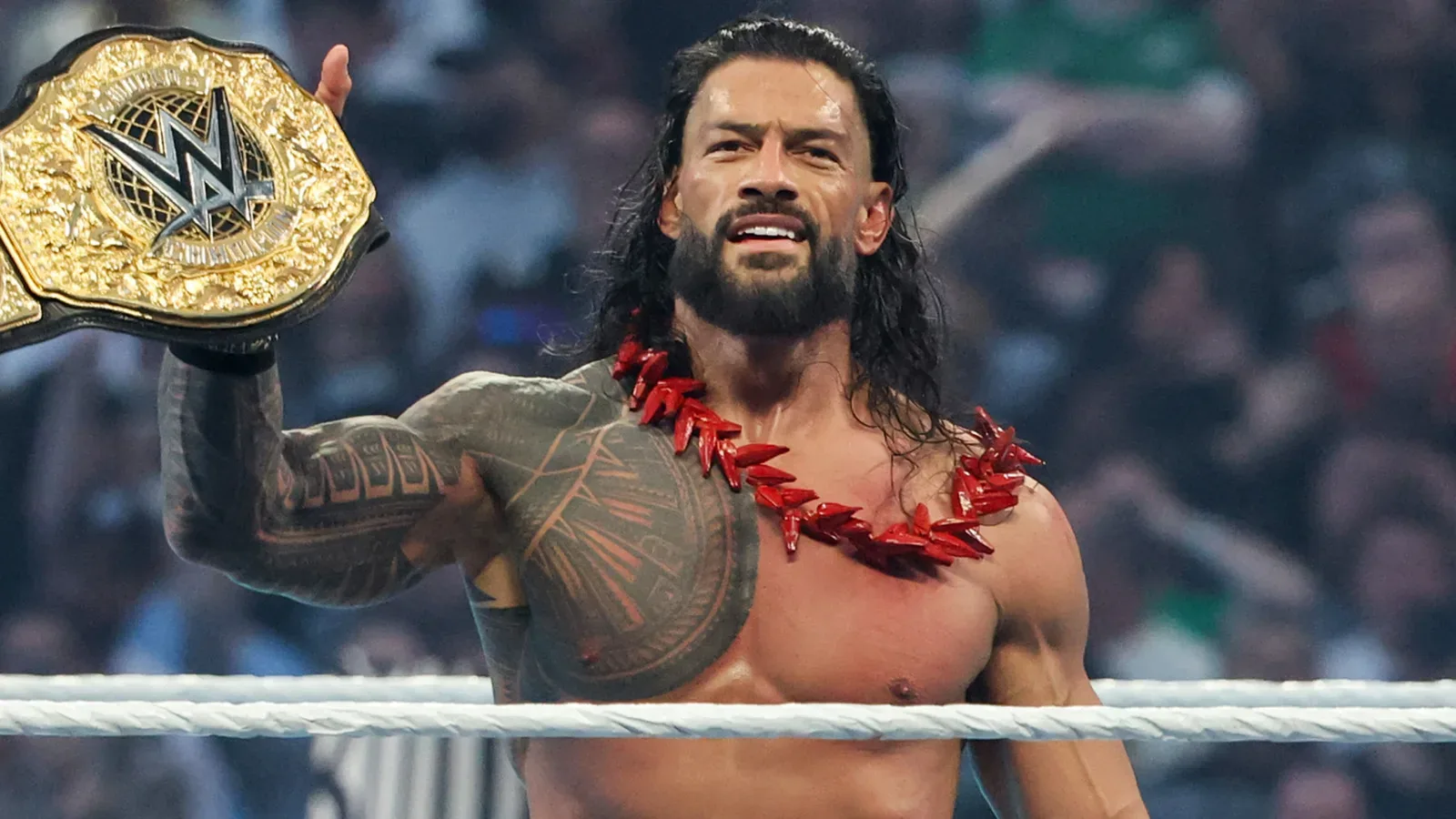
Roman Reigns has offered his own answer to one of professional wrestling’s most enduring debates: who belongs on WWE’s Mount Rushmore?
Speaking on Club Shay Shay, Reigns made clear that he does not judge the discussion by trying to weigh every possible factor at once. Rather than centering the conversation solely on match quality, championship totals, longevity, cultural influence, or personal preference, Reigns said his standard begins with the business itself.
“Only one metric matters: the money,” Reigns said on Club Shay Shay.
That philosophy, he explained, was impressed upon him from the beginning of his wrestling journey by his father. Reigns recalled being told that the ring must be viewed as a business and not confused for anything else. It is a perspective that fits a performer whose WWE career has been defined not only by championship success, but by an extended run as one of the company’s central attractions.
For more background on this topic, read Je'Von Evans Reflects On Hating The Authority And Seth Rollins' Shield Betrayal As A Fan.
Using that financial and industry-shaping framework, Reigns named Hulk Hogan, “Stone Cold” Steve Austin, Dwayne “The Rock” Johnson, and John Cena as the four men on his WWE Mount Rushmore.
“They were all critical. We wouldn’t be here today without those four, for sure,” Reigns said.
The list is a particularly revealing one because it spans multiple landmark periods in WWE history. Each choice was positioned as a defining figure of his era, but Reigns’ comments also point to a larger argument: the greatest stars are not simply remembered for what they did inside the ropes. They change the scale of the audience, the visibility of the brand, and the commercial ceiling for everyone who follows.
Hulk Hogan and WWE’s global expansion
Hogan was Reigns’ first selection and ultimately the name he appeared to lean toward when asked to choose a single greatest of all time. The choice came with an acknowledgment that the debate is difficult, especially when Austin and Johnson are also in the discussion. Still, Reigns emphasized Hogan’s importance to WWE becoming a worldwide force.
“But Hulk also took us from a carnival to a global product, you know what I mean?” Reigns said.
That distinction gets to the core of Hogan’s historical standing. Hogan became synonymous with WWE’s growth into a mainstream entertainment institution, leading an era in which wrestling reached an enormous audience and established a level of national and international visibility that transformed the industry’s perception. For Reigns, that expansion matters as much as, if not more than, any individual accolade.
Reigns also connected the Hogan-Austin comparison to merchandise and visual identity. Both men represented more than characters who wrestled on television. Their images and logos became instantly recognizable symbols for fans. In Reigns’ view, that kind of reach is a meaningful measure of a wrestler’s impact because it shows how deeply the act connected beyond the arena.
Hogan’s place on these lists has long been tied to that scale. He was not merely a top champion in a successful company; he was one of the defining faces of professional wrestling during an era that introduced WWE to a vastly broader public. Reigns’ answer did not erase the cases for later generations, but it underlined why Hogan remains such a difficult figure to dislodge when commercial impact is the primary test.
Steve Austin’s unmatched connection with an era
While Reigns seemed to favor Hogan in the narrow greatest-of-all-time discussion, he was equally clear that it is hard to overlook Steve Austin. “Stone Cold” was the central figure of one of WWE’s most explosive periods of popularity, and his rebellious persona helped reshape what a top wrestling star could look and sound like for a new audience.
Austin’s success was rooted in an unusually direct bond with fans. The character’s defiance of authority, blunt presentation, and unmistakable entrance made him a defining pop-culture figure of his time. Reigns’ reference to Austin’s merchandise presence speaks to how thoroughly that presentation resonated. The “Stone Cold” identity was not limited to a television storyline or a marquee match; it became an emblem fans recognized and wanted to carry with them.
There is also an important difference between simply being popular and serving as the commercial engine of a promotion. Reigns’ Mount Rushmore criteria places Austin firmly in the latter category. Austin was not included because of nostalgia alone. He was included because his run helped make WWE appointment viewing and reinforced the company’s standing during a pivotal chapter of wrestling history.
For Reigns, the Hogan-versus-Austin question appears to be a debate between two different kinds of transformative drawing power. Hogan represents the expansion of WWE’s global profile. Austin represents a white-hot connection that made him the defining superstar of another major boom period. The fact that Reigns had difficulty separating them illustrates the weight he gives both achievements.
The Rock’s rapid rise and lasting crossover power
Dwayne Johnson’s selection is hardly surprising, particularly given the way his wrestling stardom developed into broader entertainment prominence. Reigns specifically praised the speed and nature of Johnson’s ascent, describing it as “lightning in the bottle” and expressing respect for how quickly he was able to seize that opportunity.
The Rock’s WWE legacy contains both immediate success and unusually durable name recognition. His charisma, verbal style, and ability to command a crowd made him a major force during his full-time wrestling run. His subsequent success outside the ring added another dimension to his place in WWE history, keeping the company connected to one of the most recognizable entertainers in the world.
Reigns’ framing is important because it does not treat crossover success as separate from wrestling success. Under a business-first standard, The Rock’s ability to become a massive attraction and take the WWE platform into wider cultural spaces only strengthens the argument for his inclusion. His name carries meaning to longtime wrestling followers, casual fans, and people whose familiarity with him extends well beyond wrestling.
There is also a family connection between Reigns and Johnson, but Reigns’ explanation focused on Johnson’s accomplishments rather than that relationship. He pointed to the impact of a performer who became a major WWE draw with extraordinary speed, then maintained a profile that continues to make him one of the industry’s most visible representatives.
John Cena as the standard-bearer of his generation
The fourth spot went to John Cena, the performer who became WWE’s leading full-time face for much of the post-Attitude Era landscape. Cena’s inclusion completes Reigns’ lineup of era-defining stars: Hogan, Austin, The Rock, and Cena each carried the company’s public identity at different points.
Like the other names, Cena’s argument reaches beyond title reigns and main events. He became a constant central presence for WWE, a recognizable mainstream figure, and a merchandise powerhouse whose connection with younger fans was especially significant. His “Never Give Up” message and highly identifiable presentation helped make him an enduring symbol of WWE for an entire generation.
Reigns’ money-based metric naturally favors stars who could be relied upon as foundational attractions. Cena fits that description. He was the wrestler around whom WWE could build programming, major events, promotional campaigns, and its public-facing identity over a sustained period. Whether audiences cheered him or loudly voiced opposition, the response itself reflected how central he was to the product.
His place on Reigns’ list also provides a bridge between WWE’s previous megastar eras and the modern company. Hogan, Austin, and The Rock all represented cultural high points that are regularly invoked in historical discussions. Cena carried that burden in a different environment, as media consumption, audience habits, and WWE’s business continued to evolve.
A Mount Rushmore built around drawing power
Mount Rushmore debates rarely produce a universal answer because the criteria are never universal. Some fans will prioritize in-ring innovation. Others will focus on influence, championship success, character work, longevity, or the ability to elevate opponents. Reigns did not argue that those qualities are meaningless. Instead, he established that for his own list, financial impact is the deciding measure.
That approach produces a coherent four-man lineup. Hogan represents the expansion into a global product. Austin represents a generation-defining connection and major commercial momentum. The Rock represents rapid ascent, enormous charisma, and crossover visibility. Cena represents long-term reliability as WWE’s standard-bearer for a new era.
It also reflects the reality that professional wrestling exists at the intersection of athletic performance and entertainment business. Wrestlers can create defining moments, unforgettable matches, and beloved characters, but the performers who truly alter the industry’s trajectory often do so by bringing more eyes, more attention, and more revenue to the promotion.
Reigns has now placed himself on record with a Mount Rushmore rooted in that principle. His final choice between Hogan and Austin may remain difficult, but his overall message was direct: when judging WWE’s most essential stars, the largest business impact carries the greatest weight.
In pictures

Darryl Polo
Darryl Polo is a passionate wrestling fan covering WWE, AEW, TNA and beyond. He loves great rivalries, breakout stars and the moments that keep fans talking long after the bell. How we work.