
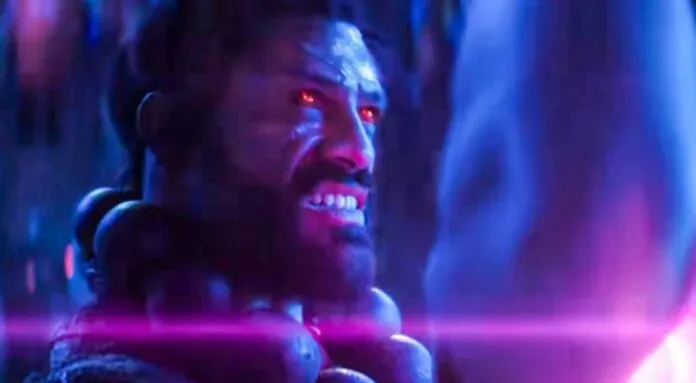
Roman Reigns is taking one of gaming’s most intimidating fighters to the live-action screen, and the WWE star says the preparation for Akuma required far more than simply maintaining the powerful physique he has built throughout his wrestling career.
Reigns is set to portray Akuma in the upcoming Street Fighter movie, which is scheduled for release next month. The project also features fellow professional wrestlers Cody Rhodes and Yota Tsuji, continuing a long tradition of wrestlers crossing into film while placing several current in-ring performers in a major video-game adaptation.
For Reigns, the assignment meant finding a way to make an instantly recognizable fighting-game character believable in a physical, live-action environment. Akuma is known for his formidable build, severe demeanor and martial arts-based fighting style. Reigns explained that the character’s muscular presentation aligned naturally with the training regimen he already follows, but that element was only a starting point once the demands of movement and fight choreography entered the process.
“I got lucky because Akuma…his physique is kind of bodybuilderesque,” Reigns said. “He’s a big brother, so he’s very muscular. That helped me out, to kind of stay in my regimen.”
For more background on this topic, read Cassie Lee Explains Why Her Fisherman’s Suplex Became a Signature Move.
That similarity between the performer and the character gave Reigns an obvious advantage in the visual side of the role. The former WWE champion has long worked with a presentation built around size, strength and controlled physical presence, attributes that make him a logical fit for a character such as Akuma. However, Reigns made clear that screen combat required him to work in positions and patterns that are different from the physical demands of a WWE match.
He described the challenge of combining lower-body positioning, balance, explosive movement and stylized upper-body poses. The work was especially demanding because the character’s martial arts identity needs to look intentional rather than simply powerful. Being strong is not the same as being able to hold a stance, shift weight quickly and execute a precise pose while preserving the appearance of a trained fighter.
“But when you add in the martial arts, the fighting disciplines…you have to be able to have your legs in a sumo squat, but then you can pop up on your toes and also hit a unique pose with your arms,” Reigns said. “There’s so much isometric work in that. There’s so much to that body control, almost like a ballerina type of work. And the footwork was pretty extensive.”
Reigns’ comments underline an important distinction in preparing for a role such as Akuma. A wrestler’s conditioning is developed around a demanding combination of strength, athleticism, timing, endurance and safe cooperation with an opponent. Martial arts choreography can share some of those traits, particularly in its attention to mechanics and repeatable movement, but it creates its own technical requirements. For a film performer, every stance and motion must also be readable for the camera.
The isometric component Reigns mentioned is particularly notable. Holding a low stance or a signature pose can put sustained pressure on the legs, core and shoulders. Those positions may look static in a final shot, but maintaining them while remaining balanced and ready to move is difficult. Reigns compared that body control to ballet, an apt description for the blend of strength, posture and precision that stylized screen fighting often requires.
Professional Wrestling Provided a Foundation
While Reigns did not suggest that wrestling and martial arts are identical disciplines, he believes his background helped narrow the learning curve. WWE performers are accustomed to absorbing and delivering rehearsed physical sequences under pressure, often while being required to maintain character, facial expression and spatial awareness. That experience can be valuable when moving into stunt-heavy acting work.
“There were a lot of parallels for me to be able to transition,” Reigns said. “I mean, they’re obviously different things you’re asked to perform, within wrestling and within martial arts. But the physical disciplines are a bit adjacent to each other, where it wasn’t as big of a gap for me to figure out.”
That distinction matters for Reigns’ screen debut as Akuma. In professional wrestling, performers train to create a compelling illusion of combat while protecting themselves and their opponents. Film fighting uses a different framework, with choreography shaped around camera angles, editing, continuity and stunt coordination. Yet both worlds reward discipline, repetition and an understanding of how the body moves in relation to another performer.
Reigns said that his professional wrestling experience helped him approach the transition, while also acknowledging that martial arts must be respected as its own discipline.
“The fact I’m in professional wrestling helped, but [martial arts] is still its own rite,” Reigns said. “It really makes you go back and look at all of the great martial artists: Jason Statham, Chuck Norris…all these guys who were able to do all these stunts and movies and and have it be so good.”
The appreciation Reigns expressed points to the scale of the task. Action stars who make fight sequences look fluid have generally spent years building their timing, flexibility, footwork and on-camera instincts. For Reigns, the Akuma role required adapting an already elite athletic base to a new performance language rather than simply reproducing what he does weekly in a WWE ring.
Why Akuma Is a Significant Role
Akuma is among the most imposing figures in the Street Fighter universe, which means the casting naturally places significant expectations on Reigns’ performance. The character’s appearance alone demands physical credibility, but his movement and aura are equally central to how fans recognize him. Reigns’ remarks suggest the production’s preparation extended beyond building a convincing silhouette and into the details that shape Akuma’s fighting presence.
There is also a clear connection between the character and Reigns’ established strengths as a WWE attraction. Reigns has spent years presenting himself as a dominant, composed and dangerous figure on television. Akuma requires a similarly forceful presence, though the role calls for that intensity to be expressed through a different style of movement and a cinematic setting rather than a live wrestling environment.
Still, the role is not a copy-and-paste extension of his WWE persona. His focus on footwork, stances and controlled posing illustrates that he had to develop tools tailored to the character. The strongest wrestling-to-Hollywood transitions tend to come when performers use their existing charisma and athleticism while learning the specific demands of acting and film production. Reigns’ training comments indicate he approached Akuma with that understanding.
Wrestling Representation in Street Fighter
Reigns is not the only wrestler involved in the movie. Cody Rhodes and Yota Tsuji are also part of the cast, giving the project representation from WWE and New Japan Pro-Wrestling. Their involvement reflects the continued appeal of professional wrestlers in action-oriented productions, where their physical preparation, comfort performing in front of large audiences and experience embodying larger-than-life characters can become valuable assets.
Each wrestler arrives from a different place in the industry. Rhodes is one of WWE’s leading stars, while Tsuji has established himself as a major figure in New Japan Pro-Wrestling. Reigns, meanwhile, remains one of the most recognizable names connected to WWE’s modern era. Their shared presence in Street Fighter brings an added pro wrestling dimension to a franchise already built around distinct fighters, heightened personalities and spectacular competition.
The movie’s release next month will provide the first opportunity for audiences to see how that crossover translates to the finished production. Until then, Reigns’ description of his preparation offers a useful look at the work behind the casting. He may have “got lucky” in finding a character whose physical build resembles his own, but the martial arts elements demanded fresh training, patience and a detailed approach to body control.
For Reigns, that process appears to have reinforced respect for the specialists who have mastered cinematic combat over decades. It also demonstrates that even a performer accustomed to WWE’s demanding schedule and physical stakes can encounter entirely new challenges when stepping into the world of action filmmaking.

Darryl Polo
Darryl Polo is a passionate wrestling fan covering WWE, AEW, TNA and beyond. He loves great rivalries, breakout stars and the moments that keep fans talking long after the bell. How we work.