
Drew McIntyre has experienced WWE from perspectives few active stars can match. He arrived as a highly touted prospect, left the company after failing to find lasting footing on the main roster, rebuilt himself outside WWE, and returned as a far more complete performer. Since coming back, he has worked through WWE’s NXT system, become a WWE Champion, carried the company through the pandemic era, and developed into one of the promotion’s most layered major characters.
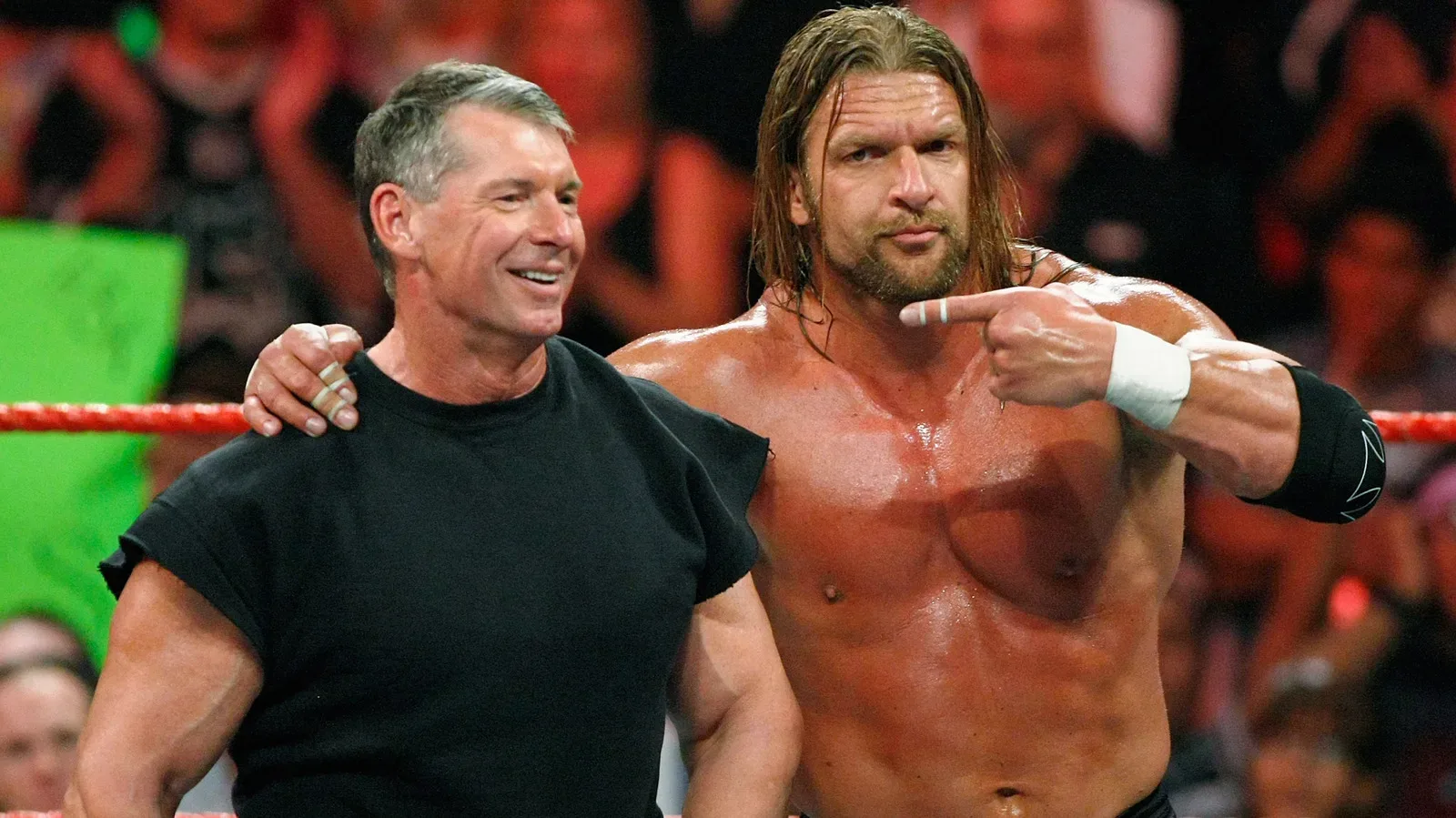
That journey also gave McIntyre an unusually clear view of the transition in WWE leadership from Vince McMahon to Triple H. Speaking on Raw Talk, McIntyre described a fundamental difference in how each executive sees wrestling characters and the stories built around them.
McIntyre characterized McMahon’s creative instinct as more direct and clearly defined, with performers generally operating in established good-guy or bad-guy roles. “[McMahon] saw things a little different, very much the kind of black and white [mentality] — good guy, bad guy, keep things a little simpler,” McIntyre said.
In contrast, McIntyre believes Triple H’s approach has allowed more room for characters to be driven by recognizable motivations rather than strict labels. “You know, [Triple H] is bit more, kind of [seeing] in shades of gray — which, that’s the real world,” he said on Raw Talk.
For more background on this topic, read Michael Hayes Recalls André the Giant Serving as a Match Agent During Freebirds Era.
McIntyre’s Career Gives Him a Unique Perspective
McIntyre’s comments carry added weight because his WWE career has spanned two markedly different chapters. His first run was defined by promise and pressure. After joining WWE’s main roster, he was presented early as a future centerpiece, but that initial ascent did not ultimately lead to the sustained top-level position expected of him. His release in 2014 forced a reset that would prove central to the wrestler McIntyre later became.
He spent the next several years away from WWE, sharpening his work and rebuilding his identity before returning in 2017. That return began in NXT, where McIntyre quickly established himself as a dominant force. The NXT run was not merely a second chance; it presented a version of McIntyre who carried himself with a different level of certainty and credibility.
From there, he reached the main-event picture on WWE’s primary roster and became one of the defining stars of the company’s pandemic-era programming. McIntyre’s “Big Hero of Covid” identity made him an important anchor for WWE during an unusual period, but it was also a character framework with obvious limits. A heroic champion can be an effective role, yet a long-running character needs the ability to react, change, fail, become frustrated and reveal contradictions if it is going to continue feeling human.
That evolution is at the center of McIntyre’s assessment of the current creative environment. His modern character has not simply switched from hero to villain in the traditional sense. Instead, he has increasingly portrayed a man who sees his actions as justified, even when those actions bring him into conflict with others and draw hostile reactions from the audience.
The Bloodline Helped Set a Different Standard
McIntyre pointed to The Bloodline as a story that helped inspire him to pursue that more textured direction. The group’s saga became one of WWE’s most prominent long-term stories, with relationships, shifting loyalties and personal grievances playing as important a role as physical confrontations.
For McIntyre, watching that narrative unfold created excitement about telling stories with a similar degree of emotional logic. He recalled that 2022 marked a key point in the movement away from the straightforward image of Drew McIntyre as WWE’s heroic Scottish Warrior.
“In 2022, we really started going from Drew the Big Hero of Covid, the Scottish Warrior, to going down the path of becoming a bad guy,” McIntyre said on Raw Talk.
However, McIntyre was careful to distinguish his path from a conventional, abrupt heel turn. In his view, the character is not simply “bad” because the crowd may reject him or because he has adopted more confrontational tactics. There is an ongoing element of his presentation rooted in how he responds to the audience’s view of him and to the slights he believes he has endured.
That distinction matters. Wrestling has always relied on clear conflicts, but the strongest rivalries often work because both sides can make a case for themselves. A performer does not have to be morally correct to be understandable. Likewise, a popular wrestler does not need to be flawless. McIntyre’s description suggests that the goal has been to make his character’s resentments and decisions feel grounded in a history the audience has watched develop.
Four Years of Character Movement
McIntyre described the result as a lengthy and rewarding process rather than a sudden reinvention. “It’s been this very fun character arc we’ve been on for the past four years, because Triple H is very open to making it like real life, and just living in shades of gray,” he explained.
The phrase “shades of gray” is particularly revealing because it captures the difference McIntyre sees between a role and a character. A role can be instantly understood: the fan favorite who overcomes adversity or the villain who creates obstacles. A character, meanwhile, can retain traits that clash with one another. McIntyre can be proud, angry, persuasive, bitter, self-aware and self-justifying at different moments without the presentation necessarily becoming inconsistent.
That type of continuity can also reward viewers who have followed the full arc. McIntyre’s current outlook is not presented as appearing from nowhere. It is connected to years of setbacks, title pursuits, frustrations and the changing relationship between the performer and the WWE audience. Even when fans disagree with the character’s choices, they are given a framework for understanding why he believes he is right.
It is an approach that fits a wrestler with McIntyre’s history especially well. His career has included an early failure, an unlikely return, a climb to the championship level and a long effort to remain at that level. Those experiences naturally offer material for a character who is unwilling to see himself as a simple antagonist in someone else’s success story.
McMahon’s Emphasis on the Present
McIntyre also returned to McMahon’s stated preference for focusing firmly on current developments. He recalled McMahon favoring a style that did not dwell on story elements from the more distant past.
“He had a very specific way of how he saw things. Like, keep it like — ‘Don’t talk about things that happened a month ago, two months ago, certainly not years ago; let’s live in the now!’” McIntyre said.
That philosophy speaks to a creative priority that has long been associated with weekly wrestling television: maintain urgency, keep the audience focused on what is immediately in front of it, and make the current program accessible without requiring extensive historical knowledge. There are practical advantages to that mindset. WWE reaches a broad audience, and a present-tense approach can allow stories to move quickly and remain easy to follow.
McIntyre’s comments do not frame either leadership style as universally right or wrong. Instead, they identify different creative instincts. McMahon’s approach, as McIntyre described it, stressed simplicity and immediacy. Triple H’s approach has given McIntyre room to use prior events as part of a continuing emotional record.
For a wrestler who has lived through multiple eras of WWE, that difference is significant. McIntyre is not discussing theory from the outside; he is describing how leadership philosophy affects the way a major performer develops on screen. His own character has become an example of what can emerge when WWE allows old disappointments, fan reactions and changing alliances to remain part of the story rather than disappear once a new program begins.
What It Means for McIntyre Going Forward
McIntyre’s reflections underline why his current presentation has felt distinct from a standard alignment change. The Scottish Warrior’s journey has been built on a belief that he is responding to the world around him, not simply embracing villainy for its own sake. That perspective gives his rivalries a personal edge and allows opponents and audiences alike to challenge his version of events.
It also reinforces the value of patience in long-form wrestling storytelling. McIntyre’s arc has taken years, incorporating his time as WWE’s pandemic-era hero and his gradual movement toward a more complicated, more combative identity. The performer sees that continuity as a product of Triple H being willing to operate in the moral ambiguity of real life.
Whether fans view McIntyre as justified, delusional, aggrieved or all of those things at once, that debate is part of the point. His comments make clear that he sees the ambiguity not as a lack of direction, but as the direction itself. In WWE’s current creative landscape, Drew McIntyre believes the most compelling answer is not always found in a simple choice between hero and villain.
In pictures

Darryl Polo
Darryl Polo is a passionate wrestling fan covering WWE, AEW, TNA and beyond. He loves great rivalries, breakout stars and the moments that keep fans talking long after the bell. How we work.