
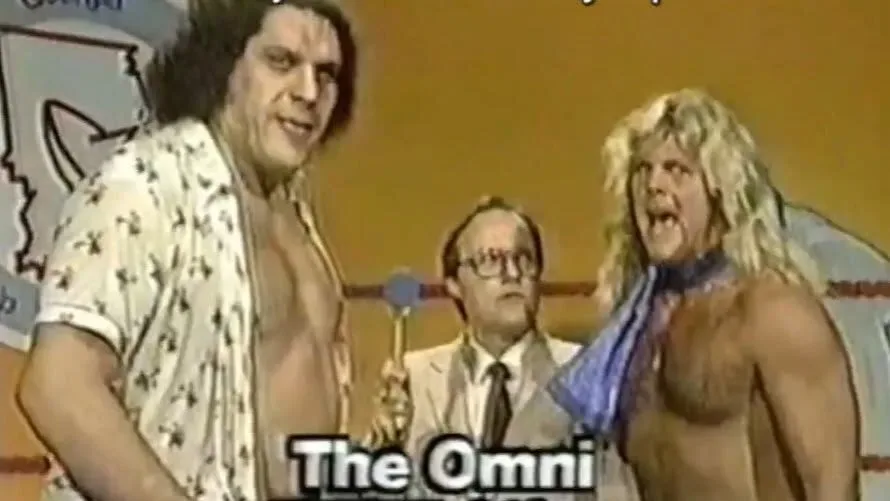
Michael Hayes has spent decades in professional wrestling as both an influential on-screen personality and a major behind-the-scenes figure, but one of the more unexpected details from his career involves André the Giant working in a similarly important production role.
During an appearance on What’s Your Story? With Steph McMahon, Hayes discussed André’s involvement in putting together wrestling events and recalled an occasion when André was serving as the agent for a show in Youngstown, Ohio. The story centered on Hayes arriving at the building in no condition to work after mistakenly believing The Freebirds did not have a booking that night.
Hayes, Terry Gordy and Buddy Roberts formed the core of The Fabulous Freebirds, one of wrestling’s most recognizable factions. Their act and their in-ring work made them a major attraction in multiple territories. Hayes’ recollection, however, showed a different side of the era: the responsibilities carried by established veterans such as André and the consequences when performers were not prepared for an assignment.
André the Giant’s role behind the scenes
When asked whether he was saying André the Giant had worked as a match agent, Hayes was unequivocal in his response.
For more background on this topic, read Scotty 2 Hotty Reflects On the Unlikely Formation and Evolution of Too Cool.
“He was an agent,” Hayes said.
Hayes explained that André was overseeing a Youngstown show while The Freebirds were based in Columbus. Hayes believed the group had the night off, leading him to drink heavily and take Valium before learning that they were in fact scheduled to appear.
“He was running a show in Youngstown, Ohio, and we were staying in Columbus and I thought we were off,” Hayes recalled. “So I drank about, I don’t know, 10 or 12 beers, and had taken some valium.”
The account provides a notable reminder that André’s value to wrestling was not limited to the immense attraction he represented in the ring. As a veteran with extraordinary experience across the industry, he could also be trusted with responsibilities related to running a card and helping manage the talent assigned to it. In the territory era, that kind of assignment was significant. An agent’s work could involve organizing matches, helping performers understand the expected direction of the show and maintaining order in a fast-moving live-event environment.
Hayes’ story did not attempt to present the incident as a proud moment. Instead, he made clear that he had already experienced trouble with André in connection with the Giant’s first time working as an agent. That prior issue was why Hayes, Gordy and Roberts were particularly concerned about being spotted by André while traveling together.
The airport encounter with Gordy and Roberts
Before revisiting the Youngstown incident in greater detail, Hayes described another moment involving himself, Gordy, Roberts and André. The Freebirds had been in Pittsburgh, where Hayes said there were no available hotel rooms. Gordy ended up sleeping outside near the pool at a Howard Johnson.
The following morning, the three men were at an airport deciding between flights. Hayes recalled that there was a flight to New Haven or another nearby destination and another flight to Atlanta. Their plans changed abruptly when André appeared.
“We got up the next morning and there was a flight to New Haven or something and there was a flight to Atlanta, and it didn’t take long and all of a sudden, we’re changing our flights and here comes André,” Hayes said.
Hayes said all three Freebirds attempted to hide behind a pillar, hoping the Giant would not see them. The image of three seasoned wrestlers trying to avoid André is amusing on its face, but Hayes’ explanation made the reason more serious. They were not simply trying to dodge a conversation; Hayes knew he had already left a bad impression after the Youngstown show.
“We hid, all three of us are hiding behind this pillar, like, ‘I hope he don’t see us. Please don’t see us,’” Hayes recalled. “God, I hope he don’t see us.”
The exchange also captures André’s stature among his peers. He was one of the most famous performers in the industry, but Hayes’ story indicates that André commanded respect away from the spotlight as well. A problem with a booking supervised by André was not something Hayes and his Freebirds teammates wanted to revisit unexpectedly in an airport.
Hayes remembers arriving at the Youngstown show
Hayes then returned to the evening that created the tension. He recalled pulling up to a school, only to be confused about why the group had arrived there. Gordy informed him that they were there to work.
“We pull up to the school, and I go, ‘What are we doing here?’ Terry goes, ‘We’re going to work.’ ‘Work!?’” Hayes said.
By Hayes’ description, Gordy and Roberts had to physically help him into the venue. Inside, André was seated, playing what Hayes described as Cribbage or a similar game while drinking wine. Once Hayes’ condition became apparent, André immediately recognized the situation.
“I walked in and literally like the cartoon you see, they’re both holding me up and André’s there playing Cribbage or whatever and drinking his wine. ‘He drunk!’ They go, ‘No, he’s not,’ and they let me go. Wham! Faceplant. Really bad,” Hayes said.
It was a disastrous entrance for a performer booked on a card being overseen by André. Hayes did not offer a claim that the situation was smoothed over or that it had no impact. On the contrary, he acknowledged that he had damaged a relationship with someone who had helped The Freebirds and spoken positively about them.
A personal connection with the Giant
Hayes stressed that the incident was especially regrettable because he and André had been close when André came through Georgia. Hayes said he would spend time with André and take him around when the Giant was in the territory.
“He was very instrumental in talking us up. Him and I were close when he would come to Georgia. I would take him around and stuff, and I blew that,” Hayes said.
That final assessment is the central point of Hayes’ recollection. The story is not merely a tale of excess from an earlier wrestling era or an anecdote about an uncomfortable airport meeting. It is also Hayes looking back at a moment when he felt he let down a respected colleague and supporter.
André the Giant remains among the most enduring figures in wrestling history because of his singular presence, his worldwide fame and his body of work across generations. Hayes’ account adds another perspective to that legacy. André was not only a special attraction brought in to headline shows; he was also someone with enough standing and experience to be given operational responsibilities at an event.
For Hayes, the story also illustrates the long memory attached to professional relationships in wrestling. A performer’s ability, popularity and history with a promotion matter, but reliability matters as well. Hayes has since built a lengthy career in WWE on the creative and production side of the business, reaching 31 consecutive years with the company. That tenure reflects a professional life that extends far beyond the Freebirds’ territory days.
Still, the André story clearly remains vivid for Hayes. From Gordy sleeping by a hotel pool in Pittsburgh to the three Freebirds hiding behind an airport pillar, the memories are colorful. Yet Hayes’ tone in recounting the Youngstown show made the lasting lesson plain: André had supported The Freebirds, and Hayes felt he had squandered that goodwill on the night he arrived unable to perform.
Hayes’ comments offer a rare glimpse at André the Giant as an agent and authority figure, a role that is less frequently discussed than his historic in-ring career. They also show why the encounter remained important to Hayes decades later.

Darryl Polo
Darryl Polo is a passionate wrestling fan covering WWE, AEW, TNA and beyond. He loves great rivalries, breakout stars and the moments that keep fans talking long after the bell. How we work.