
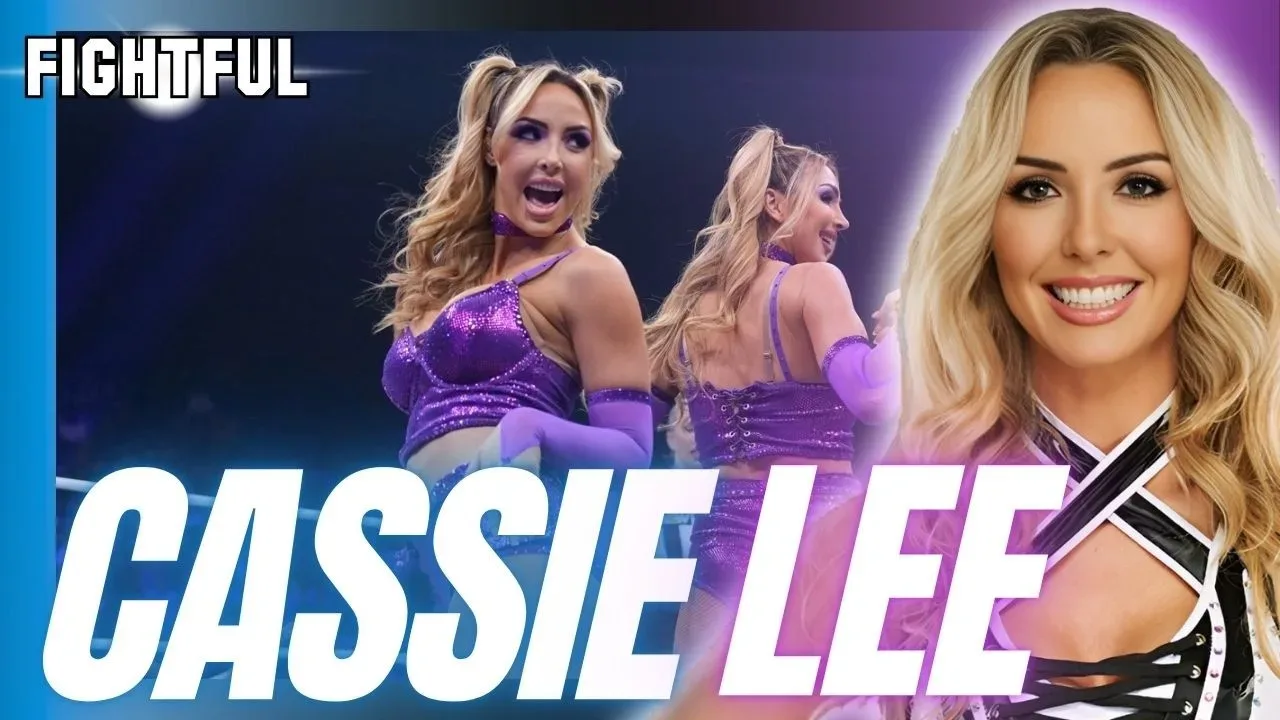
Cassie Lee’s Fisherman’s Suplex has become one of the moves most closely associated with her work in the ring, and she has now explained that its place in her repertoire began with a simple reaction from people around her during her time in NXT.
Speaking in a recent interview, Lee said she does not fully remember the original reason she tried the move. What she does remember is that she had not regularly used it while working on the independent scene. Once she performed it after arriving in NXT, however, the response centered on one particular part of the maneuver: the bridge.
“I really don’t remember why I started using the fisherman suplex. I feel like I didn’t use it on the indies. When I first started at NXT, I busted it out and everyone was like, ‘Whoa, look at that bridge.’ So I just kept using it. But I always felt like the suplex itself was less impressive than the bridge. So I struggled with the balance of that.”
The answer offers an interesting look at how a move can develop from an occasional option into a defining piece of a wrestler’s presentation. Not every signature is planned years in advance, and Lee’s comments suggest that this was a case of an organic reaction helping determine what would remain part of her in-ring identity.
For more background on this topic, read Zoey Serrano Explains Why Shayna Baszler’s Pre-Match Message Has Become Essential.
The bridge made the difference
A Fisherman’s Suplex is already a move that requires timing, coordination, and control. The attacking wrestler secures an opponent’s leg while executing the suplex, creating a distinct visual from a standard version of the move. Lee’s use of the bridge added another layer, as she emphasized the pinning position immediately after the throw.
That bridge is the visual element that stood out to those watching Lee early in her NXT tenure. In wrestling, a move’s effectiveness is not judged solely by its basic mechanics. The presentation matters just as much. A wrestler can make a familiar maneuver feel memorable through speed, elevation, impact, body positioning, or a distinctive finish. For Lee, the arch of the bridge became the feature that gave the Fisherman’s Suplex its identity.
Lee was candid in acknowledging that she viewed the throw and the bridge differently. She felt that the bridge was more impressive than the suplex itself, which created a balancing act in how she approached the maneuver. The statement speaks to the level of detail wrestlers consider when developing their offense. A move has to be safe and repeatable, but it also has to look convincing, fit the performer, and deliver a clear reaction from the audience.
In Lee’s case, the reaction she received gave her a reason to continue using it. The positive response was immediate enough that the decision was straightforward: if people noticed the bridge and responded to it, there was value in making the move a regular part of her matches.
How a move becomes part of a wrestler’s identity
There is often a tendency among fans to view a wrestler’s best-known offense as something that was carefully designed from the beginning of their career. Lee’s recollection is a reminder that the process can be far more gradual. A move may emerge because it feels natural in training, because it works well with a wrestler’s physical strengths, or because someone notices a detail that had not been intended as the main attraction.
That last point is especially relevant to Lee’s comments. She did not describe arriving in NXT with the Fisherman’s Suplex already established as a major calling card from her independent wrestling days. Instead, she said she “busted it out” after starting there. The response to the bridge then encouraged her to make it a continuing feature.
The evolution makes sense within the broader demands of televised wrestling. Performers need moments that are easy for viewers to recognize and remember. A strong bridge can provide that visual punctuation. It also gives the move a natural competitive logic: rather than simply throwing an opponent, Lee transitions into a cover in one flowing sequence. Even when a match does not end there, the hold offers a credible near-fall and creates a moment for the crowd to follow.
Lee’s comment about struggling with the balance between the suplex and the bridge also underscores the difference between executing a move and presenting it for an audience. The throw needs to look forceful, while the bridge needs to appear stable and deliberate. If the focus is too heavily on one aspect, the other can lose some of its impact. Finding the right balance is part of refining a maneuver over repeated matches.
An early NXT reaction that lasted
Lee’s time in NXT provided the setting for that refinement. The early feedback she received did not just identify a move that she could perform; it identified an attribute that others believed separated her version from similar suplexes. That distinction matters in a wrestling environment where many competitors may share elements of the same offensive vocabulary.
A Fisherman’s Suplex can be delivered in numerous ways, but a wrestler’s own form can make it feel personal. Lee’s bridge became the detail that audiences and observers could associate with her. It is also a reminder that in-ring style is built through small decisions as much as through big character changes or major match outcomes.
Lee did not claim that the move was a lifelong plan, nor did she present a dramatic story behind its origin. Her explanation was refreshingly direct: people were impressed, so she kept doing it. That straightforward answer reveals the practical side of wrestling development. When a performer receives a strong reaction to something that works, it is often worth building upon.
The result is a move that has remained a notable part of Lee’s work. The mechanics of the Fisherman’s Suplex are familiar to wrestling audiences, but the bridged finish is what helped establish her version as recognizable. For Lee, that recognition began not through a carefully scripted origin story, but through an encouraging response during the early stages of her NXT run.
AEW Women’s Tag Team Championships remain a goal
Elsewhere in the interview, Lee discussed another major ambition: winning the AEW Women’s Tag Team Championships. The titles represent a clear target for Lee, and the goal is particularly fitting for a performer whose career has included a strong association with tag team wrestling.
Lee’s championship aim adds a current competitive focus to her discussion of the Fisherman’s Suplex. While the move’s origins reach back to her NXT period, it remains part of the skill set she brings into the next stage of her career. A polished singles maneuver can still be valuable in tag team competition, whether it is used to shift momentum, create an opening, or put an opponent in position for a decisive sequence.
There is no guarantee attached to any title pursuit, and Lee did not suggest otherwise. Her comments simply made clear that the AEW Women’s Tag Team Championships are something she wants to win. In a division built around partnerships, chemistry, and coordinated offense, individual strengths can still help define a team’s identity. Lee’s bridged Fisherman’s Suplex is one example of the kind of personal signature that can stand out even within a tag team setting.
A simple explanation behind a memorable visual
Lee’s story about the Fisherman’s Suplex is ultimately a concise example of how wrestling’s most enduring details often take shape. She tried a move she had not been using regularly on the independents. People around NXT noticed the bridge. Their reaction stuck with her, and she continued to use it.
What followed was the gradual transformation of a move into a recognizable element of her presentation. Lee’s own assessment remains focused on the bridge rather than the suplex, and that self-awareness helps explain why the maneuver works for her. She understands which visual feature people responded to and why it became worth preserving.
As Lee looks toward the AEW Women’s Tag Team Championships, the Fisherman’s Suplex remains a reminder of that earlier NXT response. It was not necessarily the move itself that initially drew attention. It was the way she finished it. For a wrestler building a lasting in-ring identity, sometimes that one extra detail is all it takes.

Darryl Polo
Darryl Polo is a passionate wrestling fan covering WWE, AEW, TNA and beyond. He loves great rivalries, breakout stars and the moments that keep fans talking long after the bell. How we work.