
Roman Reigns sees a familiar pattern in the careers of WWE stars who move into major Hollywood opportunities: their physiques may evolve, but the exceptional athletic traits that made them stand out in wrestling remain unmistakable.
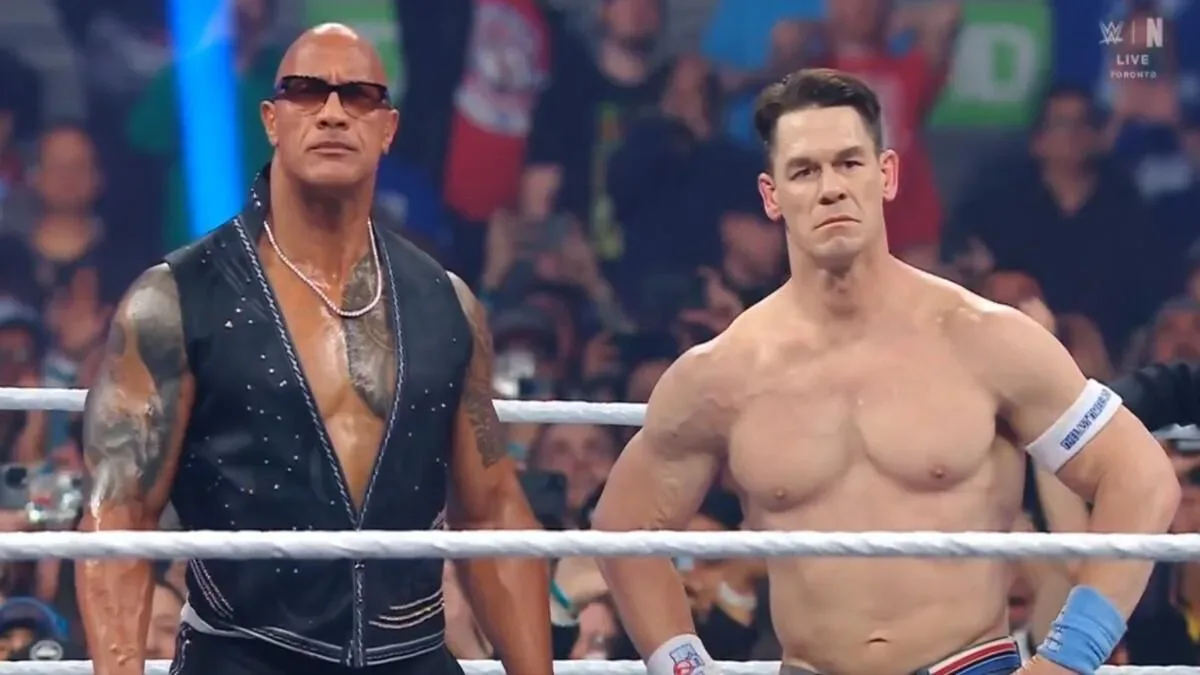
In a new interview with Men’s Health, Reigns discussed the changing appearances and training philosophies of John Cena and his cousin, Dwayne “The Rock” Johnson. Both men have balanced massive entertainment careers with their identities as WWE performers, and Reigns said their more streamlined looks should not be mistaken for any loss of physical presence.
“Even in their leaned-out stages, they’re still just superhero guys,” Reigns said. “We all get to a place where we have to adjust. We’ve got to evolve. And we have to change. I hope I can get to a place in my career, like they did, where that’s going to be the next step for me.”
The comments arrive at an interesting point for Reigns, whose own career has extended well beyond the traditional boundaries of a full-time WWE schedule. As one of the defining WWE stars of his generation, Reigns has spent years carrying the company as the centerpiece of its biggest stories and events. That position requires a level of physical preparation, but it also places an enormous demand on a performer’s body.
For more background on this topic, read Roman Reigns Explains the Demanding Physical Preparation Behind His Akuma Role in Street Fighter.
Reigns’ remarks made clear that he views physical evolution as part of longevity, not a departure from an athlete’s standards. In wrestling, size, strength, conditioning and appearance have always been central pieces of presentation. Yet performers who take on acting roles, extensive travel, promotional work and projects outside the ring often need to tailor their training toward the requirements of those commitments.
That adjustment has been visible with several prominent names. Batista, for example, has noticeably leaned down following his in-ring retirement, though he is expected to add size again for his portrayal of Kratos in Amazon’s upcoming God of War series. Reigns noted that the transition from wrestling to Hollywood can naturally alter what an athlete’s body needs to do on a daily basis.
Roman Reigns Sees A Different Shift In John Cena’s Approach
Reigns specifically addressed Cena’s training evolution, describing a change toward mobility and flexibility. Cena has remained associated with extraordinary strength throughout his WWE career, where his powerful frame and explosive style were defining traits. But Reigns believes Cena adjusted parts of his physical routine during a period that included significant time in China.
“[For John], there was a bit of a shift for him where I think he moved into mobility a lot more, and pliability, where he started really stretching,” Reigns said. “I think it was when he went to China. He spent a good bit of time over there, and I think that’s when he started to change his philosophies on a few things.”
Reigns did not frame that change as a reduction in Cena’s abilities. Quite the opposite, he emphasized that Cena remains unusually powerful.
“But John is one of those guys who’s just freakishly strong,” Reigns said.
That distinction matters when considering the demands placed on wrestlers over long careers. A physique built for peak power and a punishing WWE in-ring schedule does not necessarily need to remain unchanged forever. Mobility, flexibility and recovery can become greater priorities as performers accumulate years of impact, travel and training. For a star working across film sets and WWE appearances, the most useful version of physical preparation can look different from one stage of a career to another.
Cena’s transition has unfolded while he has remained closely connected to WWE. Even as film and television work have become major portions of his professional life, he has continued to make high-profile WWE appearances. That balancing act has allowed fans to see how his body and presentation have changed over time while his reputation for discipline and strength has remained intact.
The Rock’s Size Still Stands Out To Reigns
Reigns also addressed the subject of Johnson’s physique, stressing that television and online images may not fully communicate just how imposing The Rock is in person. Johnson has spent decades as one of entertainment’s most recognizable physical presences, first through WWE and later as a global movie star. Even when he is in a leaner phase for a particular role or goal, Reigns said his cousin remains remarkably large.
“Dwayne is huge. People don’t really understand how big DJ is,” Reigns said. “Even in his leaned-out state, he’s still a big man.”
Reigns added that his own mindset in the gym is more closely aligned with Johnson’s than with Cena’s approach. While Cena’s changes were described in terms of mobility and pliability, Reigns identified the pursuit of muscular development as a shared preference between himself and The Rock.
“I would say me and Dwayne have a little closer mindset on what we like to do in the gym,” Reigns said. “We’re chasing that pump. We’re trying to create hypertrophy.”
Hypertrophy training focuses on building muscle size, an objective that fits the visual demands associated with both WWE main-event presentation and action-oriented screen roles. Reigns’ description also offers insight into why his own physique has remained a major element of his WWE aura. He has long been presented as a dominant, heavyweight-level force, and his training priorities are consistent with maintaining that image.
At the same time, Reigns’ comments indicate that training for size cannot exist separately from recovery and overall health. The visual results may be important, but the ability to train consistently depends on recognizing when the body needs a different approach.
Reigns Details The Importance Of Listening To His Body
Reigns was candid about a recent period when physical discomfort affected his training. He explained that his elbows were badly affected last December, limiting the intensity he could bring to workouts while he was also coming out of the holidays and a period away from dieting.
“You have to listen to your body if you’re committed to this, and this is an annual thing,” Reigns said. “Your body is going to send signals when you’re not feeling good.”
“My elbows were really beat up [last] December,” Reigns continued. “So, my training struggled that whole time, and I was coming out of a non-diet phase 2 out of the holidays, so I just couldn’t get to that intensity and locked-in focus. I was just hurting. It’s just one of those things where you have to be intuitive.”
The point is particularly relevant for wrestlers, whose conditioning is shaped by far more than gym sessions. WWE performers must account for ring training, travel, match impact, media obligations and the constant need to be ready for major appearances. A workout plan may be built around a specific target, but pain and fatigue can force adjustments. Reigns’ description of being intuitive reflects a practical approach: maintaining progress over the long term can mean backing off when the body signals that the workload is becoming too much.
It is also a reminder that performers with elite physiques are not immune from those challenges. Reigns spoke about Cena and Johnson as uniquely gifted athletes, but he also placed all three men within the same broader reality of aging, workload and adaptation. The goal is not necessarily to preserve one exact body type forever. Instead, the objective is to remain capable, healthy and prepared for the next professional demand.
Hollywood Remains A Goal For The Tribal Chief
Reigns did not announce a specific acting project while discussing Cena and Johnson, but he openly expressed hope that his career can someday follow a similar path into a new phase. He has already begun taking steps outside WWE, including preparation for his role as Akuma in Street Fighter. That role represents a significant opportunity for Reigns to bring the screen presence that has defined his wrestling persona into a different medium.
His comparison to Cena and The Rock was therefore not simply about gym routines. It was also about the next chapter available to a WWE headliner whose profile reaches beyond the ring. Cena and Johnson established two different models for that transition, each remaining identifiable as a WWE superstar while navigating the altered physical demands of film and television work.
For Reigns, the lesson appears to be one of evolution. He still values the pump, hypertrophy and the imposing look that helped make him WWE’s Tribal Chief. But he also recognizes that an annual commitment to physical performance requires adaptability, particularly when injuries, soreness or outside opportunities change the equation.
Whether training for WWE, a film role or a future Hollywood schedule, Reigns’ message was direct: exceptional athletes still have to make adjustments. Cena remains “freakishly strong.” The Rock remains enormous even when leaner. And Reigns is learning that the most important part of staying ready is knowing when to push forward and when to listen to what his body is telling him.

Darryl Polo
Darryl Polo is a passionate wrestling fan covering WWE, AEW, TNA and beyond. He loves great rivalries, breakout stars and the moments that keep fans talking long after the bell. How we work.