
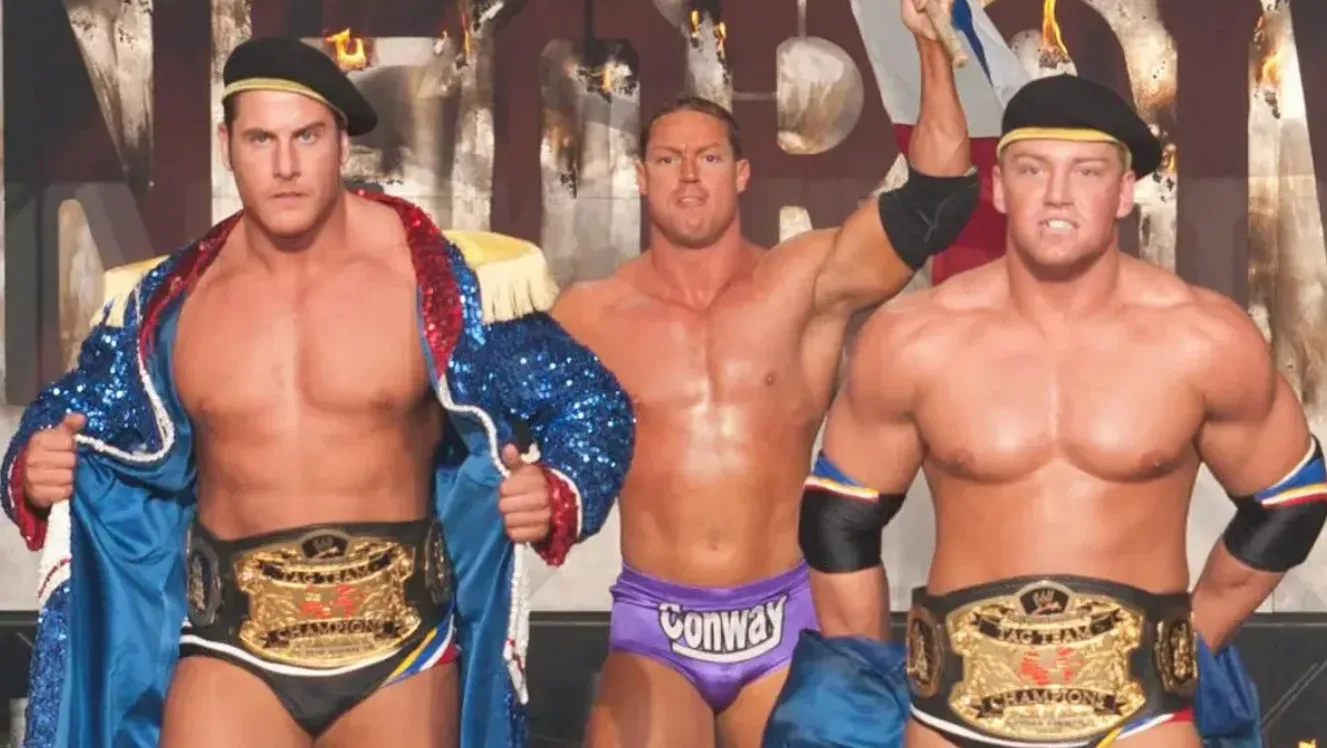
Rob Conway believes WWE ended La Resistance’ initial run before the group had reached its full potential.
Conway, Rene Dupree and Sylvain Grenier were the members associated with La Resistance during the group’s early-2000s WWE run. Although the act’s first incarnation existed only in 2003, Conway remains convinced that its connection with the audience was strong enough to support a much longer stay together.
Speaking to Chris Van Vliet, Conway reflected on the decision to separate the group and described it as a clear step backward for all three performers. In Conway’s view, WWE had taken an act with substantial heat and replaced it with individual characters that did not carry the same momentum or presentation.
“They never stopped hating us. They broke us up way too soon, like you took one faction that had more heat than anybody and broke us up into three not that strong of characters. So I felt like it was kind of a demotion when they broke us up. Went from being all the shows, being on pay-per-views, to having bad music, and being on middle to low card, having bad music.”
For more background on this topic, read Tate Wilder Says Myles Borne Has Become a Key Mentor in NXT.
Conway saw La Resistance as a complete act
Conway’s comments focus on a fundamental part of group wrestling presentation: a faction is often more than a collection of individual wrestlers standing beside one another. A successful team or stable has its own identity, audience reaction and role on a show. In Conway’s estimation, La Resistance had all of those elements working in its favor.
The former WWE talent emphasized that the audience response did not fade. “They never stopped hating us,” Conway said, presenting the sustained negative reaction as evidence that the group was doing its job. In wrestling, crowd hostility toward villains can be an important measure of whether an act is connecting. Conway’s argument is that La Resistance had already established that connection and therefore did not need to be dismantled so quickly.
That distinction is central to his disappointment. Conway was not simply saying that a later singles run could have been handled differently. He believes the act that was removed from WWE programming was more valuable than the individual parts that followed it. The split, from his perspective, weakened a presentation that had been regularly featured and had a recognizable place in the company’s programming.
A shift from featured faction to separate characters
Conway described the aftermath in blunt terms, calling the breakup “kind of a demotion.” He contrasted the group’s exposure with what he viewed as a diminished spot once its members became separate performers. La Resistance, he said, had been appearing “all the shows” and on pay-per-views. The later presentation, in his memory, meant middle- to lower-card positioning and music he strongly disliked.
His repeated criticism of the music may sound like a small detail, but it illustrates the broader point he was making about presentation. Entrance music, recurring television appearances and pay-per-view inclusion all contribute to the perceived importance of a WWE act. Conway’s recollection is that those pieces were in place for La Resistance, then were not available to the same degree after the split.
For Conway, the difference was especially pronounced because the three-man unit had already created a distinct audience response. Once the group was gone, he felt that WWE had separated performers who benefited from a shared identity and placed them into singles roles that were less defined. His remarks do not suggest that the performers lacked ability as individuals; rather, he believes the booking failed to preserve the strongest version of what they had built together.
Why faction chemistry can be difficult to replace
La Resistance’ brief first run is a reminder that wrestling groups can develop chemistry that cannot automatically be recreated through singles booking. The dynamic among members, the visual unity of the act and the response it draws can make a team feel larger than the sum of its parts. When that combination is working, a split carries risk even if the performers involved are capable of succeeding independently.
Conway’s assessment makes that risk the heart of the story. He felt the group had “more heat than anybody,” a subjective but emphatic reflection of how powerful he believed the act’s crowd reaction to be. The complaint is not merely that La Resistance did not receive more time. It is that WWE chose to end a presentation Conway believes was among the company’s most effective antagonistic acts at that moment.
That perspective also highlights the gap between being featured as part of a unit and being positioned as a singles character. A wrestler can be visible within a faction because the faction’s premise is instantly recognizable. After a split, each member needs a clear direction, presentation and consistent television purpose. Conway’s comments indicate that he did not feel those elements were as strong once La Resistance no longer existed as a group.
The former WWE performer’s choice of the word “demotion” is revealing. It frames the change not as an opportunity to graduate into a more prominent individual role, but as a move away from a successful act. The team’s payoff, in Conway’s eyes, was already evident in its regular presence and its place on pay-per-view cards. Breaking it apart meant abandoning that platform.
La Resistance still has a place in Conway’s career
Despite the brevity of its original run, La Resistance has remained part of the conversation around Conway, Dupree and Grenier. The group last teamed together in 2024, demonstrating that the association between its members has endured long after the first WWE version ended in 2003.
That later reunion does not change Conway’s frustration about the initial breakup, but it underlines the lasting recognition of the name and the connection between the three wrestlers. For Conway, the group was not simply a short chapter that disappeared when WWE moved on to other plans. His comments show that he still sees it as a missed opportunity—an act that had audience heat, television exposure and a clear collective identity, but was separated before he believed it should have been.
There is often a temptation to view a breakup as an automatic sign that a team or faction has completed its purpose. Conway plainly does not see La Resistance that way. He believes it was still working, and that the audience reaction remained intact. In his telling, WWE broke apart a group that was drawing the desired emotional response and replaced it with individual roles that were not as compelling.
Whether fans view the group’s first run through the same lens, Conway’s comments provide a direct look at how he measured its value. He points to heat, consistent appearances and pay-per-view involvement as proof that La Resistance was thriving. He points to reduced placement and weaker presentation afterward as proof that the decision cost the members momentum.
More than two decades after that 2003 run, Conway’s conclusion remains unchanged: La Resistance should have stayed together longer. The act may have had a limited first lifespan, but he believes its audience reaction and visibility showed it had much more to offer before WWE chose to move in another direction.
In pictures

Darryl Polo
Darryl Polo is a passionate wrestling fan covering WWE, AEW, TNA and beyond. He loves great rivalries, breakout stars and the moments that keep fans talking long after the bell. How we work.