
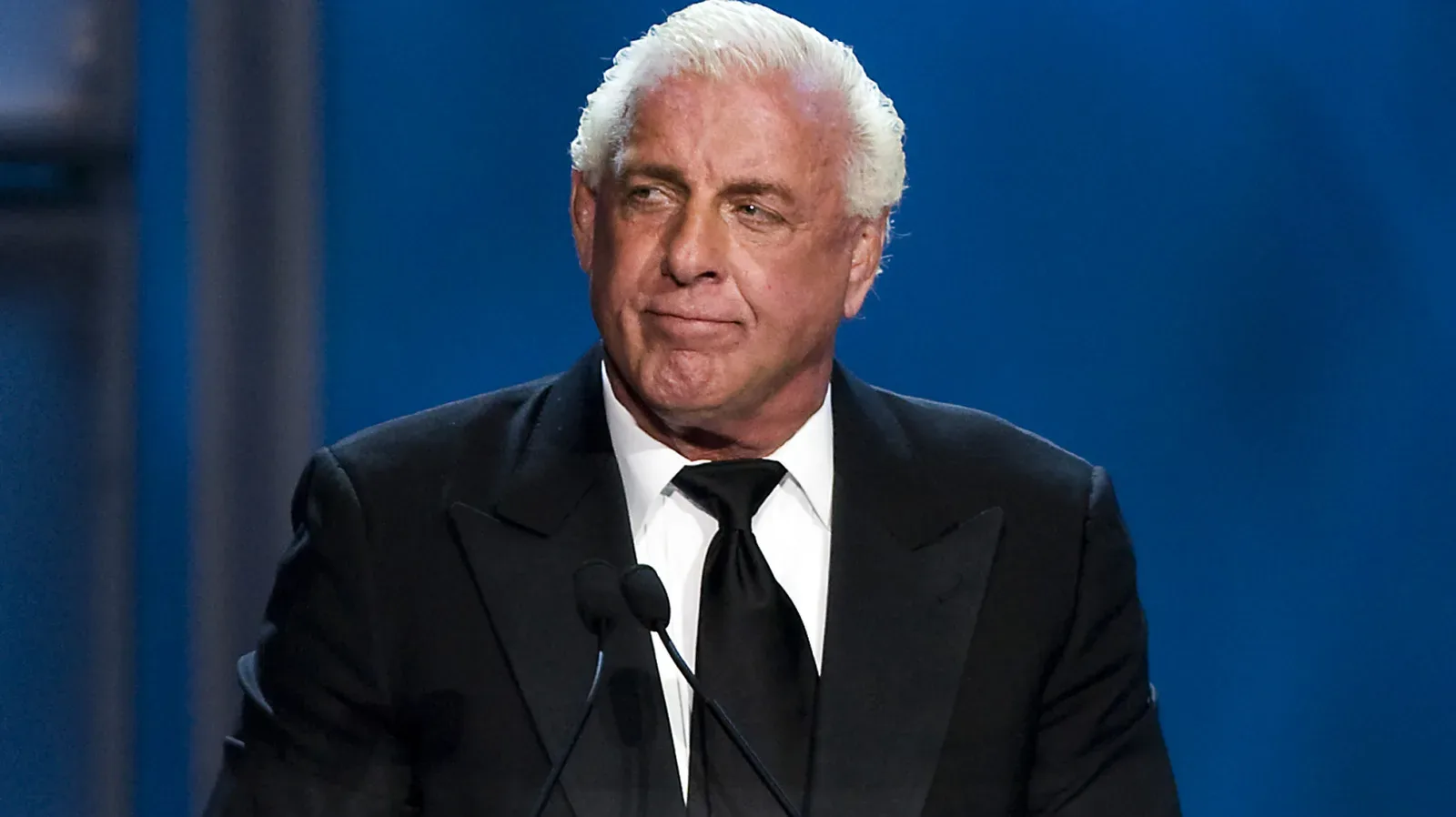
Ric Flair has opened up about an intensely personal family memory involving his late son, Reid Flair, addiction, and a Rolex watch that carried enormous sentimental value to the WWE Hall of Famer.
During an appearance on Roman Sharf’s Dual Time Podcast, Flair initially discussed his longstanding appreciation for Rolex watches through a warm story about buying a gold-and-silver model for his father as a Christmas present. The conversation then took a far more difficult turn as Flair explained what eventually happened to that particular watch during Reid’s battle with heroin addiction.
Flair said his father was not just a parent, but his best friend, and that the gift created a meaningful shared moment between them. The watch subsequently became one of Flair’s most prized possessions because of the connection it represented.
“I wanted to buy my dad something cool for Christmas, so I bought my dad a Gold and Silver,” Flair said on Roman Sharf’s Dual Time Podcast.
For more background on this topic, read X-Pac Recalls Triple H and Vince McMahon Helping Him Seek Treatment During Addiction Struggles.
For Flair, the object was never simply an expensive piece of jewelry. It was a reminder of his relationship with his father and of an occasion that clearly stayed with him. That is why the later loss of the watch became tied to an even more painful chapter in the Flair family’s history.
Flair recalled that Reid was especially close with his grandparents and said his youngest son was their favorite grandchild. Reid repeatedly asked his father if he could wear his grandfather’s Rolex. Flair was understandably reluctant because of what it meant to him, but he eventually agreed.
“He kept saying to me, ‘Dad, let me wear grandpa’s Rolex!’ I said: ‘Jesus, honey, that’s the most prized possession I have, you know,’” Flair recalled on Roman Sharf’s Dual Time Podcast.
Flair said that the watch was later sold by Reid to purchase heroin. In recalling the event, Flair described that moment as the point at which he knew there was a serious problem. The loss of the Rolex was devastating on its own, but the circumstances surrounding it made clear the extent to which addiction had taken hold.
“And finally he talked me into it. And he – this is what told me there was something really wrong – he sold it to buy heroin,” Flair said on Roman Sharf’s Dual Time Podcast.
The former multi-time world champion added that a friend who had retired from police work attempted to use his connections to locate the watch. Despite those efforts, Flair said the Rolex was never recovered.
It is a small detail in the scope of a much larger tragedy, but it carries weight because of what the watch represented at every stage of its history. Flair bought it as a show of love for his father. It became one of his own most treasured possessions after his father received it. Then it became a painful marker of Reid’s addiction and of a family’s inability to stop the damage it was causing before it was too late.
Reid Flair’s Place in a Wrestling Family
Reid Flair was part of one of professional wrestling’s most prominent families. Ric Flair’s children each had their own relationship with the industry. David Flair entered wrestling, while Ashley Fliehr became globally known as Charlotte Flair and established herself as one of WWE’s defining stars of the modern era. Charlotte has built a championship résumé that has placed her close to Ric Flair’s famous 16-time world championship benchmark.
Reid also pursued wrestling and had aspirations within the business. However, his life was marked by a very public and difficult struggle with substance abuse. He died in 2013 from a drug overdose, a loss that has remained one of the most devastating events in Ric Flair’s life.
Ric Flair has discussed Reid’s death and addiction on several occasions over the years, often doing so with a combination of grief, regret, and blunt honesty. His comments on the podcast continue that pattern. Rather than presenting addiction as a distant issue or an abstract warning, Flair described a specific moment in which its consequences arrived inside his own family and took away something connected to a cherished memory of his father.
The story also underlines the complicated reality faced by relatives of people struggling with addiction. A loved one may make promises, seek trust, and appear to be asking for something simple. Families can want to believe they are helping, or that a gesture of trust may make a difference. Flair’s memory of finally allowing Reid to wear the Rolex is especially difficult because the decision was rooted in a father’s love for his son and Reid’s connection to his grandparents.
A Story Bigger Than a Lost Watch
Flair’s account is not ultimately about the monetary worth of a Rolex. The watch was irreplaceable because of the person it came from and the occasion on which it was given. Its disappearance therefore represented more than a financial loss. It was the loss of a physical link to Flair’s father, combined with an alarming realization about his son’s condition.
His recollection that the sale of the watch made him understand that something was deeply wrong speaks to the way addiction can force families to confront realities they may have hoped were not as severe as they appeared. In Flair’s telling, the incident was a turning point in awareness, not a solution. A retired police officer’s attempt to retrieve the watch also could not undo what had happened or resolve the larger struggle.
That helplessness is central to the emotion of Flair’s story. Connections were used, efforts were made, and the family tried to respond. Yet the watch was not recovered, and the addiction that drove its sale remained a destructive force in Reid’s life.
For wrestling fans, Ric Flair is frequently associated with the extravagant image that helped make him one of the industry’s most recognizable figures. Robes, championship celebrations, high-profile rivalries, and his larger-than-life personality have long been part of that legacy. But moments such as this one show the human side beneath that public persona. The Rolex was not a symbol of wrestling excess to Flair. It was a gift for his father, a keepsake from a treasured relationship, and eventually a reminder of heartbreaking family loss.
Charlotte Flair’s continued success in WWE means the Flair name remains central to the wrestling landscape. Her accomplishments are a point of pride for her family, while David and Reid’s involvement in wrestling remains part of the broader history of the Flairs in the business. Ric Flair’s willingness to discuss Reid’s life does not remove the pain of what happened, but it ensures that Reid is remembered as more than a footnote in a famous family story.
The account shared on Dual Time Podcast is difficult because it does not offer a neat resolution. The treasured watch was never found. Reid’s addiction ended in tragedy. What remains is Flair’s memory of his father, his love for his son, and an unvarnished acknowledgment of how profoundly substance abuse affected his family.
By telling the story, Flair gave the loss of the Rolex its proper context: not as an anecdote about a luxury item, but as one painful moment within a father’s enduring grief for his child.
In pictures

Darryl Polo
Darryl Polo is a passionate wrestling fan covering WWE, AEW, TNA and beyond. He loves great rivalries, breakout stars and the moments that keep fans talking long after the bell. How we work.