
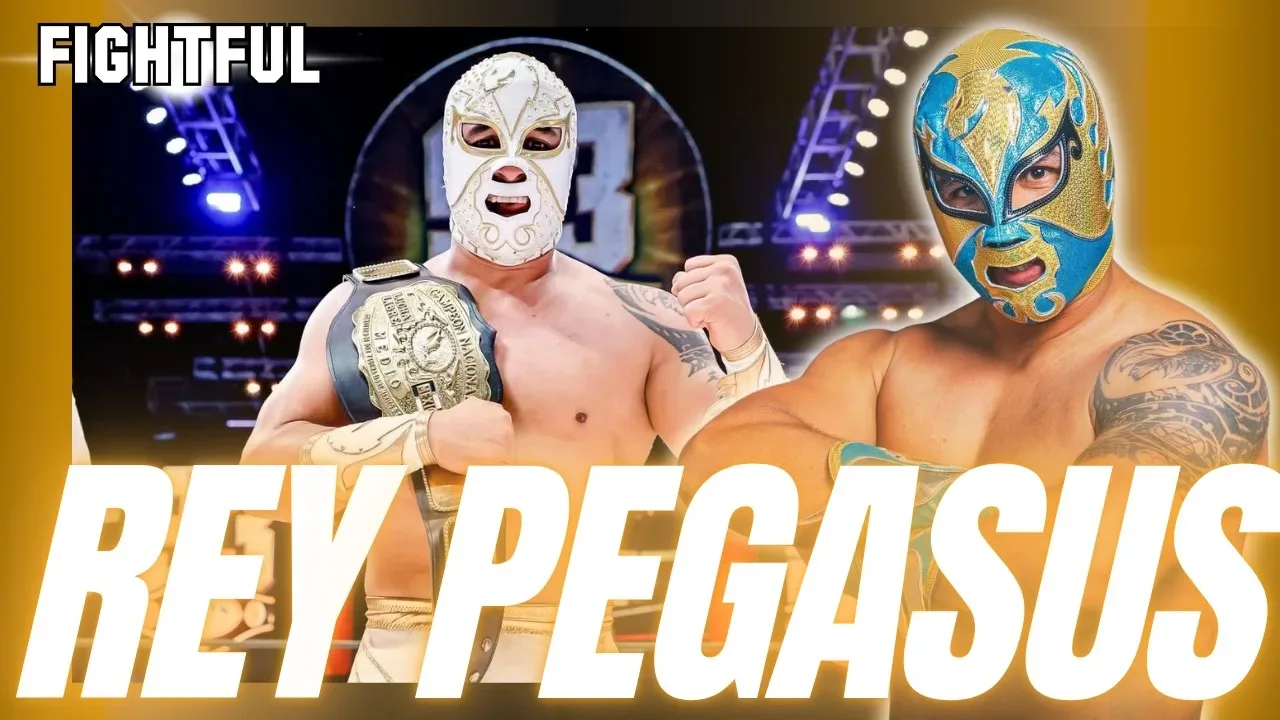
Rey Pegasus believes the difference in his developing career has come from refusing to treat high-flying wrestling as a finished product.
The World Wrestling Council standout recently reflected on the approach behind his aerial style after making an early impact in the promotion. Pegasus and Tornado won the 2026 Torneo de Escuelas, defeating the teams of Estudiante Jr. and Feroz as well as Pantera Jr. and Psycotic on their way to the tournament victory. For Pegasus, the result was tied directly to the work he put into creating offense that he felt would stand apart in a company already full of impressive wrestlers who take to the air.
Rather than simply trying to keep pace with the established level of athleticism around him, Pegasus said he made a conscious decision during his training to search for movements and sequences that audiences had not already associated with the WWC roster.
“That’s exactly what has made the difference. I was well aware that the World Wrestling Council has magnificent aerial wrestlers; that’s why, during my training at the schools, I focused specifically on coming up with moves that were very different from anything the company had seen before: very different aerial moves because, obviously, the audience likes to see something different.”
For more background on this topic, read Rebel Honored With Induction Into Owasso High School Hall Of Fame.
That perspective speaks to the challenge faced by any young wrestler building an identity through a fast-paced, acrobatic style. Aerial wrestling can instantly capture an audience’s attention, but it is also an area in which fans have seen a vast range of dives, springboards, rotations, and combinations. Pegasus’ comments make clear that his objective was never merely to be known as another capable flyer. He wanted his offense to offer a recognizable point of difference.
His 2026 Torneo de Escuelas success with Tornado gave that philosophy an important competitive platform. Tournament environments put a premium on quick connections with the crowd and on presenting a team with a defined identity. Pegasus and Tornado emerged from a field that included Estudiante Jr. and Feroz, along with Pantera Jr. and Psycotic, and Pegasus views the pair’s shared willingness to introduce fresh ideas as a meaningful part of their progress.
A deliberate approach to standing out
Pegasus did not frame originality as a matter of dismissing the wrestlers who came before him. Instead, he acknowledged the quality of WWC’s aerial performers and positioned his own approach as an effort to add something new to an already strong environment. That distinction is important. His goal was to find a lane within the promotion, not simply to claim that he was different without putting the work in to demonstrate it.
He said his training was rooted in the idea of making a difference rather than looking like everyone else. In his view, that commitment has helped both him and Tornado, whose partnership has allowed the two wrestlers to bring new moves into their matches.
“I believe my training has always been about making a difference and not being like everyone else, and that’s what has helped us. It’s helped us with Tornado as well. All the new moves I’ve introduced & that we’ve incorporated into our matches have really helped me a lot.”
For a team, incorporating new offense is about more than adding individual highlights. It can help establish rhythm, create surprise, and give supporters a reason to invest in the duo’s next appearance. Pegasus’ comments suggest that Tornado has been an important collaborator in putting those ideas into a match setting. The tournament win therefore stands not only as a personal achievement for Pegasus, but also as a validation of the work the two have done together.
The phrase “making a difference” came up repeatedly in Pegasus’ explanation, underlining how central that idea is to his wrestling identity. He wants viewers to recognize that there is intention behind the high-risk elements of his matches. The aim is to create a visual impression, but also to make sure that the audience has a reason to remember what they saw once the action is over.
Searching for the extra element
Pegasus also addressed a familiar saying in wrestling: the idea that everything has already been done. It is a thought that can be especially relevant to aerial wrestlers, whose style has evolved for generations through performers constantly attempting to add greater speed, precision, creativity, and danger to their presentation.
His answer was not to deny that wrestling has an enormous history. Instead, Pegasus said the search is always for an added detail that can make a match feel distinct in the moment. He described that extra element as something meant to appeal to the live audience, the media, and everyone who comes to watch.
“People say that wrestling has already been invented, but we’re always looking for that extra something—that element that makes everything look different to please the audience, to please the media, and to please everyone who comes to watch us make that difference.”
That is a practical outlook for a wrestler who is still establishing himself. Pegasus is not presenting innovation as a one-time destination. The comments point to an ongoing process: train, develop ideas, adapt them with a partner, introduce them in competition, and continue searching for the next wrinkle that will catch people’s attention.
It also places the emphasis on the audience experience. Pegasus repeatedly connected his creative choices to what fans want to see. His belief is that viewers respond when performers offer something beyond the expected, and that a wrestler’s responsibility is to keep pursuing those moments. In a style built around speed and spectacle, the smallest adjustment in timing, setup, or execution can alter how a sequence is received. Pegasus wants those decisions to be purposeful.
Momentum following Torneo de Escuelas
Winning the Torneo de Escuelas has given Pegasus and Tornado a significant accomplishment to point to in 2026. They overcame two opposing teams in the tournament—Estudiante Jr. and Feroz, followed by Pantera Jr. and Psycotic—to claim the victory. Pegasus’ remarks provide insight into how he sees the work behind that breakthrough.
He said the underlying idea was to make people turn their attention toward him and his work. Importantly, he did not describe that as an attempt to establish some fixed standard for others to follow. Rather, he wants people to look at his performances and notice that he is doing things differently. For Pegasus, that attention is the reward for developing an approach that does not settle for familiar patterns.
“That was precisely the idea—to get people to turn their attention to us, not to set that standard and say, ‘Okay, look, he does very different things’—and to this day, that’s what’s helping us.”
The wording reflects a measured confidence. Pegasus clearly takes pride in the originality he and Tornado have tried to bring to their matches, but he also recognizes that being different only matters if it continues to connect. The Torneo de Escuelas victory gives the team a concrete result, while the ongoing challenge is to maintain that sense of discovery each time they compete.
Pegasus also discussed getting to meet fellow wrestlers through the Torneo de Escuelas. That aspect of the tournament adds another layer to its value beyond the final result. Events involving a range of emerging performers can create opportunities to share a ring with different opponents, observe different approaches, and measure one’s own growth in a competitive setting. While Pegasus’ primary message centered on his aerial innovation, his tournament experience also involved those connections with other wrestlers.
For now, Pegasus’ message about his style is straightforward: he wants his work to be identifiable because it does not look like everyone else’s. In a WWC landscape he openly describes as rich with talented aerial wrestlers, he sees continued invention as the way to separate himself. The 2026 Torneo de Escuelas win with Tornado is already an important marker of that effort, and Pegasus believes the new moves and concepts they have incorporated have played a real role in putting them on the radar.
Whether he is competing alongside Tornado or continuing to develop his own individual repertoire, Pegasus has laid out the standard he intends to follow. High-flying ability is the foundation, but not the final objective. The objective is the extra element—the unexpected moment that makes fans look up, take notice, and remember the name Rey Pegasus.

Darryl Polo
Darryl Polo is a passionate wrestling fan covering WWE, AEW, TNA and beyond. He loves great rivalries, breakout stars and the moments that keep fans talking long after the bell. How we work.