
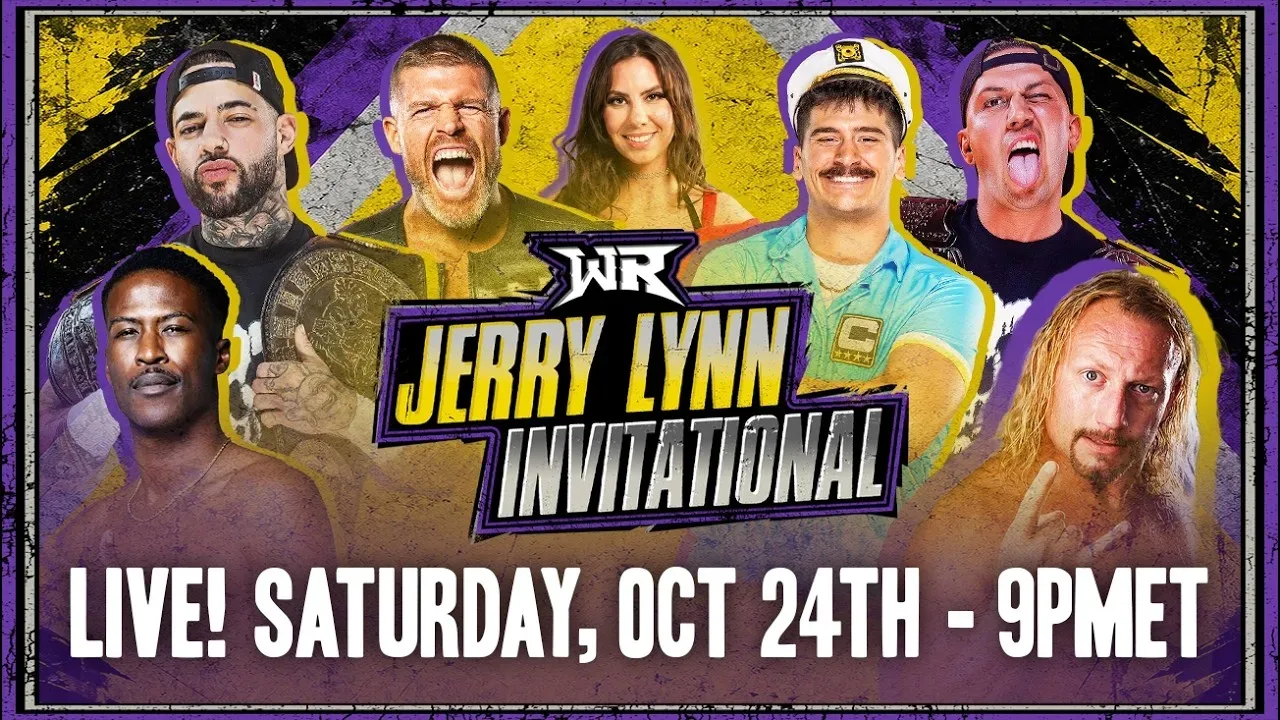
Wrestling Revolver presented The Jerry Lynn Invitational on Saturday, October 24, with a card built around a compact tournament format and several major championship matches. The event was scheduled for 9 p.m. ET and 8 p.m. CT and placed the spotlight on a first-round field featuring BDE, Trey Miguel, Juni Underwood, Marcus Mathers, Steve Maclin, Crash, Colby Carter and Troy Parker.
The central attraction was the invitational itself, which was structured to move quickly from two four-way opening-round matches into a tournament final later on the same card. Jerry Lynn was designated as the special referee for that final, making the wrestling veteran an important figure in the conclusion of the tournament. With the finalists still listed as to be determined ahead of the event, every entrant in the opening-round matches had a direct route to a high-profile bout officiated by Lynn.
Jerry Lynn Invitational opens with two four-way matches
The first opening-round match brought together BDE, Trey Miguel, Juni Underwood and Marcus Mathers. It was a notable mix of competitors with differing profiles, all entering a match where the immediate objective was simple: survive the four-way format and advance to the final. Four-way matches naturally create shifting alliances, divided attention and sudden opportunities, and that made the opening round especially consequential for the wrestlers involved.
Miguel entered the field as one of the most recognizable names on the show, while Mathers and Underwood represented hungry tournament competition looking to make the most of the opportunity. BDE completed a lineup in which no participant could afford to focus on only one opponent. The winner would not merely claim an opening-match victory; they would also move one step closer to winning an invitational named for one of the most respected wrestlers of his generation.
For more background on this topic, read Greektown Wrestling Results: ELP Earns Championship Opportunity in Toronto.
The other first-round four-way match featured Steve Maclin, Crash, Colby Carter and Troy Parker. Like the first qualifier, it offered only one advance spot, forcing four competitors to compete in an environment where momentum could change without warning. Maclin’s inclusion gave the bracket another established name, but the format meant reputation alone could not guarantee a place in the final.
Crash, Carter and Parker each had the same opportunity to disrupt the expected path of any favored entrant. Four-way bouts reward awareness as much as endurance. A wrestler can be removed from the action temporarily, can return at the right moment, or can capitalize after another competitor has done much of the damage. That dynamic made both first-round bouts important not only as qualifiers, but as tests of who could remain composed in a crowded and unpredictable match.
Jerry Lynn set for special referee role in the final
The tournament final was listed as a match between the winners of the two opening-round contests, with Jerry Lynn serving as special referee. The stipulation gave the invitational a direct connection to its namesake rather than treating the name as a simple label for the event. Lynn’s role meant the final had an additional layer of scrutiny, as the eventual finalists would compete with a legendary figure assigned to oversee the deciding match.
That setup also created a demanding night for whichever wrestlers advanced. Each finalist first had to navigate a four-way contest, then return for a one-on-one final against another wrestler who had survived the same tournament path. The schedule made recovery, strategy and resilience significant factors. Winning the Jerry Lynn Invitational required more than a single strong performance; it required adapting to two different situations in one evening.
The tournament was only one part of a card that also included three championship attractions. Those title matches gave Wrestling Revolver a lineup with several distinct stakes: a new invitational winner would be determined, the Revolver World Title would be defended, the Revolver Remix Title would be contested under Falls Count Anywhere rules, and Gringo Loco’s 24/7 Scramble Title would be placed on the line through an open challenge.
Damian Chambers defends the Revolver World Title against Jake Painter
In the card’s Revolver World Title match, champion Damian Chambers, accompanied by Kayla Kassidy, was scheduled to defend against Jake Painter. A world title bout carries the clearest possible objective for the challenger: Painter had the chance to leave the event with Wrestling Revolver’s top championship. For Chambers, the task was to continue his reign against a challenger entering a featured position on the show.
Kassidy’s presence at ringside was specifically attached to the champion in the match listing, giving Chambers an ally as he prepared to face Painter. Championship matches can be shaped by preparation, composure and the ability to handle the pressure of the moment, and the title bout represented one of the evening’s most direct tests of those qualities.
The match also stood apart from the tournament because it did not require Chambers or Painter to manage a multi-match bracket. Instead, both men could direct their full focus toward one another and the Revolver World Title. In a show containing four-way eliminators and a Falls Count Anywhere fight, the world title match offered a conventional championship setting with the promotion’s most prominent prize at stake.
Zachary Wentz and Cole Radrick meet in Falls Count Anywhere action
The Revolver Remix Title match carried its own unmistakable identity. Champion Zachary Wentz was set to defend against Cole Radrick in a Falls Count Anywhere match. The stipulation removed the normal limits of a standard bout, allowing the decisive fall to take place anywhere rather than requiring the action to remain contained inside the ring.
That rule added a volatile dimension to an already important title defense. Wentz was not simply asked to beat Radrick; he had to do so in a match designed to make the entire surrounding environment part of the contest. Radrick, meanwhile, had a championship opportunity in a format capable of rewarding improvisation and persistence as much as technical execution.
Falls Count Anywhere matches can quickly become difficult to control because neither wrestler is protected by the usual expectation that an opponent must be brought back inside the ropes for a finish. For the Remix championship, that created a sharp contrast with the World Title match. Where Chambers and Painter were scheduled for a traditional title confrontation, Wentz and Radrick were booked for a fight where location could become as important as momentum.
Gringo Loco issues a 24/7 Scramble Title open challenge
Gringo Loco was also scheduled to defend the 24/7 Scramble Title through an open challenge. Unlike the other announced championship bouts, the match listing did not identify his opponent. That uncertainty was the point of the attraction: the champion’s challenger was open, leaving the audience to wait and see who would answer.
An open challenge carries a different kind of risk for a titleholder. A champion preparing for a named opponent can study a specific style and anticipate a particular game plan. With no opponent announced in advance, Gringo Loco’s defense was defined by uncertainty. Whoever stepped forward would have the chance to challenge for the 24/7 Scramble Title without being part of the originally named match lineup.
The open challenge also reinforced the variety of the card. The invitational had a clear bracket. The World Title match had a champion and identified challenger. The Remix Title match had an identified challenger plus a special stipulation. The 24/7 Scramble Title defense offered an unanswered question until challenge time.
Street fight and tag action round out the lineup
Beyond the tournament and title bouts, Wrestling Revolver scheduled a Trio Street Fight between Alpha Sig and Tye or Die. The Street Fight designation promised a more confrontational setting than standard trios competition. With three wrestlers on each side, the match had the potential for sustained chaos and rapidly changing pairings as both teams fought for control.
The card also included The Outbreak versus The Production. While the match listing did not attach a championship or additional stipulation to that contest, it remained a significant part of a show designed to feature a broad range of match structures. Between the tournament, title bouts, street fight and tag match, the event offered a full slate rather than relying on one attraction alone.
At the center of it all was the Jerry Lynn Invitational. The winners of BDE versus Trey Miguel versus Juni Underwood versus Marcus Mathers and Steve Maclin versus Crash versus Colby Carter versus Troy Parker were positioned to meet in the final, with Lynn presiding as special referee. Alongside that tournament conclusion, Damian Chambers versus Jake Painter, Zachary Wentz versus Cole Radrick, and Gringo Loco’s open challenge ensured that championships remained central to Wrestling Revolver’s October 24 event.
The result was a card defined by immediate stakes across multiple divisions: advance or be eliminated in the invitational, retain or win championship gold, survive a Falls Count Anywhere environment, answer an open challenge, or prevail in a Street Fight. Wrestling Revolver’s Jerry Lynn Invitational brought those elements together for a night with a tournament winner still to be determined and several champions facing high-pressure defenses.

Darryl Polo
Darryl Polo is a passionate wrestling fan covering WWE, AEW, TNA and beyond. He loves great rivalries, breakout stars and the moments that keep fans talking long after the bell. How we work.