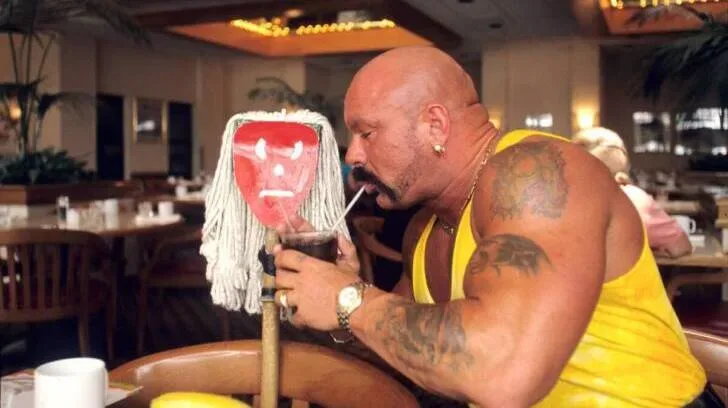
Perry Saturn’s WWE run included acclaimed work as part of The Radicalz, hard-hitting matches, and a reputation built long before his arrival in the company as one of the toughest and most intense performers in wrestling. It also included Moppy, the mop that became central to one of the stranger character transformations of the early 2000s.
Saturn has now reflected on the circumstances that led him from a serious in-ring presentation to the eccentric act that became known for its affection toward an inanimate mop. In discussing the infamous 2001 incident involving Mike Bell on WWE Jakked/Metal, Saturn said the fallout from that match directly preceded the Moppy storyline. He acknowledged that his conduct was wrong, while also describing the physical impact of the botched sequence that triggered the situation.
The match with Bell remains one of the more uncomfortable real-life chapters from WWE programming of that era. During an attempted arm drag, Bell’s execution of the move went wrong and Saturn landed awkwardly on his head. Saturn then attacked Bell for real in the ring. The incident created immediate backstage heat and became a major turning point in Saturn’s television direction.
The Mike Bell Match and the Backstage Reaction
Saturn said the response behind the scenes was intense. Tom Prichard was the agent for the match, and Saturn recalled Prichard initially trying to assess the situation and make sure Bell was alright.
For more background on this topic, read Bronson Reed Details Bicep Injury, Training Changes and WWE Return.
“They were hot,” Saturn said. “Tom Prichard was the agent, and he babyfaced me with the heat. ‘Perry, are you okay? We need to make sure he’s okay. I didn’t know he landed on his head like that.’”
While Saturn’s reaction in the match has been widely remembered as an example of a wrestler taking liberties after a mistake, he did not present his own physical condition as an excuse. He said that when he woke up the following day, his neck was badly affected enough that he needed medical attention. At the same time, Saturn was clear that being hurt did not make his response acceptable.
“The next day, my neck was f*cked up,” Saturn said. “I had to go to the doctor to get my neck looked at, but I wasn’t hurt, and that doesn’t give me the right to do what I did.”
That distinction is important in Saturn’s retelling. He described being disoriented in the aftermath of landing on his head, but he did not attempt to fully absolve himself. The botch and its consequences were serious, and WWE management confronted him over what had occurred.
Saturn said Vince McMahon wanted a direct assurance that the situation would not happen again. Yet Saturn felt he could not honestly offer the precise promise McMahon requested because he did not believe his reaction had been deliberate in the way the question suggested. That answer, by Saturn’s account, only increased the tension in the conversation.
“Vince told me, ‘Okay, Perry, you have to tell me right now that you’re never going to do that again,’” Saturn recalled. “I go, ‘Vince, I didn’t do it on purpose this time, so I can’t tell you that because I didn’t mean to do it.’”
Saturn explained that he was unwilling to say something merely to satisfy the moment if he did not believe it was true. He said McMahon became angry, but Saturn stayed with his explanation that he had landed on his head and was not fully aware of what he was doing. Within a week, he was working as Moppy’s devoted companion on WWE television.
A Drastic Shift in WWE Presentation
The Moppy material was an especially dramatic departure for Saturn. Prior to that period, he had been established through rugged, physical work in ECW, WCW, and WWE. He had also been associated with a stern demeanor that made the ensuing character change feel intentionally jarring.
On screen, Saturn began behaving erratically and treating Moppy as though it were a beloved companion. The angle made him an object of comedy, with the mop eventually becoming one of the defining visual memories associated with his WWE tenure. For a performer who viewed himself as serious and whose style had been shaped by intense competition, the idea naturally carried a major concern: whether it would permanently damage the way audiences saw him.
Saturn said the concept was not personally presented to him by the people ultimately behind the decision. Instead, Paul Heyman, whom Saturn called “Paul E,” was sent to explain the direction. Saturn believed WWE may have expected him to refuse the idea or walk away from the company.
“They didn’t pitch it to me,” Saturn said. “They had Paul E pitch it to me because I was close with Paul E, and I’m pretty sure they assumed I was going to quit, and I was going to.”
Heyman’s involvement mattered because of his long professional history with Saturn. The two had worked together during ECW’s rise, where Saturn became a prominent member of The Eliminators alongside John Kronus before later joining The Triple Threat. Saturn trusted Heyman, even if he strongly disliked the proposed WWE direction.
Paul Heyman’s Challenge: Make It Work
Saturn recalled Heyman explaining the concept in a manner that made the intended portrayal clear. Saturn said Heyman effectively presented him as “the village idiot,” a framing Saturn immediately rejected because he felt it would make him look foolish.
“I go, ‘Paul E, I’m not going to do that. I’m going to look like a f*cking idiot,’” Saturn said. “He goes, ‘Perry, you have no choice. You have to do it.’”
Saturn’s response was that he would be in trouble whether he accepted the role or refused it. He said he considered simply going home. Heyman’s counterargument was simple and became the advice Saturn repeatedly returned to during the storyline: it would not hurt him if he got it over with the audience.
“You won’t be f*cked if you get it over,” Heyman told him, in Saturn’s recollection.
That was the key point that convinced Saturn to continue, though he said he thought about quitting every day during the run. He trusted Heyman’s judgment, and he focused on finding a way to give the character as much commitment as possible. Rather than being handed detailed creative notes or a clear roadmap, Saturn said he received little more than the mop itself.
“They never gave me any direction or anything,” Saturn said. “They just go here’s the mop and do whatever. They called them Saturnisms.”
Creating the ‘Saturnisms’
With minimal instruction, Saturn said he was responsible for developing much of the character’s behavior. That included treating Moppy as a version of Wilson, the volleyball companion from Cast Away. Saturn also referenced the island material as part of the collection of ideas he devised himself.
“No direction at all,” Saturn said. “I come up with all that sh*t on my own. The island, Castaway, I make Moppy into the ball, Wilson.”
The story illustrates a recurring reality of WWE creative life, especially in an era when performers could be given abrupt character changes with little warning. A performer might reject an assignment, attempt to negotiate it, or take the challenge of making it connect. Saturn’s account places him in the last category, even though his initial reaction was strongly negative and he believed the storyline had been designed as a consequence of the Bell incident.
It also shows how the Moppy angle was not simply a spontaneous bit of comedy from Saturn’s perspective. He linked it specifically to the disciplinary aftermath of Jakked/Metal. In his view, the timeline was stark: a contentious meeting with McMahon followed by the new gimmick just one week later.
For fans, Moppy has endured as both a bizarre piece of WWE history and a contrast to the performer Saturn had been before the angle. The character may have looked absurd by design, but Saturn’s recollection makes clear that he treated the assignment with the same intensity he brought to the rest of his career. Even while he disliked the premise, he committed to adding details and building the act around the one piece of guidance he trusted: if he could get it over, it did not have to define him negatively.
Saturn’s comments do not erase the seriousness of the Mike Bell incident, and he did not try to make them do so. Instead, they provide his account of the physical botch, the heated response from management, and the creative consequence that followed. The result was a storyline remembered decades later precisely because it was so far removed from the Perry Saturn audiences expected to see.
Darryl Polo
Darryl Polo is a passionate wrestling fan covering WWE, AEW, TNA and beyond. He loves great rivalries, breakout stars and the moments that keep fans talking long after the bell. How we work.