
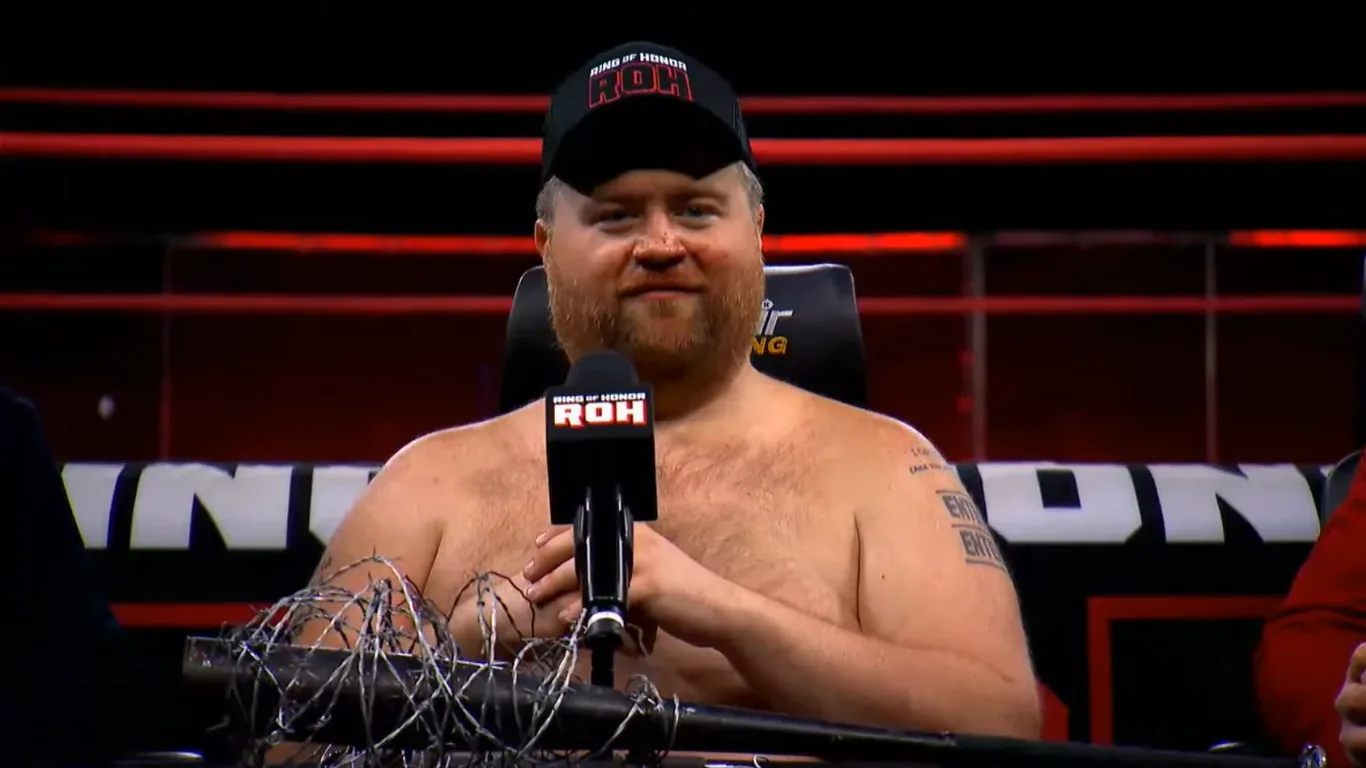
Paul Walter Hauser has addressed some of the skepticism he encountered after making the transition from acclaimed actor to active professional wrestler, revealing that he heard a prominent name in the industry had been taking indirect shots at his place in wrestling.
Hauser’s profile outside the ring is undeniable. An Emmy Award-winning actor, he entered wrestling with a level of public visibility that can bring attention to any promotion or independent event. That visibility also brings scrutiny. Celebrity involvement in wrestling has often been met with questions about commitment, training, and whether a recognizable name is being given opportunities that other wrestlers have spent years working toward.
Hauser has continued to build his wrestling résumé by appearing for several promotions, including Ring of Honor, Major League Wrestling, PROGRESS Wrestling, and independent groups. Rather than treating wrestling as a one-off attraction, he has taken matches and pursued opportunities within an environment where audiences and peers tend to judge performers on what they deliver between the ropes.
Hauser recalls early doubts about his in-ring future
In a recent interview, Hauser said he felt people were waiting to see whether he could physically handle the demands of professional wrestling when he first began competing.
For more background on this topic, read Jonathan Gresham Leaves Door Open To Future ROH Return Despite Tony Khan Rift.
“I think that when I first started, everyone was just watching me to see if I get injured, if I could survive the matches, and I think I surprised some people,” Hauser said.
That reaction is not unusual for someone entering wrestling from another entertainment field, particularly one with Hauser’s visibility. Wrestling requires a different kind of preparation from acting, along with the ability to work safely with opponents, understand ring positioning, communicate under pressure, and earn trust in front of a live crowd. A match can expose a performer quickly, which is why newcomers frequently face a prove-it standard regardless of their prior accomplishments elsewhere.
For Hauser, that standard appears to have been part of the challenge from the beginning. His comments suggest he understood that observers were not merely interested in seeing a famous actor participate. Many were evaluating whether he could withstand the physical side of the sport and contribute credibly as a wrestler.
Hauser believes he did enough to change at least some minds. While he did not claim that every critic has come around, he said his early performances surprised people who had expected a short-lived or superficial wrestling venture.
A respected name allegedly questioned whether he belonged
Hauser also discussed learning that a wrestler he considers highly accomplished had been speaking negatively about him. He did not identify the person, leaving the matter deliberately unresolved and avoiding a direct public confrontation with any specific wrestler.
“They were basically alluding to the fact that I didn’t really belong in wrestling,” he said.
He added that the individual made what he viewed as several indirect comments at his expense.
“They took a few shots at me in different ways,” Hauser said. “It was somebody I actually am a fan of and admire their work, so I was kind of bummed.”
The disappointment Hauser described comes from more than ordinary criticism. Professional wrestling is built around strong opinions and public evaluations, whether they concern matches, promos, character work, training, or a wrestler’s perceived standing in the industry. Still, criticism can carry a different weight when it comes from someone a performer respects.
Hauser did not offer details about what was said, where it was said, or when he learned about it. He also did not claim the unidentified wrestler confronted him directly. As a result, there is no indication that the issue has developed into an on-screen program, a public dispute, or a confirmed personal conflict involving a named talent.
Instead, Hauser framed the experience as useful motivation. He said discovering how people feel can create a productive edge, while also influencing the professional relationships he chooses to maintain.
“But, it’s good to find out about that stuff because it puts a healthy chip on your shoulder, and it also lets you know who to help and who not to help when they call.”
That response reflects a practical perspective on the situation. Hauser did not present himself as unaffected, but he also did not make the comments the centerpiece of his wrestling identity. He acknowledged the frustration of hearing criticism from someone whose work he admires, then redirected that frustration toward his own effort and future decision-making.
Celebrity crossover remains a difficult path in wrestling
Hauser’s comments also highlight the complicated position occupied by celebrities who pursue wrestling seriously. A recognizable performer can help attract attention, ticket buyers, and viewers. At the same time, the wrestling audience has historically been protective of the craft and wary of guests who appear to seek a spotlight without embracing the work required to perform safely and effectively.
For a crossover performer, the burden is often not simply to have one successful match. It is to continue showing up, improving, and demonstrating respect for the people whose careers are rooted in the industry. Hauser’s appearances across ROH, MLW, PROGRESS, and the independent scene have put him in settings where that commitment can be assessed repeatedly.
Those appearances matter because they move the discussion beyond a single celebrity cameo. Hauser has worked in promotions with distinct audiences and competitive expectations. He has also stepped into a wrestling culture where performers are judged not only by reputation, but by consistency, professionalism, conditioning, and their ability to work with a wide range of opponents.
His remarks suggest that he is aware of the suspicion that can greet an outsider, even one who has genuine enthusiasm for wrestling. Rather than dismissing the criticism altogether, he acknowledged that people had doubts and said he believes he has surprised some of them through his work.
PROGRESS title reign ends at PROGRESS 199
Hauser’s latest notable chapter in the ring came at PROGRESS 199, where he lost the PROGRESS Proteus Championship to Donovan Dijak.
The Proteus Championship has been associated with a distinctive concept in PROGRESS, and holding the title placed Hauser in a meaningful role within the promotion. His loss to Dijak ended that reign and gave Dijak another significant result in a career that has included high-profile performances across multiple major wrestling environments.
For Hauser, the championship loss does not erase the larger point of his run with PROGRESS. Winning and carrying a title in a promotion with PROGRESS’ history put him in a position that demanded more than a novelty appearance. It made his wrestling work part of an ongoing competitive presentation, with an eventual title defense and a clear conclusion when Dijak defeated him at PROGRESS 199.
There is a difference between appearing on a wrestling card and taking part in a title picture. Hauser’s Proteus Championship reign gave him the latter, while the eventual loss to Dijak provided a decisive outcome in the ring. It is another example of Hauser being evaluated through wrestling results and performances rather than solely through his work as an actor.
Hauser’s focus remains on proving himself
Hauser did not reveal the identity of the high-level wrestler he says questioned his place in the business, and there is no reason to assume the situation will become a public issue. The more important takeaway from his comments is how he has chosen to process that criticism.
He recognizes that some people initially expected him to get hurt or fail to adapt. He recognizes that at least one wrestler he admires apparently did not believe he belonged. But he also believes his work has changed some perceptions, and he sees the experience as fuel rather than a reason to step away.
That chip-on-the-shoulder approach will likely remain important as Hauser continues his in-ring career. He will continue to face the same basic question that confronts any performer crossing into wrestling from another field: can the person earn credibility through the work itself?
Hauser’s answer has been to keep competing. His appearances for ROH, MLW, PROGRESS, and independent promotions, along with his time as PROGRESS Proteus Champion before the loss to Donovan Dijak, have given him a growing body of work for fans and wrestlers alike to evaluate. The criticism he heard may have been discouraging, particularly because it came from someone he respects, but Hauser has made clear that it has also given him another reason to keep proving he belongs.

Darryl Polo
Darryl Polo is a passionate wrestling fan covering WWE, AEW, TNA and beyond. He loves great rivalries, breakout stars and the moments that keep fans talking long after the bell. How we work.