
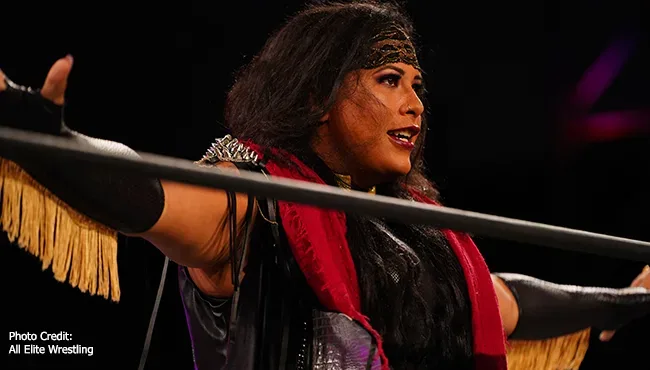
Nyla Rose has revisited the controversy surrounding her appearance at a 2024 ROH taping in Oklahoma, offering an unfiltered assessment of the Oklahoma State Athletic Commission’s response while also expressing deep appreciation for AEW President Tony Khan’s immediate support.
Rose, a former AEW Women’s World Champion and one of the most prominent transgender performers in major professional wrestling, wrestled Alejandra Lion at the Ring of Honor taping. In the aftermath, the Oklahoma State Athletic Commission issued AEW a warning tied to Rose’s participation. The matter drew widespread discussion across wrestling, both because of the commission’s involvement and because it highlighted the barriers transgender wrestlers can face in sanctioned environments.
Ultimately, the commission deferred any potential decision involving changes to Oklahoma’s rules on intergender wrestling to the state legislature. The situation did not result in a broader rule change from the commission, but it became an important moment in the ongoing conversation about inclusion, athletic commissions, and professional wrestling.
Speaking with Denise Salcedo for Instinct Culture, Rose reflected on the episode, the reaction from within AEW, and the personal reality of confronting intolerance in public.
For more background on this topic, read AEW All Out 2026 Reportedly Sells Out NOW Arena Configuration More Than 11 Days Before Chicago PPV.
Rose’s blunt response to the commission
Asked directly about the Oklahoma Athletic Commission matter, Rose did not hide her frustration. She characterized the issue as rooted in prejudice and questioned the basis for the commission’s actions.
“So basically — I mean, to be perfectly blunt, hateful bigots, you know? With no basis for anything. The athletic commission is a scam. They’re just a bunch of greedy people who have found an avenue to work people out of money, and they’re using new laws and loopholes to do what they want to do, basically.”
The comments underline how personally Rose viewed the warning. While professional wrestling has long operated with its own unusual relationship to athletic regulation, commissions can have significant influence over which events can be held and under what conditions. That influence can place wrestlers and promoters in difficult positions when state-level interpretations of rules are unclear or contested.
In this case, Rose’s match at an ROH taping placed a transgender wrestler at the center of a regulatory dispute. Rose’s perspective is that the matter was not simply a technical disagreement over policies, but an example of officials using their authority in a discriminatory way.
Tony Khan’s immediate backing meant a great deal
Rose had spoken out when the controversy initially emerged, and AEW also publicly stood by her. Looking back, Rose said Khan’s response was meaningful precisely because she did not take it for granted.
“He did, he absolutely did. I was a little shocked, to be totally honest with you. I was very shocked, very surprised, and incredibly grateful that he would — with zero hesitation. Like, there was no thought there. He knew the right side of history to be on, and that’s where he stood, ten toes down.”
Rose continued by emphasizing that support from a person in Khan’s position was a choice, not something she felt he was required to provide.
“For someone of his caliber in his position to do that, he absolutely did not have to, and he did. And that speaks a lot about who he is as a person and who he is as a man. And I’m so grateful to him for that.”
AEW’s public stance was especially notable because Rose has been a foundational figure in the company’s women’s division. She was crowned the second AEW Women’s World Champion in 2020 and has remained an established part of AEW and ROH programming. The company’s backing during the Oklahoma dispute reinforced that Rose would not be left to address the matter alone.
Her remarks also speak to a wider concern that can affect performers from marginalized communities: support is valuable not only when it is eventually offered, but when it arrives without hesitation during a contentious public moment.
Past obstacles may not always be obvious
Rose was also asked whether she believed similar issues had affected her career in other places. Her answer acknowledged that discrimination is not always as overt as a commission warning or an official statement.
“I’m sure I have. I’m sure I have, but I probably did not know because it wasn’t so bold and blatant. There have definitely been times when I’ve been left on read or given answers and reasons that didn’t quite add up, and I think that was people kind of like tiptoeing around the delicate nature of things.”
She suggested that the political climate has made some people more willing to express prejudice openly. At the same time, Rose drew a distinction between people enforcing legal or institutional guidance and those acting out of ignorance or hostility.
“With a certain regime in charge, people feel very emboldened now to kind of speak their hateful heart. And I think that’s a big part of what happened in Oklahoma. And to Oklahoma’s credit, maybe not all the way, right? Because a lot of them do have to follow what the — I guess, legal guidelines are. So they’re kind of just doing what they have to do what they’re told to do so they don’t get in trouble.”
Rose described the dynamic as a “50/50 split,” pointing to both institutional self-protection and individual hatred or ignorance. Her comments did not frame every person connected to the situation in the same way, but they made clear that she sees systems of regulation and personal bias as capable of overlapping.
Community and education as tools against fear
Rose did not minimize the emotional toll of incidents like the one in Oklahoma. She said such matters can be difficult, but she also explained that community support, public education, and direct human connection can make a tangible difference.
“It is [hard], and it can be. And it’s one of those things where, that’s where the strength of our community comes into play. And the protests, and educating the public, educating people. Education can put out a lot of those fires.”
She tied many negative reactions to fear and a reluctance to acknowledge unfamiliarity. Referencing a line associated with Yoda, Rose said ignorance can fuel hate and fear, arguing that anger is often misdirected when people feel uncomfortable about what they do not understand.
That perspective informs how Rose approaches those who are uncomfortable with transgender people. She was candid that no single statement can force someone to change. In her view, genuine change has to come internally, especially for people who have become closed off and resistant to reconsidering their beliefs.
Still, Rose stressed that education can reach more people than some might expect. She pointed to messages and interactions she has had with fans who admitted they previously held negative views, only to reconsider after seeing her perform and following her public presence over time.
“Just getting to know somebody can do it. I have had so many people come to me privately, DMs, at shows, and apologize. Say, ‘Hey, I was ignorant before. I didn’t like you because of this reason.’ But as they’ve gotten to ‘know me’ over the years on television and social media, and realize that I’m just a person.”
Rose added that her interests outside the ring are often no different from those of the people contacting her. She wants to work, go home, play video games, and open Pokémon cards. Her point was simple: transgender people are not abstractions or political talking points, but individuals living ordinary lives while pursuing their careers and interests.
“The same thing they want to do, I want to do as well; I just walk a slightly different path,” Rose said, adding that some hearts can open once people recognize that shared humanity.
An issue larger than one match
The Oklahoma episode began with a single ROH match, but Rose’s reflections show why its significance has extended far beyond one card or one regulatory warning. It involved a performer’s ability to work, a promotion’s willingness to defend its talent, and the broader question of who gets treated fairly in professional wrestling.
For Rose, Khan’s support remains a defining positive from a situation she otherwise describes in harsh terms. For AEW and ROH, the response demonstrated public support for a wrestler who has made history within the company. And for fans, Rose’s comments offer a direct account of the burden such disputes can place on performers while also outlining why visibility, conversation, and community support matter.
Quotes in this article are from Nyla Rose’s interview with Denise Salcedo for Instinct Culture.
Darryl Polo
Darryl Polo is a passionate wrestling fan covering WWE, AEW, TNA and beyond. He loves great rivalries, breakout stars and the moments that keep fans talking long after the bell. How we work.