
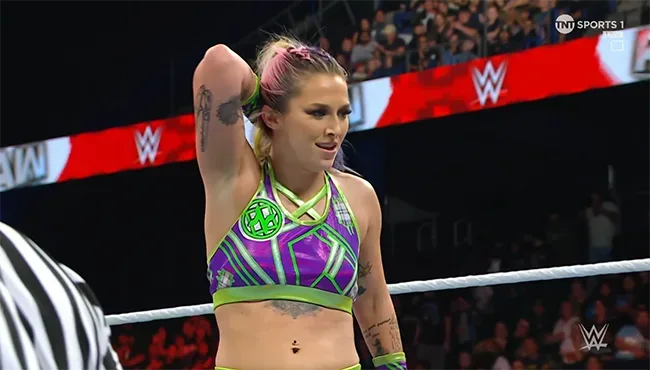
Nixon Newell believes one of professional wrestling’s most important fundamentals is being overlooked: the ability to sell. As she considers a transition toward coaching and producing work, the former WWE Superstar has identified believable physical storytelling as the part of the craft she most wants to emphasize.
Speaking about her approach to wrestling, Newell said that her own selling was regularly recognized during her time in WWE. In particular, she recalled that her commitment to portraying knee damage became so convincing that she was eventually asked to pull back on it.
“Whenever I was there, they’d always compliment my selling, to the point where they actually had to ask me to stop selling my knee because I was really believable with it,” Newell said. “I feel like that’s such a missed art in wrestling right now; it’s storytelling.”
Her comments underline a foundational idea that has long shaped the best wrestling matches: moves only carry as much weight as the wrestlers’ reactions allow them to carry. A dramatic strike, a submission attempt, a high-risk dive, or a sustained attack on a limb becomes more meaningful when the competitor on the receiving end communicates its consequences. For Newell, that is not simply a matter of physical performance. It is the mechanism that turns athletic action into a story the audience can follow.
For more background on this topic, read Chael Sonnen Takes Aim at John Cena After Motivational Social Media Post.
Selling can take many forms, from a wrestler struggling to put weight on an injured leg to a competitor gradually losing their ability to execute a signature move. It can be shown through body language, pacing, facial expressions, defensive choices, and the way a match’s closing stretch reflects everything that happened earlier. Newell’s focus on the knee is especially illustrative because limb work is among the clearest examples of continuity in a wrestling match. If an opponent spends significant time attacking a knee, the effects should remain visible rather than vanishing when the pace increases.
That commitment can make a wrestler’s offense and defense feel more logical. A damaged knee may alter whether a wrestler can run, climb the ropes, apply pressure to a hold, or land safely after a maneuver. The audience does not need every consequence explained verbally if the performer makes those limitations clear in the ring. In Newell’s view, that kind of clarity is a major part of what wrestling currently lacks.
Newell Sees Selling as a Core Strength
Newell was careful not to frame her value around teaching a long list of spectacular maneuvers. Instead, she pointed directly to the performance skill she trusts most: making the action feel credible.
“I’m not saying I can teach you all these cool wrestling moves, but I truly believe in myself and in my selling,” Newell said. “And I think that’s what wrestling lacks a lot right now is selling.”
That distinction is significant. Wrestling training naturally involves learning how to perform moves safely, build conditioning, understand timing, and develop a character. But Newell’s comments center on the less easily measured elements that help a match resonate beyond its move list. Selling is tied to pacing, crowd investment, psychology, and the ability of two wrestlers to make their exchanges feel connected rather than isolated.
In a fast-paced wrestling environment, performers can feel pressure to keep escalating the action. Newell’s perspective argues for the value of restraint and consequence. A wrestler who sells effectively may create more anticipation for a comeback, make one decisive sequence feel larger, and give the crowd a reason to react emotionally to an attempted finish. It is a skill that can make simple offense feel impactful without requiring a match to constantly add more complexity.
Her point is not that athleticism or innovative offense has no place in modern wrestling. Rather, her emphasis is on the connective tissue that helps the audience understand why those moments matter. When a wrestler appears hurt, exhausted, frustrated, or increasingly desperate, the action gains a narrative direction. A comeback means more after a sustained struggle. A submission attempt feels more dangerous when it targets an injury that has been established throughout the match. A victory can feel more earned when a performer visibly adapts to adversity.
Newell’s comments also reflect why selling remains one of the most valued skills for wrestlers hoping to work consistently with a wide variety of opponents. It requires awareness of what the other wrestler is trying to communicate, discipline in maintaining the story, and a willingness to make an opponent’s offense look meaningful. It is collaborative by nature. Strong selling does not merely showcase the person receiving the move; it helps both wrestlers and the match as a whole.
Interest in a Behind-the-Scenes Future
While Newell still has time left in her in-ring plans, she has already found opportunities to work behind the curtain. She said she has been producing matches for younger wrestlers at the Evolution Dojo when Miranda Alize is running shows there, while also helping with other duties backstage.
“Miranda, when she has shows at the Evolution Dojo, I produce a lot of the matches for the young boys, and I’ll do the little odd jobs back there, which I’m really enjoying,” Newell said. “I would absolutely love to go back as a producer or a coach in some aspect, like a guest coach.”
The experience has given Newell a practical outlet for the ideas she values. Producing a match is not simply deciding which moves happen and when. It involves helping performers identify the central story, organize a beginning and middle that lead naturally to a finish, and ensure that the match suits both the wrestlers and the setting. For younger talent, guidance on selling can be especially useful because it encourages them to think beyond individual sequences and consider how every choice affects the audience’s understanding of the match.
Her mention of “little odd jobs” also points to the broad nature of backstage wrestling work. A show depends on more than the wrestlers seen in the ring. Producing, coaching, communicating with talent, supporting the flow of an event, and assisting wherever needed are all parts of the environment Newell says she is enjoying. That experience appears to have strengthened her interest in continuing in a non-wrestling capacity.
Newell did not limit her ambition to one specific job title. She said she would be interested in returning as a producer or coach, including in a guest-coach role. The flexibility of that goal makes sense for someone who is already working with younger wrestlers while considering the next phase of her career. Whether guiding an individual match, offering feedback in training, or helping talent sharpen their storytelling, the underlying philosophy would remain the same: make the audience believe what is happening.
A Potential Retirement at the End of the Year
Earlier this year, Newell and her partner, Miranda Alize, announced their engagement. Newell has also said she will likely retire from active in-ring competition at the end of the year. The word “likely” leaves appropriate uncertainty around the timing, but her interest in producing and coaching makes clear that stepping away from wrestling matches would not necessarily mean stepping away from wrestling itself.
For performers who move into coaching or production, their most lasting influence can come through the habits they instill in the next generation. Newell has made it clear what lesson she would prioritize. Wrestling is not only about executing impressive moves; it is about making those moves matter from one moment to the next.
That is why her thoughts on selling extend beyond a critique of current trends. They also serve as a statement of purpose for what she hopes to contribute moving forward. Newell’s confidence lies in her ability to communicate pain, damage, and struggle in a way that draws viewers into a match. As she takes on more behind-the-scenes responsibilities, she wants to help younger wrestlers understand that those details are not secondary to the action. They are the story.

Darryl Polo
Darryl Polo is a passionate wrestling fan covering WWE, AEW, TNA and beyond. He loves great rivalries, breakout stars and the moments that keep fans talking long after the bell. How we work.