
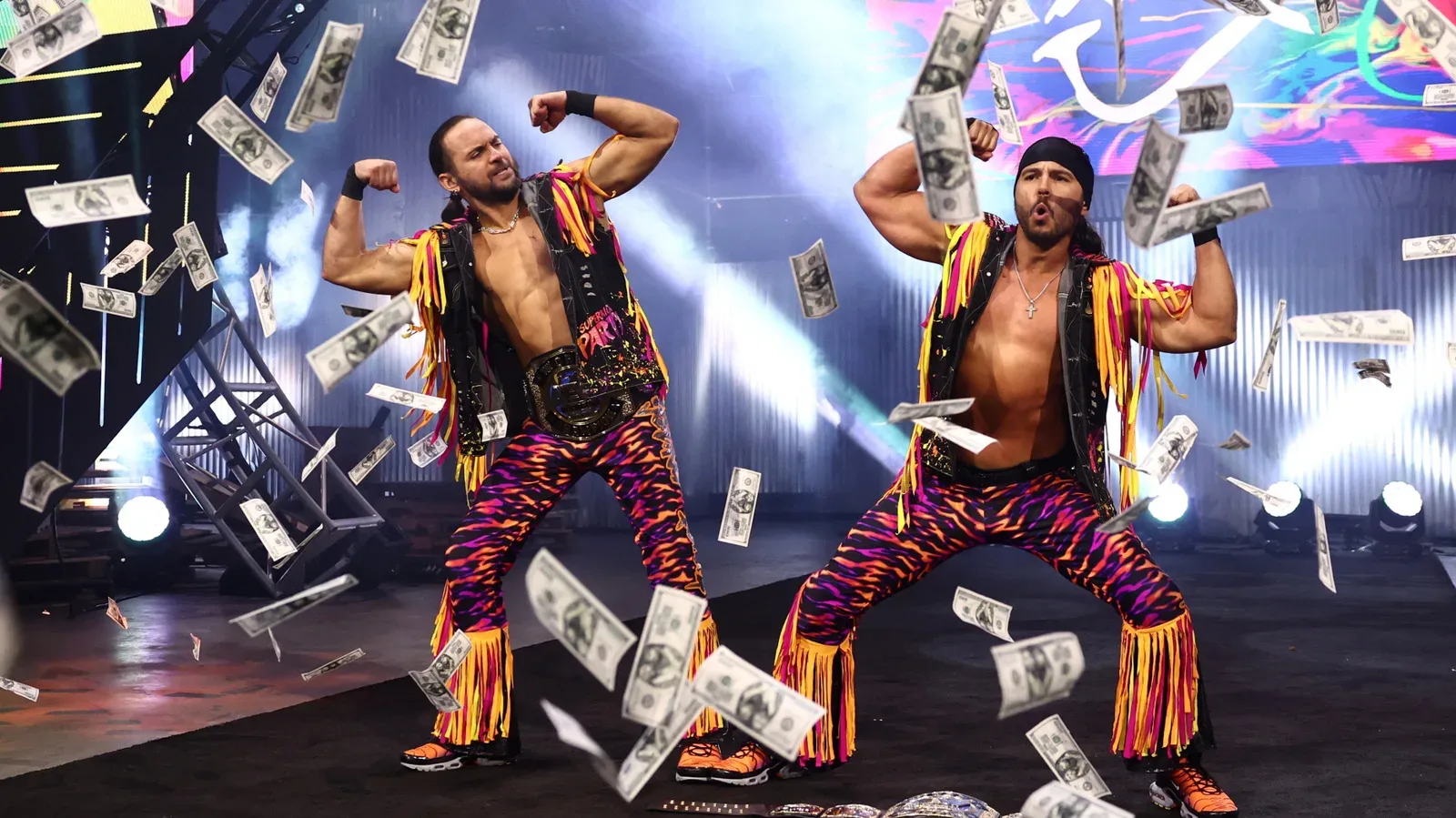
Nick Jackson has offered a concise, characteristically irreverent description of the vision he and the Young Bucks had for All Elite Wrestling from the beginning: a much larger version of the independent wrestling atmosphere that helped define Pro Wrestling Guerrilla.
During a question-and-answer session held ahead of AEW Full Gear and featured on a recent episode of Being the Elite, Nick and Matt Jackson addressed the audience about their connection to PWG. After asking whether there were Pro Wrestling Guerrilla fans in attendance, Nick summed up his view of AEW’s identity with a joke that also carried a clear creative point.
“I like to say AEW became PWG on illegal steroids,” Nick said.
Matt immediately added, “Not the doctor-prescribed ones?”
For more background on this topic, read Deonna Purrazzo Says the Right Story Would Be Essential for an AEW Blood & Guts Match.
Nick then expanded on the comparison, explaining that the heightened energy, match style, and crowd response associated with PWG were central to what the Young Bucks believed AEW could become when the company launched in 2019.
“That’s kind of what we envisioned this could be,” Nick said. “Sure enough, eight years later, every show we do, we have PWG-style matches booked and the crowd gets hotter and hotter. That would be my description of AEW and what we envisioned it as. That’s what it kind of is.”
A PWG Foundation Behind the AEW Vision
The Young Bucks’ reference carries substantial weight because of their long history with PWG. Matt and Nick Jackson were key figures in the Southern California promotion from the late 2000s through the 2010s, a period in which the company developed a devoted following through its distinctive presentation and acclaimed in-ring cards.
The Bucks debuted for PWG in June 2007. Across their time there, they held the PWG World Tag Team Championship four times, accumulating a combined 631 days with the titles. Their success in the promotion helped establish them as one of the most recognizable tag teams on the independent scene, while PWG itself became a major destination for wrestlers and fans who wanted a different kind of wrestling environment.
PWG’s identity was built around exceptional athletic competition, an intimate and vocal audience, and a tone that could move comfortably between comedy, satire, and intense action. Its shows frequently made the connection between performers and crowd feel immediate. Fans were not simply watching a conventional televised wrestling product from a distance; the atmosphere was often driven by the sense that everyone in the building understood the personalities, history, and stylistic language of the promotion.
That is the atmosphere Nick Jackson was invoking. The phrase “PWG on illegal steroids” was deliberately exaggerated, but the underlying comparison was straightforward. AEW would be a national-scale company featuring the kind of fast-paced, high-impact matches and deeply engaged crowd reactions that had made PWG such an influential independent promotion.
Nick’s comments also underscore the importance of the Young Bucks’ role in AEW’s formation. As Executive Vice Presidents, Matt and Nick were among the minds involved in shaping the company during its earliest days. AEW’s growth since 2019 has brought it to a much broader stage than PWG ever occupied, but the Bucks see a recognizable throughline between the company’s current presentation and the wrestling culture that surrounded PWG.
What the Comparison Says About AEW’s Match Style
When Nick said that AEW continues to book “PWG-style matches” on every show, he was pointing to a style that prioritizes pace, creativity, athleticism, and a crowd ready to react to every escalation. PWG became renowned for presenting wrestlers who could blend high-flying offense, hard-hitting exchanges, inventive sequences, and strong character work in front of audiences that followed the action closely.
AEW has regularly featured performers and matchups that fit within that broad tradition. The company’s presentation has included wrestlers with direct ties to PWG, along with talent whose styles align with the promotion’s legacy of aggressive, dynamic, and often unpredictable in-ring competition.
The crowd is an equally important part of Nick’s description. A loud crowd is a familiar element of professional wrestling, but PWG’s audience developed a reputation for being especially passionate and responsive. Its fan base embraced the promotion’s humor as readily as it embraced its major matches. Nick’s comments suggest that reproducing that intensity on a larger platform was not incidental to AEW’s plans; it was part of the intended formula.
That distinction helps explain why the PWG comparison goes beyond merely naming a few wrestlers who worked in both places. For the Young Bucks, the connection concerns a philosophy of presentation. It is about the types of matches being placed in front of fans, the level of energy expected from the building, and the sense that a wrestling show can contain both spectacle and a self-aware personality without losing its competitive edge.
PWG’s Extensive Connection to AEW Talent
PWG’s influence on AEW is not limited to the Jacksons. AEW commentator Excalibur, whose voice became inseparable from the PWG experience, has previously spoken about how many people in AEW had competed for the independent promotion. He noted that roughly 80 AEW employees had worked at least one PWG match.
That figure illustrates how deeply the promotions’ histories are intertwined. Excalibur’s own presence in AEW is particularly notable, as he brought his background as the voice of PWG into a national television environment. His familiarity with independent wrestling history and the careers of numerous performers has been part of his AEW commentary work.
Several major wrestling names were important parts of PWG during its active years. Alongside the Young Bucks, the Briscoe Brothers, El Generico, and Kevin Steen were prominent figures in the promotion. El Generico later became known in WWE as Sami Zayn, while Kevin Steen is known there as Kevin Owens. Kenny Omega and Ricochet are also among the AEW names identified by Excalibur as having competed in PWG.
The list reflects why PWG is often remembered as a proving ground and gathering point for talent that would go on to prominent positions across the industry. Its influence came not only from the quality of individual matches, but from its ability to bring together wrestlers who could create a distinct kind of event. Many of those wrestlers later reached far larger audiences, taking pieces of that experience with them.
For AEW, that shared background has been especially meaningful. The company was built with the involvement of wrestlers and personalities who understood the PWG audience and its expectations from the inside. Nick Jackson’s comments frame AEW not as a direct duplicate of PWG, but as an ambitious expansion of ideas that were tested and embraced in that setting.
The Young Bucks’ Long-Term Perspective
Nick described AEW’s current product as the realization of an early ambition, saying that the company has reached the point where the intended resemblance to PWG can be felt regularly. His reference to “eight years later” placed the remarks in the context of a vision that existed well before AEW officially began operating in 2019.
That timeline is significant because it highlights the long-standing nature of the Bucks’ creative outlook. Their careers were shaped by the independent circuit, and PWG was among the most important stages in that development. When they speak about AEW’s DNA, they are speaking from the perspective of performers who experienced firsthand how powerful a passionate live crowd can be when it is given matches and personalities tailored to that audience.
Matt’s interruption ensured that the moment retained the humor associated with the Bucks and with PWG’s own sensibility. Yet Nick’s larger point was serious: AEW’s blend of intense wrestling and animated audience participation was not an accidental byproduct of the company’s growth. In his view, it was built into the concept from the outset.
PWG remains on an extended hiatus, but its imprint continues to be visible through the wrestlers, commentators, and creative influences that emerged from its orbit. Nick Jackson’s assessment places AEW squarely within that legacy. The scale is different, the reach is larger, and the stakes are far greater, but the Young Buck sees the same essential spark in the ring and in the stands: ambitious matches, an energized fan base, and a wrestling atmosphere designed to feel anything but ordinary.
In pictures

Darryl Polo
Darryl Polo is a passionate wrestling fan covering WWE, AEW, TNA and beyond. He loves great rivalries, breakout stars and the moments that keep fans talking long after the bell. How we work.