
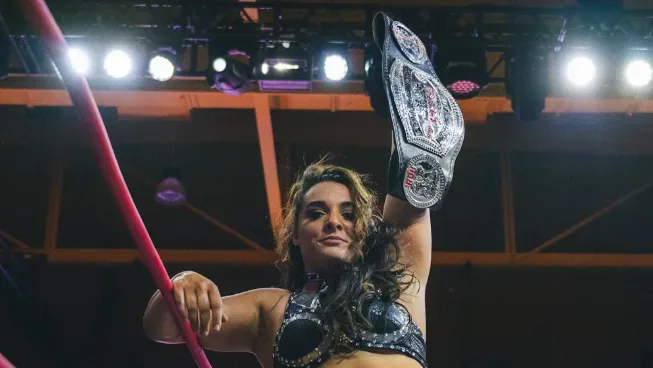
Deonna Purrazzo is not ruling out a future appearance in AEW’s Blood & Guts match, but she has made clear that simply filling a spot in the cage would not be enough. For Purrazzo, the match would need to be the culmination of a rivalry with enough hostility, history, and escalating violence to make that kind of environment feel earned.
Blood & Guts has become one of AEW’s most demanding match concepts, built around teams battling inside a large enclosed cage structure. It is a setting designed for grudges reaching a breaking point rather than a match that naturally fits every competitor or every issue. Purrazzo’s comments reflect that distinction: she sees a place for a more violent version of her character, but only if the path to that moment is properly established.
Asked whether she would be interested in taking part in Blood & Guts, Purrazzo said storytelling would be the deciding factor.
“I think for me it’s all about the story, right? I think that there’s definitely a world where Deonna Purrazzo gets violent like that. I think that it would take a lot to get me there, but if we could tell the right story and have the right feud.”
For more background on this topic, read USA Wrestling Teams With AEW and Mercedes Moné for Women’s Wrestling Initiative Ahead of LA 2028.
That answer is consistent with the presentation Purrazzo has pursued throughout her career. Her in-ring identity has long been rooted in technical wrestling, strategy, and the confidence of a competitor who believes she can outmaneuver an opponent. A Blood & Guts setting, however, asks performers to work in a more chaotic and physically punishing atmosphere. Purrazzo is open to that contrast, but she does not view it as a change that should happen without an emotional reason.
Rather than naming a current opponent or predicting when a Blood & Guts opportunity could arise, Purrazzo pointed back to one of the early rivalries of her AEW run: her program with Thunder Rosa. That issue gave Purrazzo an example of the type of escalation she believes can eventually lead to a cage war.
“When I started at AEW, I kind of had that going with Thunder Rosa.”
The Purrazzo-Thunder Rosa feud did not stay confined to standard singles competition. Their program included a no disqualification match and a lumberjack match, providing increasingly restrictive or violent settings as their conflict continued. It also led to a televised Texas Bull Rope match on Collision shortly before All In 2024, a bout Purrazzo described as the first women’s televised Texas Bull Rope match.
For Purrazzo, those matches were not separate attractions without connection. They represented the kind of progression she wants from a serious feud: each encounter should communicate that the previous one failed to settle the score. When normal rules and conventional match structures are no longer enough, the story can credibly move toward something harsher.
“We had a no disqualification match, we had a lumberjack match, we ended up having the first ever women’s televised Texas Bull Rope match on a ‘Collision’ right before All In 2024. So, I feel like that kind of story is what it takes to get to Blood and Guts, and I would love to be able to tell that story.”
Purrazzo’s framing is notable because it places Blood & Guts at the end of a journey rather than treating it as a destination in itself. In a multi-person match, individual wrestlers can be pulled into the action through alliances, rivalries, and broader faction conflicts. Purrazzo’s comments suggest that she would want her role to have a specific personal foundation within that larger fight.
That does not mean a future Blood & Guts match would have to be built around Purrazzo alone. The format is inherently a team contest, and its biggest moments often come from several stories colliding at once. Still, Purrazzo wants a feud substantial enough that fans can understand why she, specifically, has been driven to enter the cage and embrace a level of violence outside her usual approach.
The timing of the discussion also follows a women’s Blood & Guts match that featured Megan Bayne, Thekla, Skye Blue, Julia Hart, Lena Kross, and Persephone against Kris Statlander, Harley Cameron, Willow Nightingale, Queen Aminata, Jamie Hayter, and Alex Windsor. The bout put a wide range of personalities and in-ring styles into the same high-pressure environment, underscoring the opportunities the stipulation can create when multiple rivalries converge.
Purrazzo did not claim a place in a future edition of the match, nor did she reveal plans for a new rivalry intended to lead there. Her comments were conditional. She would participate if AEW develops the kind of feud that demands it. That distinction matters, particularly for a wrestler whose character work and match choices have frequently been tied to the idea of proving superiority through increasingly difficult competitive circumstances.
There is also a natural creative appeal in the prospect of Purrazzo being pushed beyond the composed, technically focused competitor audiences are accustomed to seeing. The idea of a wrestler known for control being forced into an uncontrolled setting can provide a clear character hook. The key, as Purrazzo emphasized, would be showing the audience the events that make such a transformation believable.
A rivalry built for Blood & Guts would likely require repeated setbacks, personal stakes, and a sustained inability to resolve matters through ordinary competition. Purrazzo’s prior matches with Thunder Rosa provide the template she referenced: a no disqualification match raises the level of permitted aggression; a lumberjack match removes avenues of escape; and a bull rope match places the competitors in a uniquely physical confrontation. Whether another AEW program follows that same exact sequence is unknown, but Purrazzo sees that kind of gradual escalation as meaningful.
Her willingness to revisit intense stipulations also demonstrates that she is not opposed to the risks or demands of a violent match environment. Instead, she is arguing for purpose. Blood & Guts carries an expectation of spectacle, but Purrazzo’s position is that spectacle works best when it is supported by a story that has given the performers something substantial to fight over.
That is particularly relevant in a division with numerous possible rivalries and changing alliances. A major cage match can offer a spotlight to several women at once, but it can also be most effective when the participants arrive with clearly defined motivations. Purrazzo’s remarks leave the door open for her to become part of that picture if her next major issue develops into the kind of deeply personal conflict she described.
For now, Purrazzo has set the standard she would want met before stepping inside Blood & Guts. The feud must be strong, the escalation must feel natural, and the violence must reveal something important about the character. If AEW can provide those elements, Purrazzo said she would welcome the chance to tell that story.
AEW’s November 18 episode of Dynamite is next on the company’s schedule. While Purrazzo has not announced involvement in a future Blood & Guts match, her comments make her position clear: the possibility is there, provided the road to the cage is worthy of the destination.

Darryl Polo
Darryl Polo is a passionate wrestling fan covering WWE, AEW, TNA and beyond. He loves great rivalries, breakout stars and the moments that keep fans talking long after the bell. How we work.