
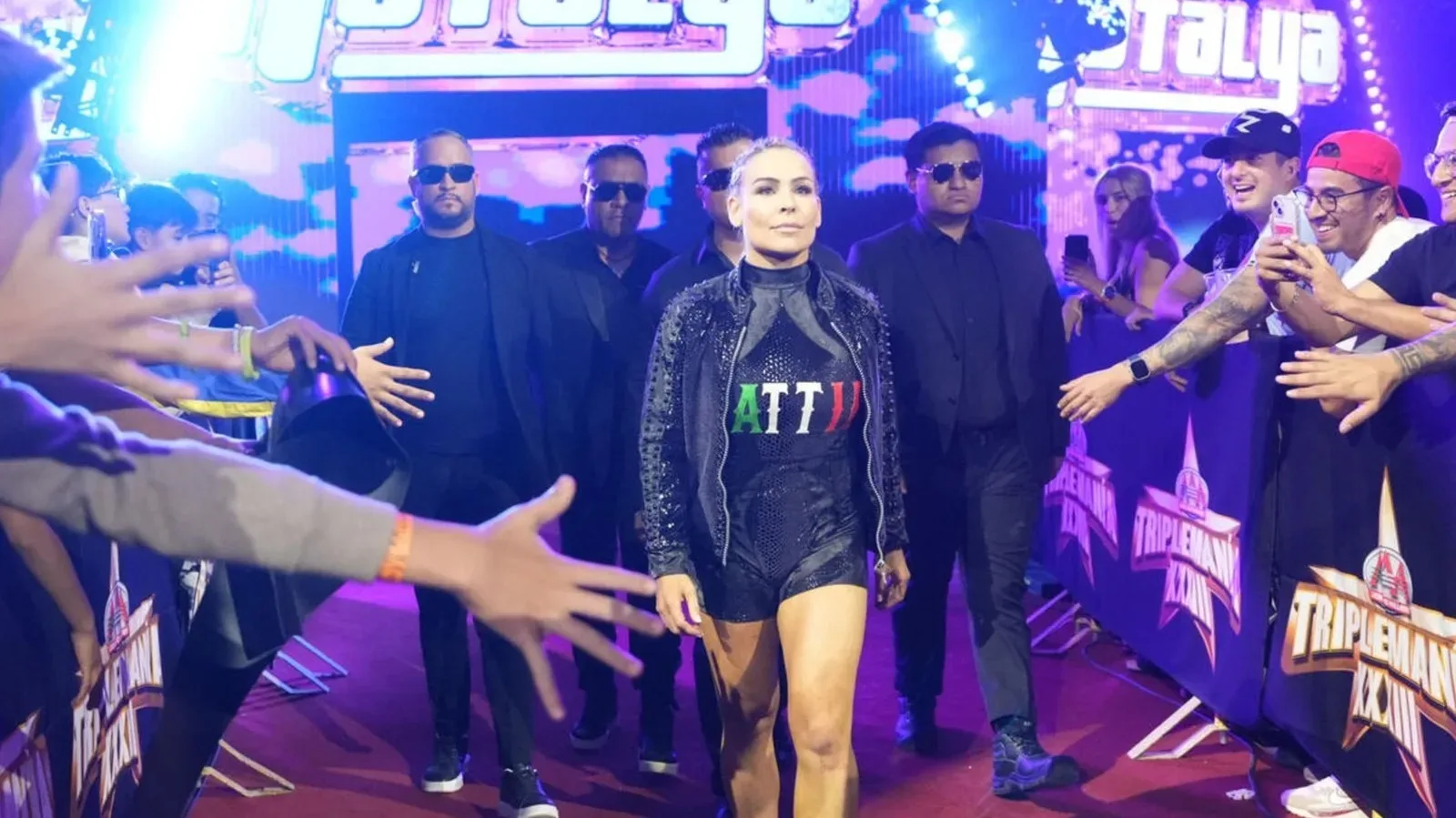
Nattie sees WWE’s current relationship with AAA as more than an opportunity for individual wrestlers to find a different stage. The veteran WWE performer believes the work in Mexico could offer a model for wider international growth, and she would like to see the company explore comparable projects in other major wrestling markets.
Speaking on Busted Open, Nattie discussed the importance of performers making the most of every opening available to them, including opportunities outside WWE’s core main-roster environment. In her view, working across different platforms can help talent reconnect with audiences, develop a refreshed presentation, and create momentum that carries back into their broader WWE role.
Her central example was Chad Gable’s work as El Grande Americano in AAA. Nattie pointed to the character as evidence that a wrestler can benefit from embracing a distinct identity and allowing that identity to grow in a setting built for it.
“I love seeing what Gable and what El Grande Americano did in AAA, because look at El Grande, he's one of the biggest — to me, he is at the top of his game. And that all stems from finding yourself in other areas and then just letting it work for you.”
For more background on this topic, read Tavion Heights Calls Jacob Fatu His Dream Opponent, Predicts an ‘Intense’ Collision.
The comments underline Nattie’s broader perspective on career longevity and reinvention. Rather than viewing a wrestler’s path as limited to one roster position or one presentation, she sees value in talent finding new ways to stand out. A character, rivalry, or audience connection that gains traction in one environment can give a performer fresh visibility elsewhere.
For Nattie, AAA has provided a particularly notable example of that possibility. WWE’s ownership of the Mexican promotion has been accompanied by what she described as a resurgence, while the presence of WWE-associated talent has created additional avenues for performers to be seen in a different wrestling context. Her remarks did not frame AAA simply as an extension of WWE programming, but as a place where wrestlers can discover something that works and let it build.
AAA as a starting point for a larger vision
Nattie has appeared in AAA herself, giving her firsthand experience with the promotion and its audience. That connection informed her enthusiasm for the work being done in Mexico, but her comments also made clear that she is thinking beyond one territory.
She said she would like WWE to consider creating similarly meaningful international ventures in other regions, specifically naming Japan and Australia as markets that would be exciting to explore. Nattie characterized herself as someone who enjoys building and seeing ideas develop into something larger, and she sees room for WWE’s international footprint to keep evolving.
“The work that we're doing with AAA in Mexico, again, I'm a dreamer and I'm a builder, and I love to see — I love building, and I love when things can be more. But I'm like, man, wouldn't that be cool if we did something like that in Japan? Wouldn't that be cool if we did something like that in Australia? Wouldn't that be cool if we did something. I love what we've done in AAA. I would love to do that with a couple of other places.”
Those comments were aspirational rather than an announcement of any new WWE project. Nattie did not indicate that a Japanese or Australian brand is planned, nor did she provide a timetable, structure, or list of potential partners. Still, her vision is notable because it places AAA within a larger discussion about how WWE could engage with wrestling scenes around the world.
Japan, in particular, carries obvious importance within professional wrestling. It is a market with its own deeply established history, major promotions, and distinct audience expectations. Any WWE-backed project there would need its own identity and direction rather than merely repeating the Mexican model. Nattie’s point was not that every international initiative should look identical; it was that AAA demonstrates the value of building something meaningful in a region with a strong wrestling culture.
Australia was the other market she mentioned. As with Japan, Nattie did not offer operational details, but the inclusion of Australia showed that she is imagining a broader network of opportunities rather than focusing only on one traditional wrestling destination. Her remarks centered on potential: more places where talent can work, more audiences that can be reached, and more opportunities for wrestling identities to take shape.
El Grande Americano and the value of opportunity
Gable’s El Grande Americano work was at the heart of Nattie’s comments. She praised the character’s current standing and linked that success to the idea of allowing performers to find themselves through different opportunities. In an industry where a wrestler’s presentation can change dramatically depending on the setting, Nattie’s view is that talent should not hesitate to pursue the right platform.
The significance of her example is not limited to a single character. Nattie was making a larger argument about adaptability. Wrestlers can have an established role, an established audience perception, or a familiar place on a roster, but those things do not have to define the full range of what they can become. A different market or brand can give a performer room to try a new approach and reach fans who may respond in another way.
That approach can be especially valuable for veteran talent, developing talent, and anyone looking for a renewed spotlight. Nattie’s wording emphasized “finding yourself in other areas,” a phrase that speaks to the creative side of wrestling as much as the business side. The opportunity is not merely to appear on another show. It is to find an element of a performer’s work that connects, then build on that connection.
AAA’s place in WWE’s wider landscape therefore appears important to Nattie as both a promotion and a creative outlet. The relationship allows for a different cultural setting, a different audience environment, and potentially a different way for wrestlers to present themselves. Her praise for El Grande Americano suggests she believes that kind of flexibility has already produced visible benefits.
Recognition for The Undertaker and Jeremy Borash
Nattie also credited WWE Hall of Famer The Undertaker and backstage executive Jeremy Borash for their role in transforming AAA. Her praise positioned them as key figures in the work taking place around the promotion, highlighting the importance of experienced leadership behind any effort to develop a brand and give it direction.
The mention of The Undertaker is significant because Nattie’s larger idea includes a possible role for retired or veteran WWE figures in future international expansion. She believes there are people with the knowledge, credibility, and connection to specific markets who could help build WWE-related ventures abroad. Her comments suggest that a project’s success would depend on more than sending active roster talent to a new location; it would also require leaders who understand how to foster a local identity.
Nattie specifically named AJ Styles as someone who could potentially help create something in Japan. Styles has a memorable history in NJPW, and Nattie’s suggestion was rooted in that established association. She did not say that Styles is leaving WWE, that he has been assigned to any project, or that a Japanese expansion effort exists. Instead, she offered him as an example of a respected wrestler whose background in a particular market could make him a compelling person to involve if WWE ever pursued such a direction.
That distinction is important. Nattie’s ideas remain personal hopes for what WWE could do, not confirmed corporate plans. But the names she raised illustrate the kind of framework she has in mind: internationally recognized performers, experienced figures with regional familiarity, and brands designed to become meaningful destinations rather than temporary side projects.
A vision centered on building
Nattie’s comments ultimately reflect an optimistic view of WWE’s potential international future. She is encouraged by the work being done with AAA, impressed by the way talent such as Gable has benefited from an expanded stage, and interested in the possibility of applying similar ambition elsewhere.
Her message to wrestlers was equally clear. Opportunities can emerge beyond a performer’s usual lane, and taking advantage of those chances can lead to a new level of confidence, exposure, and creative momentum. For Nattie, El Grande Americano is a current example of that process working.
Whether WWE pursues additional international brands in Japan, Australia, or other markets remains unknown. Nattie did not present her thoughts as a report on upcoming plans. What she did offer was a vision shaped by AAA’s resurgence: build with purpose, give talent space to grow, and recognize that professional wrestling can become bigger when performers and promotions are allowed to find the right environment for success.
In pictures

Darryl Polo
Darryl Polo is a passionate wrestling fan covering WWE, AEW, TNA and beyond. He loves great rivalries, breakout stars and the moments that keep fans talking long after the bell. How we work.