
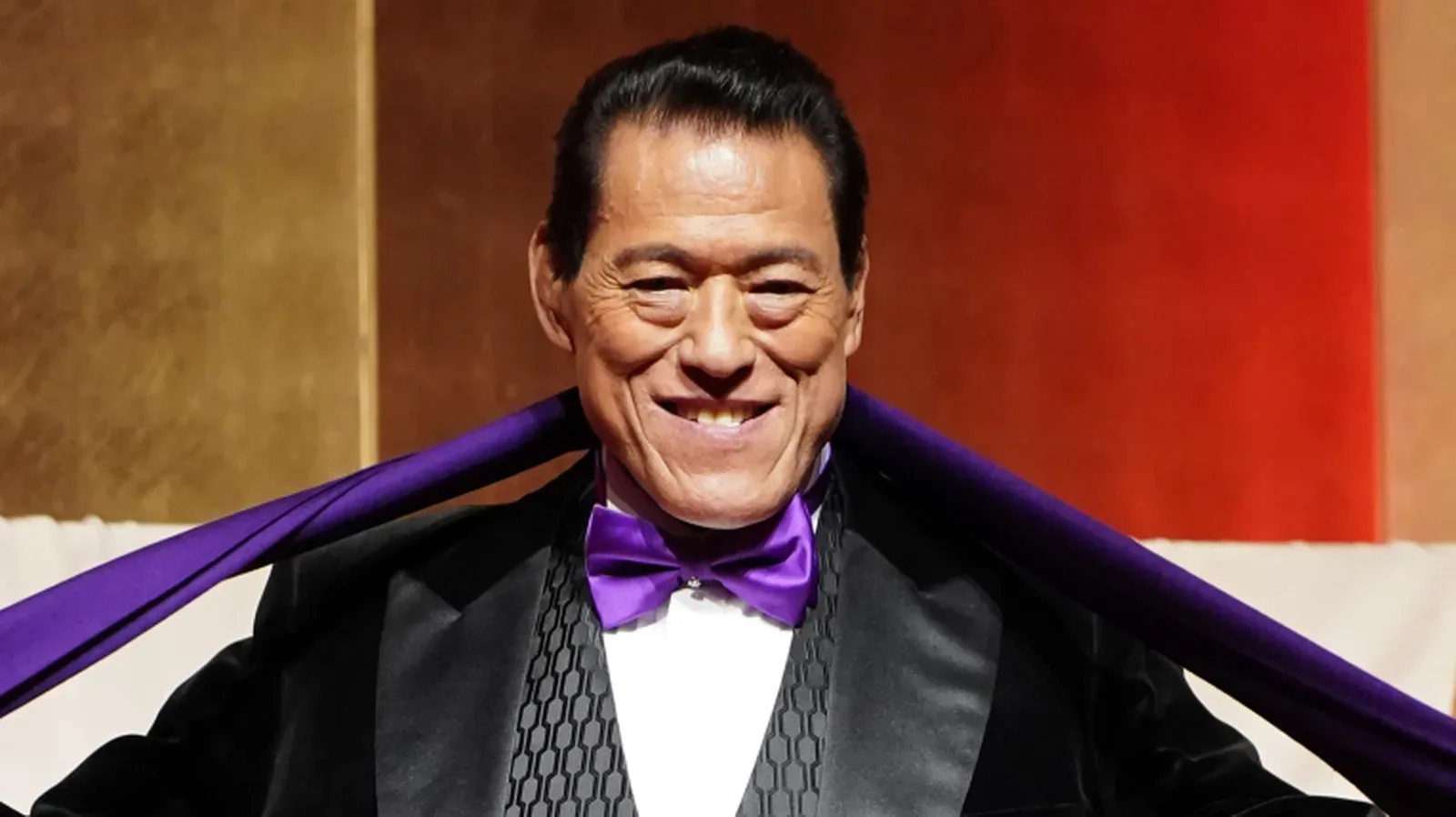
Naoto Inoki, the grandson of New Japan Pro-Wrestling founder Antonio Inoki, has taken a major step toward a potential career with the promotion by joining the NJPW Dojo.
The 18-year-old reportedly began training at the dojo seven weeks ago, placing him inside the system built by the company most closely associated with his grandfather’s name. Antonio Inoki was not simply a former star connected to New Japan; he was the founder and defining public figure of the promotion for generations. That family connection naturally makes Naoto’s arrival notable, but the available details indicate that he did not enter the dojo without prior experience.
Before joining NJPW’s training environment, Naoto Inoki had already spent time in amateur wrestling during his high school years in California. He also began professional wrestling training under his stepfather, Durango Kid, a luchador who competed for CMLL during the 2000s, as well as Katsuyori Shibata. Shibata is one of the most respected wrestlers of his generation in Japan and is a former NJPW performer who later became closely identified with the company’s dojo system.
Those details give Inoki a more layered background than the immediate family headline might suggest. Amateur wrestling experience can provide an early grounding in conditioning, balance, grappling, and competitive discipline, while his professional training has included influence from both lucha libre and the hard-hitting Japanese style represented by Shibata. How those different elements translate once he is further developed remains to be seen, but his path has clearly involved more than simply arriving at a famous training facility with a famous surname.
For more background on this topic, read Royce Isaacs Returns To The Ring Following 2026 Back Issue.
Masked Independent Experience as Kumo
Inoki’s time in wrestling also appears to have gone largely unnoticed outside smaller circles. Over the past two years, he has reportedly worked low-level independent matches under a mask as Kumo. The masked identity meant that his connection to Antonio Inoki was not a central part of his presentation, and it seems the family relationship was kept quiet while he gained early experience.
That decision is significant. For the grandson of a historic figure, beginning under a mask can offer a degree of separation from the expectations attached to a legendary name. It allows a young wrestler to take early bookings, make mistakes, learn in front of smaller crowds, and develop without every appearance being treated as a major legacy event. For an 18-year-old at the beginning of a professional journey, that room to grow can be valuable.
At the same time, anonymity can limit attention and opportunity. A recognizable wrestling family name may open doors, especially in markets where promotional lineage is frequently emphasized. There is a potential advantage to being known immediately as Antonio Inoki’s grandson, particularly in the United States, where second- and third-generation stories have often been framed as attractions of their own. But there is also a cost: the wrestler may be judged before he has developed a distinctive style, character, or body of work.
Inoki’s reported approach appears to have favored patience over instant visibility. The Kumo identity gave him a chance to work beneath the weight of the Inoki name before formally entering New Japan’s dojo. Whether that name continues to be used or is retired as he moves through training has not been established.
A Different Kind of Spotlight in Japan
Naoto Inoki’s situation also comes with a reminder that wrestling lineage does not carry the same meaning in every country. A famous family connection can generate attention, but it does not automatically guarantee a featured role or sustained success in Japan. The history of Japanese wrestling includes multiple descendants of foundational figures who have faced the challenge of establishing themselves beyond their last names.
Tatsumi Fujinami’s son, Leona, is one prominent example. Fujinami was a major New Japan star, yet Leona has struggled to make a major impact across his 13-year career. That does not diminish the difficulty of maintaining a career in the industry, but it illustrates how legacy alone does not create a clear path to stardom.
The Momota family offers further examples. Yoshi Momota and Chikara Momota, respectively the son and grandson of Japanese wrestling pioneer Rikidozan, also encountered the complicated reality of entering the business with an historic family name. In a profession where fans and promoters can be intensely aware of lineage, the connection may create initial interest while also setting an unusually high standard for comparison.
The most successful legacy case cited among Japanese wrestling’s major family lines is Mitsuo Momota, another son of Rikidozan. Mitsuo enjoyed a long career with All Japan Pro Wrestling and Pro Wrestling NOAH, and he won the AJPW World Junior Heavyweight Championship in 1989. His career demonstrates that a descendant of a pioneer can build meaningful accomplishments of his own, though it also underlines the point that longevity and credibility still have to be earned in the ring.
For Naoto Inoki, those comparisons are informative but not predictive. He is only 18 and still in the opening phase of his professional development. The expectations around him will be considerable because Antonio Inoki’s place in the history of New Japan is so unique. However, the examples of Leona and the Momota family show why it would be premature to assume either an automatic push or a predetermined outcome.
The NJPW Dojo Test Still Awaits
The NJPW Dojo is an especially consequential destination for any young wrestler, regardless of background. Joining the dojo means entering an environment associated with demanding training, discipline, and the development of wrestlers who are expected to represent the company at a high level. A family name may draw notice on day one, but it cannot complete the physical and professional work required over time.
That is likely to be the central story of Inoki’s next stage. His background includes amateur wrestling, early professional instruction, independent experience, and a direct familial tie to New Japan’s founder. Yet he is now in a setting where the focus will inevitably turn toward conditioning, fundamentals, ring presence, resilience, and the ability to improve in a structured system.
His relationship with Shibata adds another compelling element. Shibata’s involvement in Inoki’s early professional training connects Naoto to a wrestler known for a serious in-ring approach and for his own work with young talent. With Inoki now training in the NJPW Dojo, the overlap between his earlier guidance and his current destination may help provide continuity as he adapts to the next level of preparation.
Durango Kid’s role matters as well. His experience in CMLL gives Inoki a connection to lucha libre training, while Inoki’s use of a mask as Kumo suggests he has already explored an aspect of that tradition in his earliest matches. There is not enough information to define his eventual in-ring style, but the combination of amateur wrestling, lucha instruction, independent appearances, and Shibata’s influence presents several possible building blocks.
A Name That Will Always Carry Expectations
Antonio Inoki’s legacy is impossible to separate from this story. Any wrestler entering New Japan as his grandson will be viewed through that historical lens. The challenge for Naoto Inoki will be finding the balance between honoring that connection and becoming identifiable on his own terms.
Keeping his early independent work quiet may have been an intentional way to start that process. Working as Kumo did not erase his family history, but it seemingly gave him a period in which the audience’s attention was not immediately dominated by it. Now that he has entered the NJPW Dojo, the secretive stage of his development is no longer the entire story.
There is no indication yet of when Inoki might debut in a New Japan ring, whether he will be publicly presented under his own name, or what role he could eventually have in the company. Those are questions for the future, and the seven weeks he has reportedly spent in the dojo represent only the earliest portion of a much longer process.
What is clear is that New Japan now has a young trainee with one of the most important surnames in its history, along with legitimate prior experience that predates his arrival. Naoto Inoki’s progress will draw attention because of who his grandfather was. Ultimately, though, his standing will depend on what he becomes inside the ring.
In pictures

Darryl Polo
Darryl Polo is a passionate wrestling fan covering WWE, AEW, TNA and beyond. He loves great rivalries, breakout stars and the moments that keep fans talking long after the bell. How we work.