
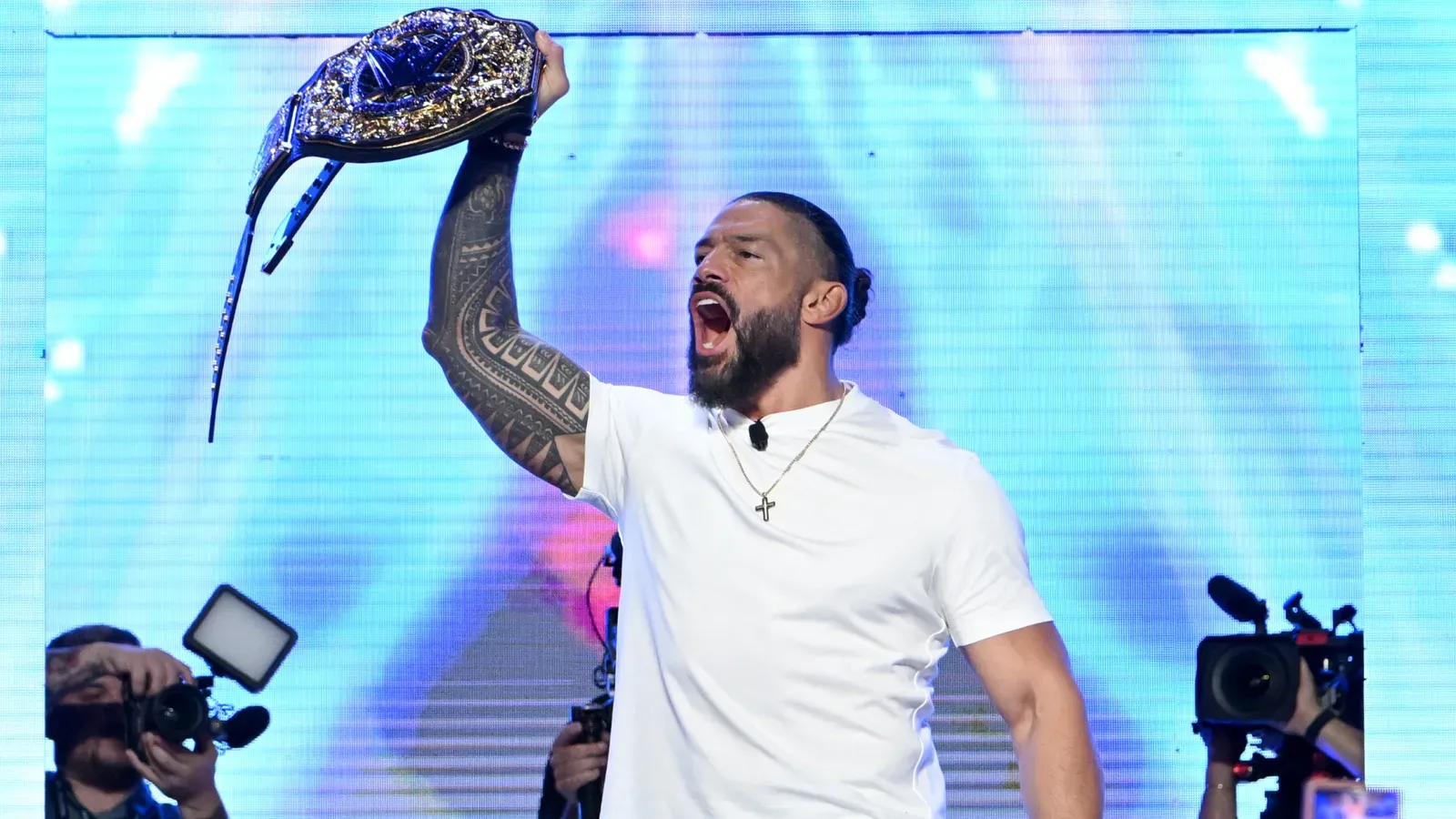
Roman Reigns’ standing as WWE’s defining attraction of the modern era has rarely been in doubt inside the wrestling business. His championship reigns, major-event positioning, premium live event presence and ability to make a limited schedule feel important have all contributed to that status. But MVP believes there is a meaningful distinction between being the biggest star in WWE and achieving the level of mainstream cultural familiarity reached by some of wrestling’s most famous names.
Speaking on Marking Out, MVP considered whether Reigns has the kind of crossover profile traditionally associated with the industry’s biggest stars. The AEW performer was careful not to dismiss Reigns’ success or his impact as a ticket-selling attraction. Instead, he questioned whether the former Undisputed WWE Champion is as recognizable away from wrestling as icons including Hulk Hogan, “Stone Cold” Steve Austin, The Rock and John Cena.
It is a conversation that gets to the heart of how wrestling stardom is measured in the current media landscape. WWE’s business metrics, live-event interest and audience response have repeatedly established Reigns as a central figure. At the same time, mainstream celebrity has historically meant something more expansive: visibility among people who do not watch weekly wrestling television, recognition across entertainment and a public profile that exists independently of an active wrestling storyline.
MVP Draws a Line Between WWE Success and Crossover Fame
MVP said that wrestling’s biggest historical names were often known well beyond the industry’s core audience. “Traditionally, the biggest stars that we’ve had in wrestling have had a mainstream crossover appeal,” he said on Marking Out.
For more background on this topic, read WWE’s Internal Alignment for The Bloodline Reportedly Splits Solo Sikoa From the Rest of the Group.
For MVP, names such as Cena, The Rock, Austin and Hogan represent a particular kind of public recognition. A person did not need to follow WWE programming to know their names, faces or signature personas. The Rock became one of Hollywood’s most visible performers, Cena developed a substantial acting career and broad media presence, Austin remained a widely identifiable figure long after his full-time in-ring run, and Hogan was a household name during and after wrestling’s 1980s boom.
Reigns, MVP argued, may not yet occupy that same space. “Their fame transcended beyond pro wrestling,” MVP said of the stars from earlier eras. “I don’t necessarily see Roman Reigns ... having the same level of popularity outside of wrestling.”
The comparison is not necessarily a straightforward one. Wrestling has changed dramatically since Hogan’s national expansion era and Austin’s late-1990s boom, while the media environment has become more fragmented. A modern star can command a massive audience within a devoted global fan base without becoming universally recognizable in the way major broadcast-era celebrities were. Social platforms, streaming, gaming, cable television and international markets have created more ways for performers to connect with fans, but they have also made broad, across-the-board celebrity harder to define.
Still, MVP’s point was not that Reigns lacks star quality. It was that external visibility remains a different test from WWE’s internal business success. He used a simple hypothetical: ask 10 random people whether they know Cena, The Rock, Austin or Hogan, and he expects many would recognize those names. He was less certain the same answer would apply to Reigns at this stage.
Reigns’ WWE Value Is Not in Doubt
While MVP questioned Reigns’ current mainstream profile, he also acknowledged that the business evidence strongly supports Reigns’ position as WWE’s leading attraction. “It doesn’t seem [like it] to me, but in terms of being ‘the man’ for WWE? The numbers say different!” MVP said.
That is an important qualifier in any assessment of Reigns. WWE spent years positioning him as a foundational star, and the results of his eventual Tribal Chief reinvention established a different level of connection with audiences. Reigns became the centerpiece of The Bloodline, a storyline that helped define WWE programming across multiple years and produced some of the company’s most consequential matches and angles.
His presence also became a key element of the modern WWE premium live event calendar. Whether appearing in a title defense, a Bloodline confrontation or a major comeback segment, Reigns has been presented as an attraction whose involvement elevates the perceived scale of an event. His schedule has made those appearances feel less routine, and that scarcity has only increased the attention attached to his major dates.
MVP went further in explaining his view of Reigns as a draw, saying that placing him on a card would increase interest in a show. The veteran’s comments were not an argument against Reigns’ value; they were an argument that WWE drawing power and crossover celebrity should not automatically be treated as the same achievement.
That distinction may matter especially as Reigns continues to explore opportunities outside the ring. He has appeared in video games and has gradually taken on film work, which gives him avenues to expand his profile. MVP believes those opportunities will eventually lead to a much larger acting and television career.
“At some point, Roman is going to go the way of The Rock and become a movie star,” MVP said. “He’s got the presence, the good looks, the charisma; Roman Reigns will be an actor, he will be a television star, he is that dude!”
MVP Rejects the ‘Industry Plant’ Label
The discussion also touched on claims that Reigns was essentially manufactured by WWE’s corporate backing rather than organically earned. MVP strongly rejected that framing, calling the “industry plant” idea “absolutely ridiculous.”
Reigns’ path to becoming WWE’s top star was famously complicated. He was heavily promoted for years before much of the audience embraced him in that role, and the strong negative reactions he received at points in his babyface run became a defining part of the conversation around WWE’s creative direction. Yet MVP argued that aggressive backing is not an unusual or illegitimate feature of star-making in professional wrestling.
“Every star is, as they like to say, ‘crammed down your throat.’ That’s how you become a star!” MVP said. He pointed to the traditional model in which a promoter chooses a featured performer and consistently places that person over the rest of the roster. “Vince, back in the day decided, ‘this is the guy I’m going with,’ and you beat everybody!”
That perspective recognizes a basic reality of the business: top-level stars require investment. Television time, key victories, major stories, promotional focus and repeated high-profile placement are all tools used to turn talent into reliable attractions. The process does not guarantee fan acceptance, but a performer cannot become a central draw without the company creating opportunities for that performer to reach audiences.
Reigns’ early push may have been contentious, but MVP agreed that he ultimately found the character and presentation that connected at the highest level. The shift toward the Tribal Chief persona gave Reigns greater control, more menace and a sharper sense of character than his earlier run. Rather than being presented primarily as a heroic successor selected by management, he became a calculating family leader whose authority, vulnerability and manipulation drove WWE’s most important ongoing narrative.
Paul Heyman’s Role in the Tribal Chief Era
MVP identified the period following the 2020 COVID-19 pandemic as the point when Reigns truly “hit his stride.” That era began with Reigns’ return and rapid transformation into the Tribal Chief, a move that reshaped both his presentation and the direction of WWE’s top storyline.
Paul Heyman was central to that development. As Reigns’ “Special Counsel,” Heyman provided an on-screen counterpart who could reinforce Reigns’ status, add layers to the character and help deliver the verbal intensity that became a staple of Bloodline segments. The relationship gave Reigns an effective foil: Heyman could project fear, devotion, calculation and concern, all while highlighting the power Reigns held over those around him.
MVP credited Heyman’s influence while discussing the value of that creative partnership. “I don’t think there’s anybody that’s worked closely with Heyman in that dynamic, that relationship, that didn’t grow,” he said.
That does not diminish Reigns’ own evolution. The Tribal Chief persona worked because Reigns was able to embody it with a more measured style, a more deliberate delivery and an ability to make silence as useful as dialogue. But Heyman’s presence helped establish the world around the character, making Reigns feel like more than simply a champion with a manager. He became the center of a hierarchy, a family conflict and a WWE story built around power.
MVP’s comments ultimately offer a nuanced appraisal of Reigns’ place in wrestling. He does not see clear evidence that Reigns has already reached the universal mainstream recognition of WWE’s most crossover-ready legends. But he sees no reason to question Reigns’ current status as a major draw, no merit in dismissing him as a creation of the office, and considerable potential for him to expand into film and television.
For WWE, that may be the most significant takeaway. Reigns has already established himself as an era-defining attraction within the company. Whether his name eventually carries the same immediate recognition as Hogan, Austin, The Rock or Cena beyond wrestling remains an open question. MVP believes the potential is there, even if he does not believe Reigns has fully reached that point yet.
In pictures

Darryl Polo
Darryl Polo is a passionate wrestling fan covering WWE, AEW, TNA and beyond. He loves great rivalries, breakout stars and the moments that keep fans talking long after the bell. How we work.