
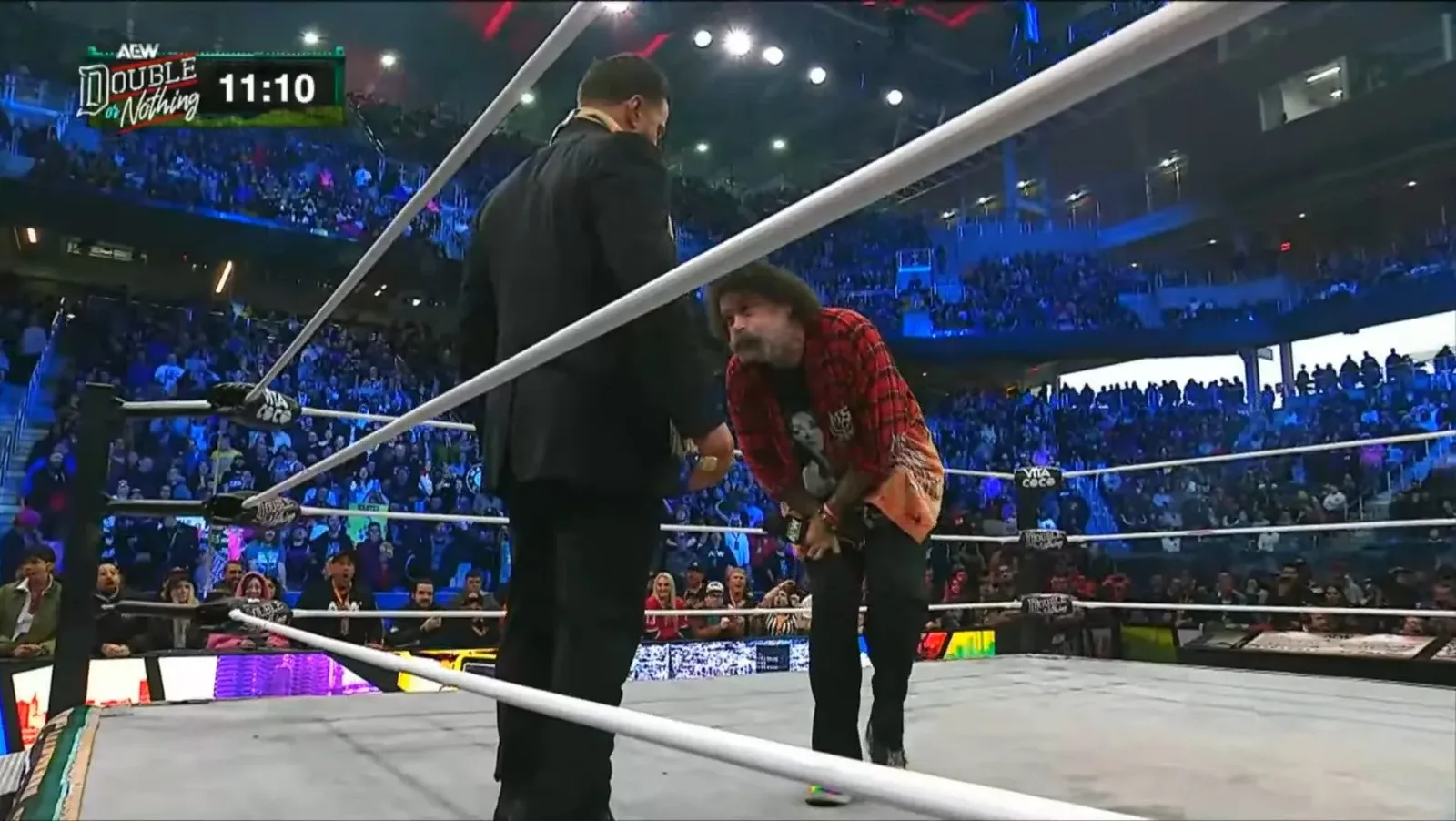
Mick Foley has identified his AEW Double Or Nothing pre-show confrontation with MJF as the work he is most proud of from his time with the company so far.
Foley made his first AEW appearances earlier this year and has taken on several duties, including serving as a pay-per-view pre-show analyst, conducting backstage material, and participating in in-ring interviews. His most prominent on-camera moment came at Double Or Nothing, where he shared the ring with MJF for a verbal exchange that ended with MJF kicking Foley below the belt. Darby Allin then emerged to make the save.
Speaking about the various hats he has worn in AEW, Foley pointed directly to that segment with MJF. He said the goal was not merely to create a memorable moment with two strong talkers, but to shape the crowd response around MJF at a time when there was concern that the audience in New York could be inclined to cheer him.
“Well, you mentioned a pre-show analyst for the pay-per-views. I was really proud of the promo I did with MJF. I know there was some concern that know fans were really going to cheer MJF in New York and I think the interview was really effective in that way, and I’ve done some backstage things and I’ve done some in-ring interviews.”
For more background on this topic, read Jeff Jarrett Calls Bryan Danielson ‘Maybe the Best Storyteller’ in Wrestling History.
Foley’s Segment With MJF Had a Clear Purpose
The Double Or Nothing angle followed a familiar but effective professional wrestling structure. Foley, one of the industry’s most beloved veteran figures, stood opposite MJF, a performer whose presentation thrives on confidence, cruelty, and the willingness to push a confrontation beyond polite boundaries. The exchange gave MJF a recognizable foil and allowed the segment to escalate from words into a physical act that drew additional sympathy toward Foley.
The eventual kick was designed to make MJF’s intentions unmistakable. It also created the opening for Darby Allin to enter the situation, tying the confrontation into the active AEW roster rather than presenting Foley solely as a nostalgia appearance. That final beat mattered: Foley’s involvement helped establish the emotional tone, while Allin’s appearance redirected attention toward a current AEW star.
Foley’s comments indicate that he viewed the audience reaction as an important measure of the segment’s success. Wrestling crowds can have complicated reactions to a performer as naturally charismatic as MJF, particularly in a major-market setting. A crowd may appreciate the quality of a heel’s performance even while the story calls for disapproval. Foley believed the interview helped address that challenge and made the intended emotional dynamic clearer.
That is an especially revealing detail because it underscores the difference between simply placing a legend in a segment and using that legend for a specific storytelling purpose. Foley was not describing the appearance only as a chance to revisit his own legacy. He was assessing whether the exchange helped AEW achieve the desired reaction for MJF. In Foley’s view, it did.
An On-Camera Veteran With Multiple Uses
Foley also made clear that his AEW role is not limited to a single type of appearance. He mentioned pre-show analysis, backstage pieces, and in-ring interviews, reflecting a willingness to contribute wherever he can be useful. The range is notable because each of those formats asks for a different skill set.
As an analyst, Foley can provide perspective around major matches and pay-per-view stories. In backstage segments, he can help deliver information, establish the stakes of a developing issue, or interact with talent in a shorter format. In the ring, his history and comfort on the microphone give a confrontation an immediate sense of weight. Foley has long been known for speaking in a conversational style that can make even a heightened wrestling scenario feel personal, and that style remains valuable in interview-driven programming.
Foley said he believes he could also be effective on the promotional side of the company.
“I think I’d be really effective at promotion. You know, so many of the people in the media now grew up as fans of the Attitude Era, and maybe I can open doors in the same way that Paul Wight was (doing) in Poland a few weeks ago doing promotion for AEW. I’m open to anything and just about everything they could throw at me.”
That openness offers AEW several possible ways to utilize Foley without requiring every appearance to follow the same formula. A recognized figure can be valuable in traditional media settings, in special-event programming, and in storylines that benefit from a respected outside voice. Foley’s point was not that he is limited to one assignment; it was that he is prepared to work in a variety of capacities.
Why Foley’s Promotional Experience Could Matter
Foley’s observation about media members who grew up during the Attitude Era speaks to the broad familiarity he carries outside of a single current storyline. For many fans and media figures, Foley is associated with a period of wrestling that remains deeply influential. That recognition can make him a useful representative when AEW is promoting an event or seeking to communicate with audiences who may already understand his place in wrestling history.
Paul Wight’s promotional work in Poland was the example Foley cited when discussing that possibility. The comparison was not about duplicating Wight’s exact work, but about the value of an established personality helping introduce or amplify AEW in media environments. Foley sees himself as someone who may be able to create similar opportunities.
His willingness to do that type of work fits with the broader approach he described. Foley has already appeared in front of the audience as an analyst and interviewer. He has already been involved in a storyline-facing in-ring segment. He is now also signaling interest in assignments that may take place away from the ring and outside the normal rhythm of weekly television or pay-per-view coverage.
For a promotion, having a recognizable veteran who is comfortable speaking at length and understands the demands of both wrestling storytelling and mainstream promotion can be useful. Foley’s comments do not reveal any specific upcoming assignment, and he did not announce a defined long-term position. What they do establish is his interest in continued involvement and his readiness to consider different forms of work.
The Darby Allin Connection
The Double Or Nothing segment also served a practical narrative function for Darby Allin. After MJF’s attack on Foley, Allin made the save, providing a clean transition from the veteran’s presence to an active performer. Foley’s recollection centered on the promo with MJF, but the closing visual ensured that the segment was not simply a self-contained exchange between two generations.
That kind of structure can be particularly helpful when a legacy name appears on a major show. Foley’s presence can draw immediate interest, while the current wrestler who enters the scene can inherit momentum from the confrontation. In this case, MJF’s attack established the need for a response and Allin supplied it.
Foley did not claim credit for the broader storyline or discuss plans beyond that moment. Still, his description of the segment as effective suggests he appreciated how the interview, the attack, and Allin’s save worked together. The angle gave MJF a chance to generate heat, gave Foley a meaningful role, and gave Allin a notable arrival point.
Foley Is Open to What Comes Next
The central message from Foley’s comments is straightforward: he is pleased with what he has done in AEW, especially the MJF confrontation, and he does not see his contribution as limited to one occasional appearance. He has worked as a pre-show analyst, completed backstage and in-ring interview duties, and believes he can offer value as a promotional representative as well.
His pride in the MJF promo also highlights the standard Foley is applying to his AEW work. He is not judging the segment solely by the fact that he was involved in a high-profile moment. He is looking at the intended crowd reaction and whether the performance helped the company’s storytelling. In his estimation, the exchange accomplished that.
There are no new appearances, matches, or specific promotional commitments attached to Foley’s remarks. However, his statement that he is open to “anything and just about everything” AEW could offer leaves the door open for further work in several forms. Whether that means more analysis, more interview segments, another storyline appearance, or promotional activity, Foley has made his position clear: he is willing to be part of AEW’s plans wherever the company believes he can be most effective.

Darryl Polo
Darryl Polo is a passionate wrestling fan covering WWE, AEW, TNA and beyond. He loves great rivalries, breakout stars and the moments that keep fans talking long after the bell. How we work.