
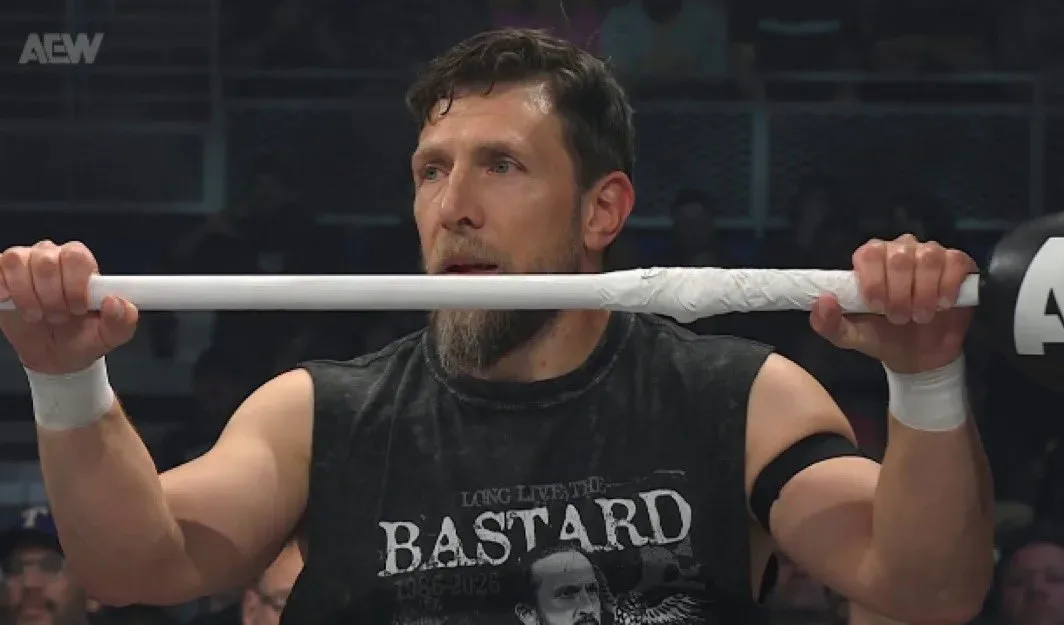
Jeff Jarrett has offered major praise for Bryan Danielson, calling the AEW star “maybe the best storyteller in the ring in the history of the business.”
Jarrett made the assessment during a rapid-fire interview with Kickout, when he was asked to choose between Kurt Angle and Danielson. Rather than frame the answer as a simple comparison between two celebrated technical wrestlers, Jarrett emphasized the quality that he believes separates Danielson at the highest level: the ability to tell a story once the bell rings.
“I believe Bryan Danielson is maybe the best storyteller in the ring in the history of the business. That includes Jerry Lawler. There’s a lot. Bryan’s very, very good at what he does.”
It is a striking endorsement from Jarrett because of the scope of the comparison. He did not merely describe Danielson as one of the strongest performers of his era or place him among the elite of modern professional wrestling. Jarrett raised the possibility that Danielson belongs at the very top of the discussion across the full history of the industry.
For more background on this topic, read Jeff Jarrett Still Wants To Settle Unfinished Business With MJF In AEW.
Jarrett also specifically invoked Jerry Lawler, a name synonymous with the ability to connect in-ring action to emotion, character, crowd response, and the broader stakes of a rivalry. By mentioning Lawler, Jarrett made clear that he was not limiting the conversation to one style of wrestling or one generation. His praise was about the wider craft of making a match feel meaningful to an audience.
Jarrett’s praise centers on storytelling
The distinction is important. In-ring storytelling is often discussed as a combination of pacing, selling, body language, escalation, and the capacity to make every turning point matter. A wrestler can execute demanding moves and possess tremendous athletic ability, but storytelling is what gives those moments context. It is what allows a match to communicate urgency, frustration, resilience, vulnerability, or triumph without needing constant explanation.
Jarrett’s answer suggests that Danielson’s greatest attribute, in his view, is not simply technical excellence. Danielson’s reputation is strongly tied to his ability to make the physical and emotional elements of a bout feel connected. The reactions, the struggle, and the momentum shifts all become part of the narrative being built in the ring.
That is particularly notable in the context of the question. Kurt Angle is widely known for his own extraordinary in-ring résumé and technical background, so selecting Danielson as the wrestler whose storytelling stands out most was not a casual response. Jarrett did not diminish Angle in answering the question, but he used the opportunity to define how highly he rates Danielson’s particular strengths.
The wording of Jarrett’s response also leaves room for the enormous range of talent that has existed throughout wrestling history. “Maybe” is a meaningful qualifier when discussing a subjective subject with no definitive answer. Still, the rest of his statement removed any doubt about his admiration. Jarrett said Danielson is “very, very good at what he does,” then placed him in a conversation that includes Lawler and countless other major figures.
Danielson’s recent AEW return carried unusual circumstances
Jarrett’s comments arrive after an eventful period for Danielson in AEW. At AEW WrestleDream in 2024, Danielson officially retired from in-ring competition after a violent angle in which he was attacked by The Death Riders.
Last week, Danielson returned to the ring for a one-night-only appearance. He teamed with The Death Riders against the Don Callis Family in a match held in memory of PAC, who had passed away the weekend before.
That appearance made Danielson’s return especially significant. After officially stepping away from in-ring competition at WrestleDream 2024, any subsequent match carries a different level of attention. The return was not presented as an ordinary chapter in a regular schedule, but as a one-night appearance under deeply emotional circumstances.
In that setting, the qualities Jarrett highlighted take on additional resonance. Storytelling in wrestling is not confined to a single match’s opening, middle, and finish. It can also involve the larger context surrounding a performer’s return, the alliances involved, and the emotional reality attached to why the match is taking place. Danielson’s one-night return alongside The Death Riders against the Don Callis Family came with all of that context already attached.
A comparison that reaches across generations
Jarrett has been part of professional wrestling for decades and has worked in multiple eras of the business. That makes his assessment of Danielson especially notable, not because it settles an inherently subjective debate, but because it comes from someone who has seen very different approaches to the craft.
Different generations have defined great wrestling in different ways. Some audiences place the greatest value on technical mastery. Others favor charisma, dramatic match structures, explosive athleticism, or the ability to draw an audience into a personal conflict. Jarrett’s answer places Danielson’s storytelling in a category broad enough to encompass those different standards.
Lawler’s inclusion is central to that point. The comparison does not suggest that Danielson and Lawler are identical performers; their careers, settings, and styles are distinct. Instead, it speaks to a shared standard of communication. Great storytellers make the audience understand what matters in the moment. They make the consequences of a hold, a strike, a comeback, or a mistake feel clear. They turn physical performance into drama.
Jarrett’s answer also demonstrates why debates involving all-time great wrestlers rarely have a single clean answer. Angle and Danielson represent two performers whose bodies of work inspire strong opinions. Yet Jarrett did not try to resolve every possible category between them. He identified the one quality that, for him, makes Danielson extraordinary.
Why the comment matters for Danielson’s legacy
Danielson’s legacy has been shaped by the way audiences and fellow wrestlers have responded to his work over time. Jarrett’s statement adds another emphatic veteran perspective to that discussion. More than a compliment about match quality, it is an argument that Danielson’s skill lies in the deeper mechanics of wrestling performance.
Calling someone an all-time storyteller recognizes an ability to hold an audience’s attention beyond the spectacle of individual moves. It recognizes the performer’s judgment: when to accelerate, when to slow down, when to show pain, when to create hope, and when to make a decisive moment land with maximum impact. Jarrett’s praise indicates that he sees Danielson as exceptional in those areas.
That assessment is also relevant to Danielson’s recent status following his official retirement from in-ring competition at WrestleDream 2024. A performer’s influence does not disappear when their regular in-ring career changes. The significance of a rare return can become even greater because fans recognize that it may not be routine. Danielson’s one-night return last week was therefore viewed through a different lens than an ordinary match announcement would be.
For Jarrett, however, the core point is straightforward. Whatever debates continue around the best wrestler, the best technician, or the greatest performer of any generation, he believes Danielson belongs in the most elite possible conversation when it comes to storytelling.
“That includes Jerry Lawler,” Jarrett said, underscoring the scale of the compliment. “There’s a lot. Bryan’s very, very good at what he does.”
It is difficult to offer a stronger concise appraisal than that. Jarrett did not present Danielson as merely excellent in a crowded modern field. He presented him as a wrestler whose command of in-ring narrative could stand against anyone in the history of the business.

Darryl Polo
Darryl Polo is a passionate wrestling fan covering WWE, AEW, TNA and beyond. He loves great rivalries, breakout stars and the moments that keep fans talking long after the bell. How we work.