
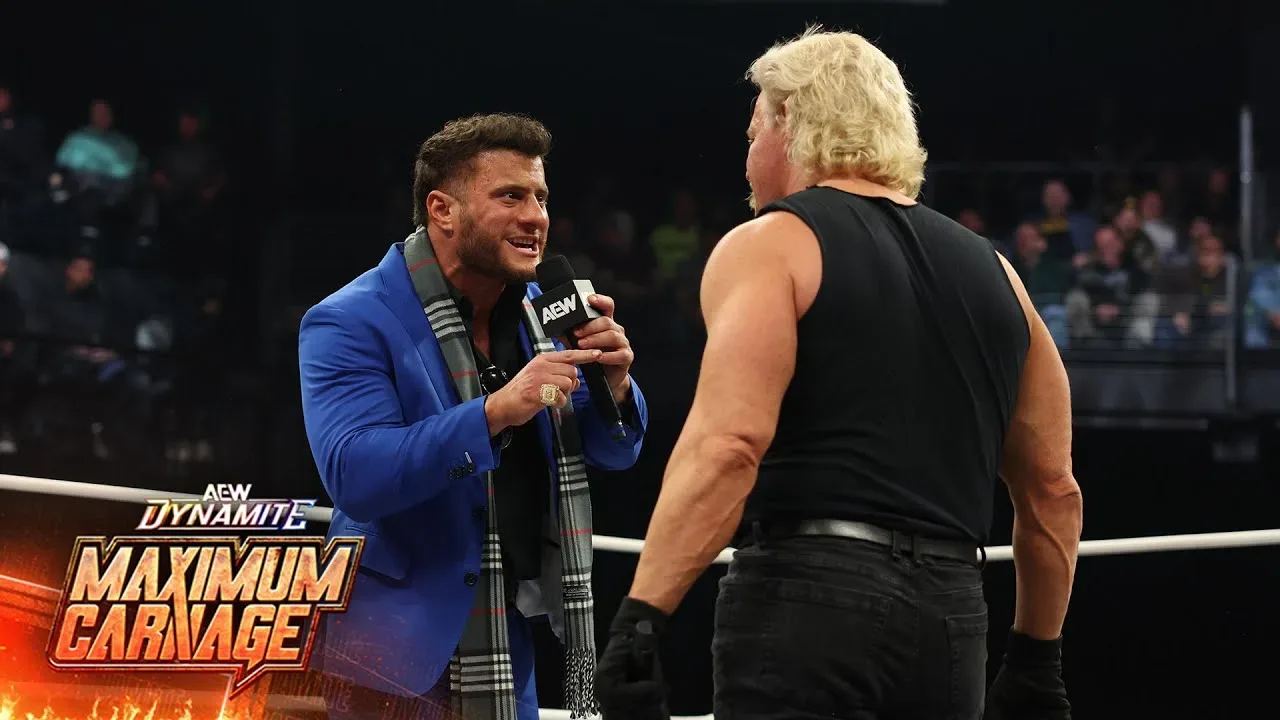
Jeff Jarrett has identified one piece of unfinished business that he would still like to address during his time in All Elite Wrestling: MJF.
Jarrett and MJF launched into a personal, inflammatory rivalry in January of last year, creating an issue that carried plenty of verbal heat but never culminated in a sanctioned blowoff match between the two men. The feud was built around the contrast between Jarrett’s long-established career and MJF’s position as one of AEW’s most prominent modern stars, and it gave both performers material that leaned heavily into their confidence, ego and willingness to make an angle feel personal.
While discussing whether there is a major AEW storyline he would still like to do before retirement, Jarrett immediately pointed toward MJF. The veteran did not frame it as a firm prediction or a demand for a match, but he made no secret of his belief that their unresolved history remains worth revisiting.
“Well, MJF will always need to be slapped. But no, I take it one day at a time. I enjoy, you know, I do the pre-shows, whether it’s called Zero Hour or Buy-In. I enjoy that a lot. Me and Mick Foley, we had a really good time last month. You never know. If you’re a professional wrestler, chasing gold is in your DNA. Maybe not the world title, maybe a trios, maybe a tag, I don’t know. But… Chasing gold is something that you always want to do.”
For more background on this topic, read Jeff Jarrett Says TV Partnership and Consistency Are Key to AEW’s Future in France.
An AEW Rivalry Without a Final Match
The key point in Jarrett’s answer is not simply that he wants an interaction with MJF. It is that their prior issue did not receive the conventional in-ring finish that often defines a wrestling feud. In a business built around escalation and payoff, a rivalry that ends without a decisive match can remain available for a return when timing and creative circumstances allow.
Jarrett’s reference to MJF needing “to be slapped” also fits the tone of their earlier program. It is a line that preserves the antagonism without locking either man into a specific scenario, date or stipulation. Jarrett did not claim that an angle is scheduled, nor did he indicate that AEW has committed to revisiting the program. Instead, he described it as a possibility that remains appealing to him.
That distinction matters. Jarrett’s comments are an expression of interest in completing a story, not confirmation of a future AEW match. MJF’s own direction, Jarrett’s role on television and AEW’s broader plans would all determine whether the thread is picked back up. Still, the fact that Jarrett raised the issue so quickly demonstrates that he sees value in a definitive chapter rather than allowing the rivalry to remain a loose end.
For MJF, a renewed conflict with Jarrett would provide a different kind of opponent from many of the major contemporary names on the AEW roster. Jarrett brings decades of experience as both a wrestler and an on-screen personality, and he has consistently been effective in stories where pride, legacy and generational friction are at the center. MJF, meanwhile, has built much of his identity around his ability to weaponize words and turn verbal confrontations into pivotal parts of an angle.
A program between them would therefore not need to rely solely on the prospect of a match. Their history already established the potential for confrontations, insults and increasingly physical encounters. The unanswered question is whether AEW will ever create the moment that turns those elements into a true final showdown.
Jarrett Embraces His Current Place In AEW
Although MJF was the first name Jarrett mentioned, his wider answer reflected a practical outlook on his present AEW run. He said he takes things “one day at a time,” a measured approach from a performer with an extensive career who continues to contribute in several capacities.
Jarrett specifically spoke positively about working pre-show broadcasts, whether they are branded as Zero Hour or Buy-In. Those broadcasts are an important part of AEW event presentation, setting the tone before major cards and giving performers and guests a platform ahead of the main show. Jarrett’s comments make clear that he enjoys that work rather than viewing it as secondary to wrestling on the main card.
He also mentioned having a good time with Mick Foley last month. The remark underlines the range of opportunities available to a veteran performer in a company environment: wrestling, hosting, appearing in segments, helping frame event coverage and sharing the stage with other established names. Jarrett did not limit his idea of a fulfilling role to one particular match or title pursuit.
That perspective is consistent with the way Jarrett has continued to operate late in his career. He remains interested in meaningful stories and competitive goals, but he is also clearly engaged by the broader performance side of the industry. The enjoyment he expressed over pre-show duties is a reminder that a wrestler’s value can extend beyond bell-to-bell competition, especially in a promotion with frequent major events and a deep roster.
Why Championships Still Matter
Jarrett also made it clear that, regardless of the changing shape of his role, the competitive impulse has not disappeared. He described chasing gold as something embedded in the DNA of a professional wrestler. That statement was not limited to the AEW World Championship. In fact, Jarrett specifically allowed for the possibility that a future championship objective could involve trios or tag team gold instead.
That is an important nuance. Jarrett is not presenting himself as someone who must be placed into a world-title program in order for his remaining AEW time to matter. He is leaving the door open to several possible goals, from singles competition to team-based championship pursuits. In a roster with multiple title divisions and numerous established alliances, that flexibility could be valuable.
It also gives Jarrett a straightforward motivation regardless of where he appears. Whether he is part of a singles storyline, a tag team situation or a trios program, championship ambition offers an immediate competitive purpose. His quote recognizes that the exact prize may change, but the desire to win something tangible remains constant.
For fans, Jarrett’s comments lay out two parallel hopes for the remainder of his AEW career. One is narrative: the chance to finally give his issue with MJF an in-ring conclusion. The other is competitive: a pursuit of championship gold, potentially outside the world-title picture. Neither has been announced, but both are possibilities Jarrett openly welcomes.
No Retirement Timeline, But Clear Remaining Goals
The question posed to Jarrett was framed around what he might still want to do before retiring, but his answer did not offer a timetable for that decision. There was no announced final match, no declared retirement date and no suggestion that his AEW tenure is nearing an immediate endpoint. Instead, Jarrett emphasized enjoying his current responsibilities while remaining ready for whatever opportunities arise.
That makes his MJF comment more interesting than a simple retrospective. Jarrett is not only looking back at a rivalry that did not receive a final match; he is saying that the possibility of finishing it still resonates with him. At the same time, he is not narrowing his future to that one objective. A title chase, continued pre-show work and unexpected appearances are all part of the outlook he described.
For now, the MJF rivalry remains unfinished rather than officially revived. Jarrett’s words ensure that it will remain a subject of interest whenever either man is positioned for a new major direction in AEW. If the promotion decides to revisit the issue, it would have a built-in story: a veteran who believes an arrogant rival still deserves to be put in his place, and a conflict that has yet to receive its final bell.

Darryl Polo
Darryl Polo is a passionate wrestling fan covering WWE, AEW, TNA and beyond. He loves great rivalries, breakout stars and the moments that keep fans talking long after the bell. How we work.