
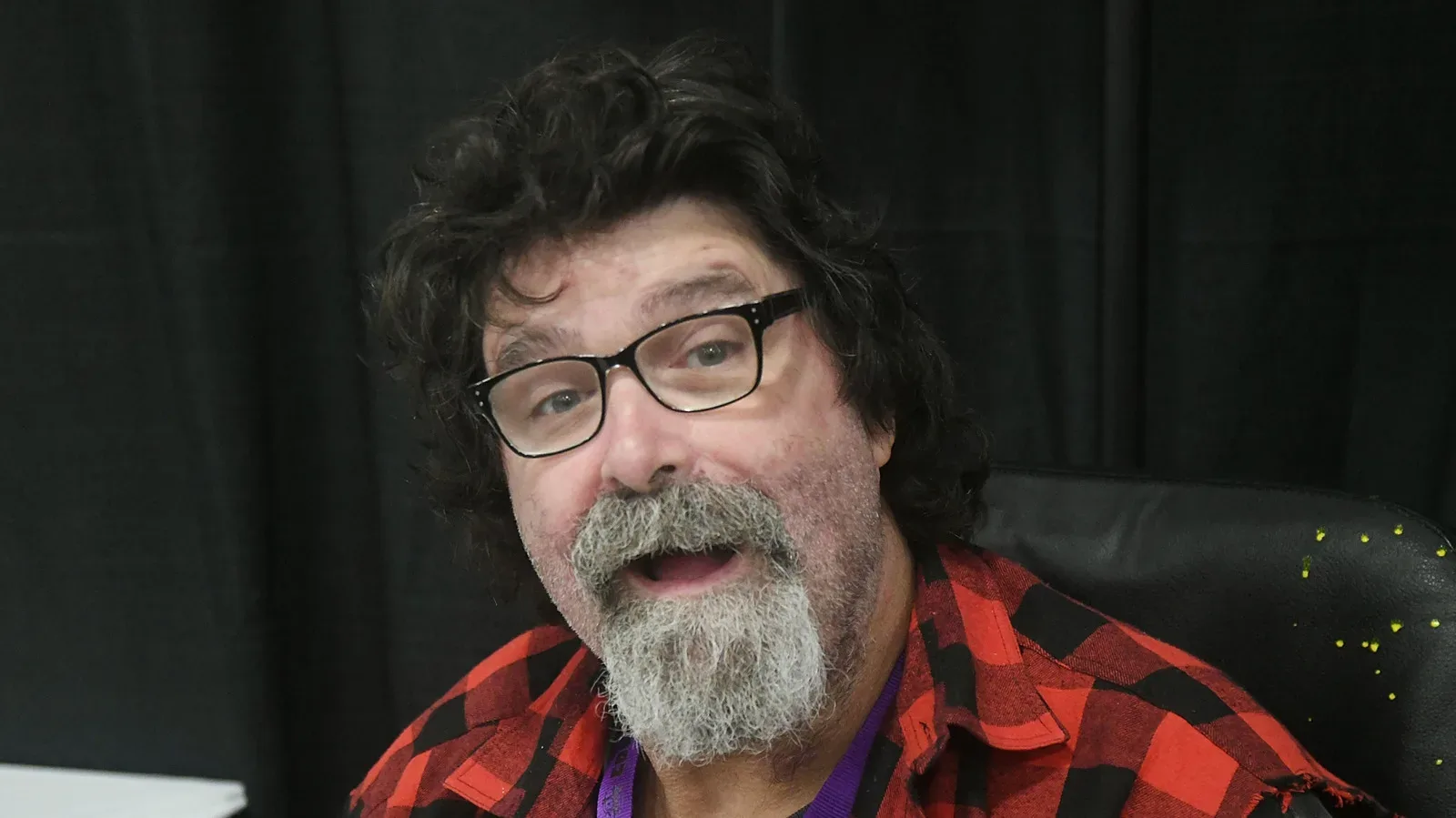
Mick Foley has seen professional wrestling at its most spectacular, painful, heartfelt and unforgettable. Across four decades in the industry, the WWE Hall of Famer has been part of landmark matches and has watched countless performers create moments that have lasted far beyond a single broadcast. Following AEW Dynamite: Rebel Heart, Foley placed one emotional scene involving Rebel and Britt Baker in that rare category.
The September 9 edition of AEW Dynamite was dedicated to Rebel and her ongoing battle with ALS. The night included a trios match victory for Baker, but the lasting image came after the action, when Rebel made her way to the ring on her motorized scooter and later left with Baker sitting in her lap. For Foley, who was in attendance for the show, the moment was far more than a celebratory post-match visual.
“In my 40 years in wrestling, I probably have a dozen moments that stand out in my mind as being so extraordinary that I will never forget them,” Foley said. “Last night I had the honor of witnessing one of those moments.”
Foley shared his reaction alongside a backstage photograph with Rebel, describing the entrance and exit as one of the greatest things he has witnessed in wrestling. He also recalled the scene after Rebel returned backstage, where colleagues gathered around her and many were visibly emotional.
For more background on this topic, read Effy Revisits AEW, Ricky Saints Fallout and Why He Wants Major Promotions to Do Better.
“Watching Rebel make her way to the ring, and roll away with Britt Baker in her lap was one of the greatest things I’ve seen in professional wrestling,” Foley said. “Being in the audience when it happened, rushing backstage to see dozens of her colleagues surrounding her – many of them in tears – was beautiful to witness.”
A Night Built Around Rebel
AEW Dynamite: Rebel Heart centered the performer at a deeply personal time. Rebel has been open about living with ALS, a devastating illness for which there is currently no cure. Rather than treating her appearance as a brief cameo, the show gave the AEW veteran a prominent place in its emotional foundation, allowing the company’s roster, fans and wrestling peers to rally around her.
The image of Baker riding in Rebel’s lap on the motorized scooter represented the connection between the two performers, as well as the broader support surrounding Rebel. Baker’s victory in trios competition provided the in-ring setting for the sequence, but Foley’s comments emphasized that the power of the scene was rooted in the people involved rather than the result itself.
Professional wrestling is often remembered through towering athletic feats, championship changes, rivalries and dramatic confrontations. Yet some of the medium’s most resonant moments arrive when the planned presentation gives way to genuine affection and shared humanity. Foley’s response made clear that he viewed Rebel’s AEW appearance in precisely those terms.
“Rebel has managed to uplift others even as she battles a devastating illness that has no cure,” Foley said. “I’m proud and privileged to call her a friend.”
That sentiment carried particular weight coming from Foley. His legacy includes a career defined by extraordinary physical sacrifice, but he has also long been recognized as one of wrestling’s most empathetic and reflective voices. He understands both the performance side of the business and the relationships that sustain people within it. His description of the moment did not focus on production, storyline or spectacle. Instead, it focused on Rebel’s ability to affect those around her during an extraordinarily difficult fight.
Wrestling Figures Gathered in Support
Foley was among several notable figures from across wrestling who attended the event in support of Rebel. Her former TNA colleagues Gail Kim, Christy Hemme, Allysin Kay and Marti Belle were also present. Their attendance reflected the relationships Rebel has built throughout a career that has taken her through multiple promotions and connected her with performers from different generations.
The gathering was significant because it extended beyond a single locker room. AEW provided the setting for Rebel Heart, but the support around Rebel included friends and peers from elsewhere in the industry. In a profession often driven by company loyalties and competitive divisions, nights such as this can put the focus back on the personal bonds that survive roster changes, changing eras and professional distance.
For the wrestlers and personalities in attendance, the event was an opportunity to be present for a friend. For the audience, it was a reminder that the people seen on television are part of a community that exists outside the boundaries of character alignment and weekly programming. The tears Foley saw backstage underscored how personally the night was felt by those who know Rebel.
AEW’s $140,000 Commitment to ALS Research
The emotional presentation was accompanied by a substantial charitable contribution. AEW donated $140,000 to I AM ALS and Team Gleason, organizations working to support those impacted by ALS and advance continued research. The donation ensured that Rebel Heart was not solely a tribute or a show of solidarity; it also produced direct financial support for efforts connected to the disease.
ALS, also known as amyotrophic lateral sclerosis, is a progressive neurological disease that affects nerve cells involved in voluntary muscle movement. The lack of a cure makes research, advocacy and support resources especially important for patients and families navigating the condition. By directing funds to I AM ALS and Team Gleason, AEW connected the on-screen tribute to organizations engaged in that wider work.
The $140,000 donation gave the broadcast a tangible legacy beyond its immediate emotional impact. Wrestling benefits and awareness-driven events can bring together a passionate audience, but the lasting value is strengthened when attention is converted into practical assistance. The contribution to I AM ALS and Team Gleason helped do exactly that while honoring Rebel’s ongoing fight.
Why Foley’s Praise Matters
Foley did not casually describe Rebel’s moment as memorable. He specifically said that, in 40 years around professional wrestling, only around a dozen experiences stand out to him as so extraordinary that he knows he will never forget them. By including Rebel’s entrance and departure with Baker among those memories, Foley offered a powerful measure of how deeply the scene affected him.
His career has placed him at ringside, backstage and inside the ring for many of wrestling’s most enduring chapters. That perspective makes his reaction especially meaningful, though the central focus remains Rebel herself. Foley’s message was not simply praise for an emotional segment. It was recognition of her resilience and of the effect she continues to have on friends, colleagues and fans.
Rebel Heart demonstrated what wrestling can accomplish when it uses its platform to support someone within its community. Baker’s trios win and the scooter ride gave viewers a signature image. The presence of Foley, Kim, Hemme, Kay and Belle showed how many people wanted to stand beside Rebel. AEW’s donation gave the event a meaningful charitable purpose. And the backstage response described by Foley revealed the depth of feeling behind every part of the night.
For Foley, the most important takeaway was simple: Rebel was able to uplift others while facing an illness of enormous severity. That is why the moment resonated beyond a conventional wrestling celebration. It was a display of friendship, courage and collective support, and it left one of wrestling’s most experienced observers certain that he had witnessed something he will carry with him for the rest of his life.
In pictures
Darryl Polo
Darryl Polo is a passionate wrestling fan covering WWE, AEW, TNA and beyond. He loves great rivalries, breakout stars and the moments that keep fans talking long after the bell. How we work.