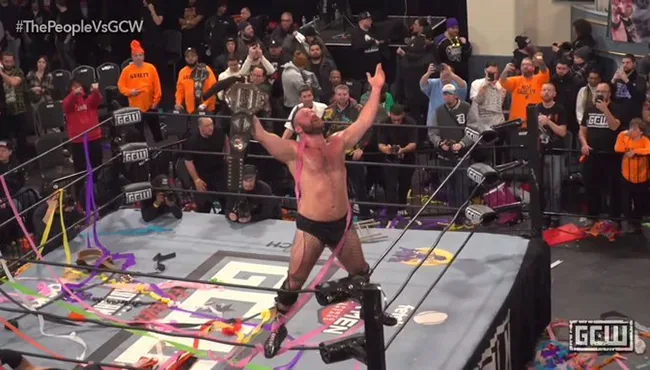
Effy has revisited the controversy that connected his public criticism of AEW with Ricky Saints being removed from scheduled GCW appearances in November 2024, offering an unapologetic assessment of major wrestling promotions while also expressing regret for any difficulty the situation caused other performers.
During a wide-ranging interview, Effy addressed the circumstances that followed AEW’s decision to pull Saints, then known as Ricky Starks, from GCW dates. The matter emerged amid a dispute over AEW’s planned events at the Hammerstein Ballroom, a venue GCW had also booked. Effy subsequently made critical remarks about the Khan family, including the line, “Brett doesn’t have a dad who pays him to stay away,” referring to GCW promoter Brett Lauderdale.
Saints later departed AEW and debuted for WWE NXT at NXT Arrival in February 2025. He is now a title-holding WWE performer who regularly appears on television, a development Effy said is ultimately the kind of outcome he wanted to see for the wrestler.
Effy says Ricky Saints being featured was always the point
Effy did not walk back his broader frustration about Saints’ lack of television exposure before his AEW exit. At the same time, he made clear that he recognizes the fallout of public remarks can reach people beyond the individual making them.
For more background on this topic, read MLP Mayhem Results: Josh Alexander vs. Stu Grayson Set for Northern Rising.
“Ricky Saints is a title-holding WWE superstar,” Effy said. “Ricky Saints is on TV all the time, and that’s all I wanted in any of this.”
Effy acknowledged that his comments may have contributed to complications faced by others, saying he was sorry for causing “anybody else any grief or any trouble in dealing with things.” But he maintained that he does not believe the concerns he raised were wrong, particularly when it came to performers he feels should have been presented more prominently.
He argued that it was difficult to understand why a wrestler with Saints’ ability was not being used weekly if a company was looking to improve its television performance. Effy compared the situation to watching someone carry a “pot of gold” while valuable pieces fall away, with observers left wondering why those opportunities are not being recognized or picked up.
The comments reflect a familiar fan discussion around Saints’ final stretch with AEW. Before leaving the company, he was absent from AEW programming for an extended period. His WWE move gave him a fresh start, and Effy viewed Saints’ present status as evidence of what he had been arguing: the talent was capable of being a meaningful television presence.
A larger criticism of televised wrestling
While the Ricky Saints situation was the immediate backdrop, Effy framed his frustrations as part of a much broader concern about the wrestling business. He believes weekly televised promotions have a responsibility to keep audiences energized about wrestling as a whole rather than presenting a product that might turn potential fans away before they explore independent wrestling.
Effy stressed that he was not solely directing that criticism toward Tony Khan or AEW. In his view, the issue extends across the industry, including creative approaches that rely too heavily on familiar formulas and voices from previous eras instead of taking chances on fresh ideas and emerging stars.
He questioned the influence of agents and decision-makers who were capable in-ring performers but were not major attractions themselves. Effy’s argument was that wrestling cannot thrive merely by repeating what worked in 1998, 2007, or 2011. He said promotions must account for the specific audience in front of them and be willing to create something new.
For Effy, that is especially important because the independent scene depends on a healthy broader interest in pro wrestling. If viewers lose interest in the high-profile televised shows that are most readily available to them, he believes fewer of them will go on to seek out performers, promotions, and concepts outside that ecosystem.
“My goal is to never work for you,” he said, explaining that his priority is not necessarily a place in a major company. “My goal is to make sure you don’t run away fans before they get to me.”
Effy also singled out what he sees as an overly scripted feel in some modern televised wrestling. Discussing an episode of SmackDown he watched, he was critical of the matches, promos, and overall presentation, while conceding that performers successfully executed their assigned production beats. His preferred style, he said, carries more uncertainty: viewers should feel that anything can happen once wrestlers step into the ring.
The Hammerstein Ballroom issue and GCW’s position
The November 2024 incident occurred during a significant period for both AEW and GCW. GCW had plans for a return to the Hammerstein Ballroom, a building it had not run in three years. Effy said GCW was attempting something special with the venue and found it unusual that AEW would hold three events there the previous month after the building had gone years without being used by other wrestling groups.
Effy’s comments about AEW and Shahid Khan became part of the story after Saints was pulled from the GCW bookings. AEW’s reported decision became a point of discussion because of the connection between the wrestler’s planned independent dates and statements made by someone who was not signed to AEW.
Lauderdale later addressed the matter and drew a clear distinction between GCW and Effy’s personal views. “What Effy says is Effy’s opinion,” Lauderdale said. “He is an independent wrestler, an independent contractor.” Lauderdale added that Effy’s personal podcast was not endorsed, amplified, or promoted by GCW.
That distinction remains important to Effy’s current stance. He portrayed himself as someone speaking independently and said he does not work for AEW, does not seek a role there, and does not expect a business relationship to develop. His concern, as he framed it, is less about securing his own opportunity and more about how major companies use their platforms and treat wrestlers within their orbit.
Effy says criticism was meant to push improvement
Effy said that the sharp tone of his commentary has been interpreted as an attempt to embarrass or damage people, but he described a different intention. He said his “shady” observations are meant to identify failures that he hopes companies will address, not to permanently shame anyone.
He specifically cited wanting to see Saints featured on television, wanting Sonny Kiss treated “like a real person,” and not wanting wrestlers to be pressured out of situations because they were booked in a match with him. In Effy’s view, the desired response to criticism should be correction rather than punishment.
“It’s with the intention of them changing,” he said of his critiques. “It is not with the intention of shaming you or putting you down forever.”
Effy also said he had heard concerns from people who struggled to get conversations with Tony Khan, though he emphasized he was not inside AEW and did not claim to know the full reality of how the company operates. He said he does not want to be there and does not personally care to be part of that environment, but he believes communication problems can hurt a wrestling promotion when talent and staff cannot quickly address concerns.
He argued that fans should be frustrated if personal disputes influence a wrestler’s push or a company’s creative decisions. Wrestling has a long history of stories about talent losing opportunities due to clashes of personality or politics. Effy’s position is that any such dynamic can undermine a product when the goal should be giving fans the strongest possible show.
Open to a conversation with Tony Khan
Despite the forceful nature of his remarks, Effy said he would be willing to have a conversation with Tony Khan. He suggested that the clip involving Shahid Khan may have been used as a scapegoat, noting that it had approximately 2,800 views on TikTok and questioning whether it was significant enough on its own to justify the scale of the reaction.
Effy maintained that his point about Tony Khan’s family connections was factual, even if it was provocative. He said the remark may make people uncomfortable, but he does not see that as the same thing as stating something false.
At the same time, Effy acknowledged that people running a business may not welcome criticism delivered in a rude manner. “I don’t blame them for this,” he said, while repeating that wrestling can be harmed when personal reactions take precedence over making better creative and business decisions.
Nearly two years removed from the controversy, Effy’s central position has not changed. He is not asking for a spot on AEW television, and he is not presenting a reconciliation as necessary for his own career. Instead, he is arguing that wrestling’s largest companies should better identify valuable talent, create programming that inspires audiences to dig deeper into the medium, and view criticism as a potential prompt for improvement rather than simply an attack to be answered.
For Saints, the landscape has already changed dramatically. His WWE run has placed him back on weekly television and given him championship success. For Effy, that outcome remains the clearest part of the entire episode: a wrestler he believed should have been showcased is now being showcased, even if the route there came through a different company and a very public dispute.
Darryl Polo
Darryl Polo is a passionate wrestling fan covering WWE, AEW, TNA and beyond. He loves great rivalries, breakout stars and the moments that keep fans talking long after the bell. How we work.